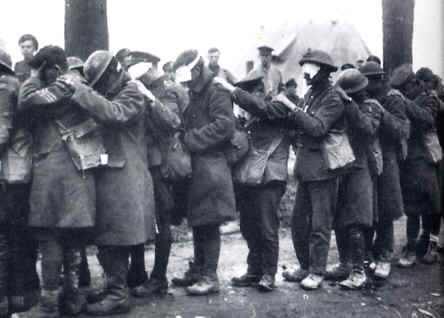
November 1918.

November 7th 1918. V.C. FOR FERMANAGH HEROISM OF COL. WEST IN FACE OF CERTAIN DEATH.

The King has been graciously pleased to approve of the award of the Victoria Cross to the under- mentioned officer:—Captain (A. Lieutenant-Col.) Richard Annesley West, D.S.O., M.C., late North Irish Horse (Cav. S.R.) and Tank Corps, For most conspicuous bravery, leadership and self-sacrifice.

During an attack, the infantry having lost their bearings in the dense fog, this officer at once collected and re-organised any men he could find and led them to their objective in face of heavy machine-gun fire. Throughout the whole action he displayed the most utter disregard of danger, and the capture of the objective was in a great part due to his initiative and gallantry.

On a subsequent occasion, it was intended that a battalion of light tanks under the command of this officer should exploit the initial infantry and heavy tank attack. He therefore went forward in order to keep in touch with the progress of the battle, and arrived at the front line when the enemy were in process of delivering a local counter-attack. The infantry battalion had suffered heavy officer casualties, and its flanks were exposed. Realising that there was a danger of the battalion giving way he at once rode out in front of them under extremely heavy machine-gun and rifle fire and rallied the men. In spite of the fact that enemy were close upon him he took charge of the situation and detailed non-commissioned officers to replace officer casualties. He then rode up and down in front of them in face of certain death encouraging the men and calling to them ’Stick it men; show them fight; and for God’s sake put up a good fight. He fell riddled by machine-gun bullets.

The magnificent bravery of this very gallant officer at the critical moment inspired the infantry to redoubled efforts, and the hostile attack was defeated.  The deceased officer was a native of Fermanagh, being the fourth and younger son of the late Mr. A. G. West, of Whitepark. He was born in 1878, and fought in the Boer War .with Kitchener’s Scouts, afterwards taking a commission in the North Irish Horse. The West family has long been connected with Fermanagh and Tyrone, but Mr. E. E. West,  its present head, now lives, in Dublin.

Lieut-Colonel Herbert N. Young, D.S.O., Royal Inniskillings (temporarily commanding a battalion of the Sherwood Foresters), killed in action on 25th October was one of the best-known officers of the Inniskillings, with whom he had soldiered for 15 years.

THE MILK SCARCITY.

If the members of the Enniskillen Urban Council who raised the question of the scarcity of the milk supply were genuine in their anxiety for the poor, they have done nothing in the matter till it now is too late to do anything. A year ago an attempt was made to get milk from Fermanagh for Dublin’s poor, and this attempt the Impartial Reporter frustrated, pointing out at the time that any spare milk was badly needed by our own poor in Enniskillen. We then advocated the founding of a municipal milk depot, as had been done in other places, but the Urban Council took no action. The Council was asked to make preparations for the founding of a communal food kitchen to cook food for the very poor. This suggestion was also scouted by the very men who are now crying out about the coal shortage. It is the usual grumble without action. Everyone knew that coal would not get more plentiful, and it was common knowledge that milk would be much scarcer. To talk of obtaining a milk supply now is beating the air. The Chairman of the Urban Council should surely know that creameries have no milk to spare for sale in a stock-rearing county like Fermanagh, except perhaps from the Belleek district. The farmers require all the skim-milk they can get; the creameries dare not cut them short, and thus lose some of their best customers. Milk is scarce to all, rich and poor, alike, and if the poor are in a bad way for milk this winter they know who had it in their power to save them, from such a catastrophe but did nothing till too late, and then, as usual, only talked.

A MEMORIAL SERVICE. Enniskillen Presbyterian Church. It was a moving service — but just one of those things which Rev. Mr. Jenkins knows how to do well, at the proper time, and in the fitting way. Three soldiers of the Enniskillen Presbyterian Congregation have passed away quite recently—Lieut. John Darling, M.C., 9th Royal Irish Fusiliers, from wounds received in action ; Company Sergt. Major Wilson, of the 1st Royal Inniskillings, died in action; and Private Herbert Caldwell, from ill-health and starvation, when wounded as a prisoner-of-war in Germany. The congregation at Enniskillen, which has given most of its manhood to the army, per cent., has also had the greatest number of casualties.

November 21st 1918.

Lance-Corporal Seaman, of the Inniskilling Fusiliers has been awarded the Victoria Cross. The official record states that he is awarded the coveted distinction. For most conspicuous bravery and devotion to duty. When the right flank of his company was held np by a nest of enemy machine guns he, with great courage and initiative, rushed forward under heavy fire with his Lewis gun and engaged the position single-handed, capturing two machine guns and 12 prisoners and killing one officer and two men. Later in the day he again rushed another enemy machine-gun position, capturing the gun under heavy fire. He was killed immediately after. His courage and dash were beyond all praise, and it was entirely due to the very gallant conduct of Lance-Corporal Seaman that his company was enabled to push forward to its objective, and capture many prisoners.

BAR TO M.C.

The Commander-In-Chief of the B.E.F. has made an award of a Bar to the Military Cross to Second Lieutenant T. J. Adams, M.C., Royal Inniskilling Fusiliers, for conspicuous gallantry in action last month. Second Lieutenant Adams is a son of Mr. Thomas Adams, Tullywinney, Ballygawley.

DERRYGONNELLY MAN WINS D.C.M.

The Distinguished Conduct Medal has been awarded to Sergeant J. Foy, Royal Inniskilling Fusiliers (Derrygonnelly, County Fermanagh)

For conspicuous gallantry in command of his platoon during an attack. When an enemy machine gun attempted to check his advance he came round its flank and with another man charged it and captured the gun and four prisoners. He set a splendid example of courage and determination to his men.

The Cork Eagle records the death in hospital of Cadet Frank Semple of the Royal Air Force, son of Mr. John Semple, Bandon, and formerly of the General Manager’s office, Great Northern Railway, Enniskillen. The “funeral at Cavereham Cemetery was a military one, and the coffin was covered with wreaths. Mr. Semple’s eldest son, Herbert, a brilliant scholar, also gave up a career of bright promise to serve his country and fell in her cause.

PRIVATE JAMES MCTEGGART. Mrs. Quinn, Henry-street, Enniskillen, has been informed that her brother, James McTeggart was killed in action on the 7th November. He had seen much active service with the Inniskillings at the Dardanelles in the retreat from Servia, and in Palestine, before coming to France. His captain in a letter of sympathy says—‘His pals and I miss him very much as he had done good service for the battalion. He was struck by a bullet in the head and death was instantaneous. He is nearly the last of the good old boys who came out with the battalion.’

Private Wm. Manly, 9th Inniskillings, from Tullyavey, died in action on the 29th September, leaving a wife and seven children. His brother, who also had worked at Riversdale, had also served In the army, having served in the 27th Inniskillings in the Boer war. Trory parish yielded 37 of the Protestant men to the army at the call.

Private Bernard Drum, of the Royal Inniskillings has been at home on leave, after having been six months in hospital from wounds received in France, and has gone to Oswestry to join the reserve battalion of the regiment.

Clones and the Epidemic. SHORTAGE OF MEDICAL MEN.

Clones has been terribly in the grip of the Spanish influenza, and suffered all the more because that Dr. Henry, who has a wide circle of patients and the Union hospitals under his charge, became a patient himself.

The town found itself with only one doctor available to minister to the whole district, Dr. Tierney, and lamentable cases on every side. But Clones rose to the occasion. Its chief men met, as they generally do, as neighbours and friends, not as politicians, and subscribed money to meet the emergency; the ladies of the town provided meals for the poor; and by good luck one young doctor was found to take up medical duty in the district, and Mr. Knight obtained the friendly advice of Dr. Kidd of Enniskillen as to procedure; and Dr. Kidd advised among other things, that the assistance of men of the Army Medical Corps at  Enniskillen headquarters be requested, to enable nursing and care to be attended to.

Since then, the so-called influenza has got a bad grip of the Clones district, it has also brought its people together to meet the danger and combat it; and we trust their praiseworthy effort will meet with the success which it deserves.

The Recent boxing tournament in Enniskillen for the benefit of Inniskilling prisoners of war resulted in a net profit of £57, which has been sent to the Secretary of the fund at Omagh.

Sale of Fruit to Householders.—Instances having been brought to the knowledge of the Food Control Committee for Ireland, that apples are being sold to householders and others at prices in excess of those set out in the Apples and Perry Pears (Sales) Order, the attention of consumers is directed to the advertisement which appears in this issue.

The Cattle Feeding Staffs supply to Ireland is to be increased.

The German Army committed continual robberies in its retreat, including herds of cattle, carts, chickens, clothing, and vehicles.

The rumour is Revived that the ex-Czar is alive, and that he may be replaced on the Russian throne.

The Galway Board of Guardians have felt hurt that out of 156 circulars sent out, asking that medical practitioners who have been interned for political offences should be released to relieve the scarcity of medical practitioners, only five applies should have been returned, and of these one (Belfast) was against the resolution. Dungannon burned it.

A BIG FIRE AT THE GRAAN MONASTERY. HUNDREDS OF POUNDS DAMAGE.

A destructive fire, entailing the loss of several hundred pounds worth of property, broke out at the Gabriel Retreat, The Graan, about two miles from, Enniskillen, in the early hours of Sunday morning. Residing at the Retreat are four or five priests and about twelve students or novitiates of the Passionists Order of the Roman Catholic Church.

Shortly before one o’clock on Sunday morning one of the resident brothers observed a light in the office-houses near the main dwelling, and upon investigating the matter found the building was on fire. He immediately raised an alarm, but by this time the whole building where the cattle were stalled was a mass of flames. There being no efficient fire extinguishing apparatus about the place, efforts were made to quell the outbreak by means buckets of water drawn from water barrels near by, but these were quite ineffectual.

Word of the fire having been sent to Mr. Christopher Bracken, whose residence is close at hand, both that gentleman and his eldest son were soon on the scene, and worked very hard in assisting the inmates in their fight against the flames. Despite all exertions, however, eight valuable cows, worth from £40 to £50 each and also two calves were burned to death, while the byres, calf-house, and piggeries were razed to the ground. Fortunately the fire did not spread to the large barns attached, in which much corn, hay, and other inflammable material were stored, else the loss would have been considerably heavier. As it was, a valuable staircase, a huge quantity of glass, and other articles intended for use in the new building at present in course of construction, and which were stored temporarily in one of the office-houses, were all burned.

End of WW1. Impartial Reporter November 7th 1918.

End of WW1. Impartial Reporter November 7th 1918.

The Sinn Fein in Convention are as insane as their members individually. They have asked by resolution for the complete evacuation of Ireland of the British military forces, the release of all ‘Political’ prisoners, and the absolute independence of Ireland. Imagine any body of sane men being so idiotic as to gravely prefer such a request expecting it to be granted. How truly they have been termed ‘dreamers.’ How thoroughly impractical! If it could be possible that such a request could be granted we would have Bolshevism in Ireland, massacre and robbery. Men who cannot control themselves cannot control anyone else; and Ireland under them would be a veritable hell—far worse than Dublin under the bloody gang of Easter week. Happily, Ireland will never, under any circumstances, be under men who have turned the whole world against a disgraceful set of scheming fanatics.

DISPATCHES.BY AEROPLANES.
We mention as an historical fact, so that readers of the Impartial Reporter generations hence, when perusing its files, may want to know when mails went locally first by aeroplane, that military dispatches have been sent by military aeroplane to Enniskillen, and been received in the Enniskillen fairgreen by an orderly in a spot appointed
for the purpose. In Ballinamallard, at Mr. Archdale’s function for the Red Cross, on Thursday, two aeroplanes circled about and dropped recruiting literature.

THE INNISKILLINGS.
The Inniskillings have been again engaged in action and have suffered many casualties. We deeply regret the death of Colonel H. N. Young, D.S.O., a very brave soldier, in Italy. He recently received a bar to the D.S.O. His command of the 7th Inniskillings produced a model battalion, ‘the Fighting Seventh;’ and one of the smartest in the Army.

THE INFLUENZA EPIDEMIC.
The epidemic of influenza has prostrated people from town and country, and has caused a few deaths. On the whole it has been less fatal in this district than in others. Our Royal School was badly crippled, owing to the number of cases, but Major Bruce, Army Medical Corps, very kindly sent nine of his Army nurses to Portora, and the very sight of the men in uniform cheered the boys, as they ministered to them. A household of 112 people was not an easy one to grapple with. Yet School was kept going all the time for those who were free from the disease. All the other schools in the town had to be closed, as in other places, but the worst of the plague is now over. (My Granny died in it)

KESH.
A social meeting of the Kesh C.A.S. was recently, held. In the absence of the chairman, Mr. Phillips, Mr. Hall of Lack presided, and Shareholders, with members of their families, were strongly represented. Messrs. Lowry and M‘Gee of I.A.O.S. gave addresses on co-operation, and urged the members to subscribe more capital to meet the developments and increasing trade of the society, Two hundred pounds .have already been deposited in the society; and as a result of the meeting £300 more have been promised. It was decided to canvass the district. The co-operators who sympathised with this society in its struggles will be gratified to hear the loss of £800 caused by the fire has now been reduced to £400, and the management feels that if the members supply them with sufficient capital to save all discounts and buy in larger quantities that this latter sum can be very soon wiped out.

Owing to pressure on our space we are unable to publish an article received from. Mr. H. E. Watkin, Enniskillen, on “The Art of Dancing Well.” Mr. Watkin deals at considerable length with the “Waltz. He says that “during the present year attempts were made to introduce Rag Time in Enniskillen, but the good sense of the public gave it an inglorious quietus.’’

A severe wind and rain storm passed over Enniskillen and district on Thursday night, when some damage was done to house property. A portion of the roof on premises at the rere of Messrs. Plunkett’s establishment in High Street was blown off.

The news of the conclusion of the war was announced in Enniskillen by the
ringing of joybells, the booming of guns and the blowing of factory horns. Flags were displayed from a number of houses, and the Union Jack and Irish and American flags were flown from the Townhall.

Capt. Rev. Father J. Nolan, son of Mr. J. Nolan, Aghabog, Co. Monaghan, has arrived home from Germany. He was an army chaplain for two years, and last May was reported missing. Subsequently his relatives were informed he was taken prisoner. Father Nolan was formerly a curate at Arney, parish of Cleenish, and later Dromore, Co. Tyrone.

‘Mr. H. Walker, R.M., at Enniskillen Petty Sessions on Monday, said it had been suggested that the Court should be adjourned in view of the very joyful tidings received that morning but as there were only two small cases they had decided to dispose of them. A man charged with drunkenness was allowed off “owing to the day being one of rejoicing.”

1950s in Belleek, Ballyshannon and Bundoran

 Local Events

January 1st 1950. Ceili Mor in Mc Cabe’s Hall, Belleek, Friday 6th January, 1950. Dancing 9pm –2am. Music by T. Boyd and his band. Admission 2-6.

January 1st 1950. Miss Ima Weight – World’s Fattest Girl – Quarter Ton!! Will visit Enniskillen on Friday 15th January for two days. On view from 3 to 12 daily. Admission Adults 6d, Children 3d.

January 7th 1950 Catholic Ireland joins in the Holy Year. Vast crowds attend the Midnight Masses. Scenes of wonderful fervour and devotion. Crowded congregations attended the first midnight masses known in many areas since the dawn of the century. In Armagh, Most Rev. Dr. D’Alton, Archbishop-Primate, in an address to the people referred to the danger that Catholic Schools in the Six Counties might be threatened in the near future.

Jan. 14th 1950 Irvinestown Rural District Council is to require the owner of the 8 houses in Hawthorne Terrace, Belleek to install water closets. The house rents were 2-3 and 2-6 per week and installing the closets would cost £50 each. Even if the owner increased the rents by the maximum of 8% it would take about 12 years to recoup the outlay.

Jan. 14th 1950 There has been an epidemic of bicycle stealing in Ballyshannon.

Jan. 14th 1950 Case against Garrison man fails. Thomas Allingham, Slattinagh was charged at Belleek Court along with Thomas Mc Elroy, Kiltyclogher of being concerned in removing 8 cows contrary to the Customs Act.

January 21st 1950 Miss Valerie Elliott, Pettigo who is employed in the firm of Myles and Son, Ballyshannon has suffered bereavement by the death of her brother who was one of the victims of the recent British submarine disaster in the Thames Estuary.

January 21st 1950  Since the advent of the Erne Scheme Ballyshannon has come to be regarded as a minor boom town, and no doubt this is partly true, since the increase in population and employment has provided a temporary prosperity reminiscent of the town’s golden days when it was an important Atlantic port and the natural gateway between Connaught and the North.

January 21st 1950 Mr. T. Campbell, Belleek, at the Fermanagh GAA County Convention, said that a member of the RUC had taken part in last year’s competitions and several members of the RAF. He said it was a rule of the GAA that they should not be allowed to play. It was unfortunate that a rule was necessary to prevent these people from playing. There should be enough national pride in the clubs to have no association at all with these people.

January 28th 1950 The recently organised Devenish Band has reached an advanced stage of training and to use a favourite expression, “will soon be on the air.”

Feb. 4th 1950. Cahir Healy unanimously selected at big convention to stand for election in Fermanagh South Tyrone.

Feb. 18th 1950. Area and local news – Ballyshannon and Bundoran. There is general disapproval at the suggestion of Fermanagh GAA officials that members of the British Forces should be debarred from Gaelic Games. It is doubtful if many playing members would sanction their narrow view. That members of the RUC should play Gaelic games must surely be regarded as a moral victory by all reasonable men associated with the movement. The original spirit of the GAA was synonymous with a missionary ideal, a crusade not only to foster a love of race and nationhood but also to give something original and wholesome to the world of sport. Now when it is expanding and prosperous such an attitude is childish, obsolete and retrogressive.

Feb. 18th 1950. Reflections on Voting in the old days. A priest once accosted a voter who was said to have openly voted for the landlord. “I am told you sold your vote to the landlord for two pounds. Aren’t you ashamed of yourself?” The reply was “Sure Father it was all I could get.” At one election where the electorate only numbered 300 the bill for whiskey treats alone (at 3 pence per glass) came to £547.

Feb. 18th 1950. Sean Mc Bride, Irish Minister for External Affairs is coming to Enniskillen on Thursday evening to address a public meeting in Paget Square in support of Cahir Healy. This is the first occasion on which a member of the Irish Cabinet will have taken part in a Six-County Election since Partition.

Feb. 25th 1950. Poteen drinking is made a reserved sin. The crime of Partition and its evil consequences. Lord Bishop of Clogher, Most Rev. Dr. Eugene O’Callaghan’s Lenten Pastoral.” Smuggling is one of the dire consequences arising from the mutilation of our country, and the unnatural border which has cut our diocese in twain. The moral evils are deplorable. Some people appear to live for this illegal traffic. Little heed is paid to the virtue of truth, and perjury is on the increase. Our secular judges complain of the want of truth, and the lamentable disregard for the sacredness of an oath.”

March 4th 1950 If Dublin is “the city of dreadful rumours,” Ballyshannon may fairly be described as the town of hopeful rumour. It has had during the past two years, successive rumours of the establishment of a trans-Atlantic airport in the Wardtown area, a Butlin Holiday Camp at Rossnowlagh, and an American sponsored air base for the Irish Air Force at Finner Camp. The latest persistent rumour, though less sensational, has brought warm hope to many locals, and is to the effect that one of the town’s fine cinemas is to soon cease as such and to be turned into a sort of town hall for housing large scale social functions such as concerts, dances and stage shows. It has long been felt that when the Erne Scheme is completed the decreased local population could not support two cinemas as large as the “Abbey” and the “Erne” it is fortunate that the transition from cinema to Townhall would, in present conditions, be a profitable move.

March 11th 1950 G.A.A. trial games on Sunday next. Lisnaskea, champions for ten years until deposed by Belleek will play the Rest of South Fermanagh while Belleek, the reigning League and Championship winners will play the rest of North Fermanagh.

March 18th 1950 The death has taken place of Mr. James McGurl, Farnacassidy, Belleek, after a lengthy illness.

April 15th 1950 Erne Scheme Tragedies. John O’Dowd, Tullycrusheen, Tubbercurry, County Sligo, employed as a greaser by Cementation Co., Ltd., on the Erne Scheme at Ballyshannon, lost his life as a result of severe burns, received when he was refuelling an engine on a barge engaged in excavation operations. Petrol splashed on the heated exhaust pipe became ignited. The petrol in the can caught alight, and the unfortunate man was enveloped in flames. He jumped into the river and although suffering great agony, was able to pull himself on board again. He was conveyed to the Shiel Hospital, where he died. This is the second tragedy on the Erne within the past few days. Bernard Moore, Elphin, County Roscommon, having been killed when he fell over 100 feet down a shaft.

April 15th 1950 Sensational Fermanagh G.A.A. County Board Developments. Mr. Gerald Magee MPS, Irvinestown, County Chairman resigns over certain incidents connected with the Fermanagh-Monaghan game at Clones on Sunday week. He is being asked to reconsider. This year there are only four senior teams in the county, Belleek, Lisnaskea, Irvinestown and Roslea. There are twelve junior teams divided into three sections with Derrygonnelly, Garrison, Cashel and Ederney in section A.

Fermanagh’s Early Formal Education.

John Cunnigham         Page 1 3/24/2016

“Times will never be good till poor men leave off whiskey and poor women tea” – A look at Fermanagh’s Early Formal Education from a social perspective.

John McEvoy in his Statistical Survey of Tyrone writes in 1802 “When children are able to perform any sort of work, such as herding of cattle, they are then taken from school.” Children provided a major part of the labour force in the 19th century. Their labour and the income it provided were vital for the family’s existence thus education was for those who could afford it, both in paying for it and in the loss of income which the child’s labour could have generated. The purpose of this article is to get some idea of early education in Fermanagh, the motives of those providing it, the means of delivering it and some thoughts on its impact.

Today education is seen largely in terms of fitting out children for jobs in later life. However the early providers of formal education just over two hundred years ago saw education principally and, especially for the masses, as a means of saving their souls. In a sense they were being educated for the next world rather than this world and concern was often expressed lest the masses be educated above their station in life. “The Church of England, like most denominations, has claimed the right to supervise education in the interests of perpetuating the faith.” [i] The same can be writ large over Irish education.

Formal education in Fermanagh probably begins with the establishment of the Fermanagh Royal Free School now usually referred to as Portora Royal School. By order of the Privy Council in 1608, Royal Schools were to be established as free places of education in connection with the confiscated lands of Ulster, “for the education of youth in learning and religion” After a brief sojourn in Lisnaskea the school was built near the present Enniskillen Cathedral c 1643. It was moved to Portora in c1777 and educated both Roman Catholics and Protestants alike. However, in 1891, the Roman Catholics took their half of the endowments to educate their own children separately. Why this was necessary is unclear since many Catholics went through Portora to become priests and even bishops e.g. Rev. Edward Kernan, bishop of Clogher 1824-44 and native of  Enniskillen was educated at Portora.

An act of 1709 made it an offence, punishable by immediate transportation, for any catholic to teach school publicly or privately. This act was not repealed until 1792. All teachers other than those of the Established Church were proscribed under the Penal Laws. This applied to Catholics and Presbyterians alike and a list of illegal Catholic Schools in Clogher shows that in 1731 there were 14 illegal Popish Schools in the Diocese of Clogher  with 4 Popish Schoolmasters in the town of Clogher (Tyrone), 3 in Clones and Galloon, 2 in Cleenish and one each in Monaghan Town, Donagh, and Magheraculmoney. [ii] In 1779 Presbyterians were officially allowed to become teachers and in 1782 Catholics were likewise allowed. In 1733 The Society for the Promotion of Christian Knowledge in Ireland got a Royal Charter to solicit funds and build schools to educate poor Protestants and proselytise poor Catholic children. [iii]

Protestant and Catholic religious buildings were often the focus of early education. James Murphy, Bishop of Clogher, 1801-1824 writes in 1814 of the building of “upwards of thirty good chapels … within these twenty eight years and there are two more on hands at present.” [iv] These chapels were typically a square slated house unadorned apart from a set of the stations of the cross inside and a bare earthen floor without seats or pews. The people often gathered inside the chapel to gossip, exchange news and do business before the priest arrived to say mass. The building also functioned as a meeting place for clergy and laity and for catechism teaching. In addition, “Where ever there was a chapel the school was held in a chapel. The scholars made basses of straw and sat on them and wrote on their knees. They kindled the turf outside and brought it inside and put it in a hole to heat the scholars.” [v]

The revenue of the parish priests of Clogher varied according to the wealth of their parishioners and their own private property which they inherited from their families. Of the 36 Parish priests in 1800, four or five had slightly more than £100, four less than £50 and the rest earned between £60 and £90. They were relatively well off. On the other hand the curates eked out a miserable existence. They got their “keep” from the parish priest which was invariably miserly or from a special collection of the parish. Curates frequently had to seek additional income and often this was through education. Fr. John Keenan who was curate in Glasslough in 1814 was unable to live without the profits he derived from running a school.[vi]

It is a misconception to think that Ireland, especially Roman Catholic Ireland, in the late 18th and early 19th century was largely a society of oral culture. Books were common and often locally produced in Ireland and they were freely available through the travelling chapman. Hundreds of chapmen roamed the towns, villages and countryside selling ribbons, needles, toys, combs, mirrors, stockings, knives, scissors, coloured pictures, pepper, cloth and small items of clothing and a wide range of chapbooks. Ballad sheets and the printed last speeches of criminals were also sold. These men generally followed a regular route and built up a knowledge of what did and did not sell therefore the books they carried for sale represented the tastes of his customers. The smaller variety of chapbook were known as sheet books where a single sheet of paper was folded to make a booklet of 16 or 32 pages and which generally sold for 1 penny. Those for children were about 5 ½ inches by 3 ½ inches and contained from 4 to 24 pages and depending on illustrations and quality of cover sold from a few farthings to a shilling and they were sold in thousands. One Enniskillen chapman was Lauturnal Hudson who lived in Eden Street.

These books were a weird and wonderful collection of which we find evidence in the report of the Commissioners of Education in 1825. Henry Cook, a Presbyterian schoolmaster of County Derry tells the Commissioners of only three school-books used, Manson’s Primer and Spelling Book and Fenning’s Universal Spelling Book but goes on to list 14 other books used in schools including Valentine and Orson, Irish Rogues and Raparees, Chineese Tales, Lilliputian Magazine, Seven Champions of Christendom and Destruction of Troy and  History of Captain Freney, a robber to name a few. A further selection of school texts which he came across in his education is given by the writer, William Carleton. These included The Battle of Aughrim, the Forty Thieves, Robin Hood’s Garland (a Garland was a book containing several ballads), The most pleasing and delightful history of Reynard the fox and the Garden of Love. [vii] The Lilliputian Magazine and the Youth’s Instructor were two of the most popular childrens’ books in the 18th century and mentioned as such to the Commissioners in their report of 1825 as being popular in the Hedge Schools. The former was subtitled, The young gentleman and lady’s golden library, being an attempt to mend the world, and contained stories, jests, riddles and songs. It was published in London in 1752 and subsequently a Belfast edition appeared in 1775. This edition omitted all illustration, substituted a prayer instead of the original preface and had prayers and hymns added to it. The Youth’s instructor had a similar content and had local editions published from 1768 to 1780. Similar books were the foundation of early school education in Fermanagh.

The demand for the ability to read increased in the 1700s with the arrival of newspapers in Ulster. There had been papers in Dublin from the late 1600s but the first in Ulster was the Belfast Newsletter in 1737. It began as a single sheet printed on both sides and then rose to a four page format which it held for over a hundred years. The Northern Star, 1792-1797, the organ of the United Irishmen, was also published in Belfast and eagerly read for its political content in the period up to the 1798 Rebellion. Its presses were wrecked by the Monaghan Militia in 1797. Thomas Paine was one of the great influences on the United Irishmen and others and between March 1791 and February 1792 he published numerous editions of his Rights of Man, in which he defended the French Revolution against the attacks by Edmund Burke, in his Reflections on the Revolution in France. But it was more than a defence of the French Revolution it was an analysis of the roots of the discontent in Europe and which he attributed to arbitrary government, poverty, illiteracy, unemployment and war. It was originally priced at 3 shillings but despite this it sold 50,000 copies in a few weeks. Later it appeared in a 6d edition and was read and quoted by almost everyone. Developments like these provided powerful incentives for adults as well as children to learn to read. The Belfast Newsletter reckoned that about six people read each of its editions and the reality may have been many more for any paper or pamphlet. The paper would have been read aloud in an inn and by the fireside, debated over and re-read many times until it physically disintegrated.

Religious literature was a steady seller for the itinerant chapman. Bunyan’s Pilgrim’s Progress sat easily in any religious camp but most were by popular nonconformist authors. Common Prayer books, the Protestant Dissenter’s catechism and Bibles sold well. From the 1790s onward a new form of religious work came to be sold or given away in Ireland – the religious tract. These were aimed at the poor by their social and economic betters who no doubt felt themselves to be their moral and religious betters also. The literary entertainment of the lower classes was seen to be a source of corruption to them and religious tracts were intended to counteract these and dispose them to “honesty, sobriety, industry, cleanliness and submission to the laws, instead of the contrary vices to which they were accustomed to be stimulated by their former course of reading, are truly incalculable.”[viii]

There is little to suggest that any of the books so far listed should be seen as a source of corruption to the lower orders but appearances could be deceptive. Much of the literature was escapist and set in far away places or in a chivalric style which allowed naughty bits to be written and immediately condemned after the little bit of titillation had been recounted. (See today’s popular newspapers). The Works of Aristotle, the famous philosopher, was a creation of an anonymous hack or hacks and had nothing to do with the famous philosopher of that name and was a straightforward sex book concerning procreation. It was full of totally errant sexual information such as how to beget a male or female child or how to foretell the sex of children. However, even  a book such as the Seven Champions of Christendom containing tales of St. Patrick, St. David, St. George etc has satyrs dragging fair maidens away by the hair, saints resting themselves on their ladies’ fair bosoms and a staked out, naked, virgin, about to be raped by three deformed Moors. Even the most innocent sounding of titles, The most pleasing and delightful history of Reynard the fox, and which Carleton had read at school had its coarse humour. In the story King Lion has sent Sir Tybert , the cat, to bring Reynard the fox to court but Raynard has tricked the cat into a trap set by Martinet, the priest. Followed by Dame Jollocks, his wife, the priest and his son run down the stairs when the trap is sprung during the night and attempt to beat the life out of the cat  “… which the cat perceiving, and finding what danger he was in, taking a desperate leap between the naked priest’s legs, with his claws and teeth caught hold of his genitals, and brought them clean away which made him a perfect eunuch, this Dame Jollock seeing, cried out most piteously, and swore she would rather have lost ten years offerings, than one small morsel of those precious jewels …. “ [ix]

The report of the Commissioners of Irish Education Inquiry in 1824 revealed that almost 400,000 children attended 9,352 pay schools in Ireland which are more popularly but largely inaccurately known as hedge schools. Some may have literally been held behind a hedge in the summer months but the reality of Irish weather dictates that this could not be done in the rain and cold of most of the year. They had their biggest attendance in the warmth of summer, were half attended in the heavy work periods of Spring and Autumn and almost deserted in the cold and frost of Winter. The more usual term for these schools in the Belleek area of Fermanagh was barn schools which more properly reflected the premises in which the schools were conducted although the term Hedge School was still used. In the 1824 Commissioners report Conagher school in Inishmacsaint Parish was conducted in an excavation in a turf bank covered with scraws. This school house had been erected at a cost of 6 shillings but it seems to have been popular as its master, James Timoney, was earning £15-10-0 per year. There were 19 schools in Fermanagh specifically mentioned as being carried on in barns.

Most school buildings in Fermanagh were described as indifferent, bad or very bad. The exceptions are therefore all the more interesting. (The school names are spelt as in the 2nd report of the Commissioners of Irish Educational Inquiry.) In Clones Parish, Ahadrumsee school cost £120 and Clogh £150-£200 and was held above a parish stable. Rabbit Island school in Drumkeeran Parish cost £44 and in Cleenish Parish, Belnalick School cost £22 and Skea was built for a princely £250 by its patron, Mr. George Hazzard. In Devenish Parish, Kilcoo School cost £32 and was built by Major Dunbar and Ely Lodge School cost £100 and was built by the Marquis of Ely. In Enniskillen, Portora Royal School, was estimated to have cost £4000, Windmill Hill School in Enniskillen cost £35 and was built by the master, Hugh Mc Guire. The Moat School in Aghalurcher Parish was two stories high, contained two school rooms and five private apartments and cost £500. In Derryvullan Parish, Tamlagh School cost £35 in Irvinestown the Erasmus Smith School was in a good two story slated house which had cost  £300. In Magheracross Parish, Ballinamallard School cost £100. In Enniskillen many of the schools are indicated as being held in a room in a lodging house. There are 28 schools in Fermanagh described as “Bad” or “Very Bad” but it is impossible to say what exactly this means alongside the description, “a mere hovel” or how might one classify the 38 school houses built of sods or having mud walls.

In some accounts hedge schools have been highly praised as places of great learning where the teachers passed on their knowledge of Latin and Greek to those who would then go to the Continent to become priests. Since this was forbidden under the Penal Laws such education brought considerable risks to the teacher and the school was protected by a pupil or pupils on lookout. By June 18th, 1666 all Irish schoolmasters had to take the Oath of Allegiance and from the Penal Laws of 1695 after September 7th nobody other than those of the Established Church could open schools in Ireland or send children to school in Europe. The enduring image is as portrayed in these lines.

….crouching ‘neath the sheltering hedge,

Or stretch’d on mountain fern,

The teacher and his pupils met

Feloniously to learn.


Lord O’Hagan: The New Spirit of the Nation. P16

This rather daring and romantic view of education of the time is a contrast to other accounts where the schools are conducted in squalor and educational anarchy. A single teacher might well be struggling with a hundred or more pupils crammed into a thatched hovel dug into a roadside hill. The truth usually lies somewhere in between as most schools were private initiatives and lasted as long as there were enough pupils paying to make it economically viable. Simon Macken, the Fermanagh scribe and schoolmaster is earning £80 per year according to the 1825/6 report. He taught in a room in a lodging house and most of his pupils were Protestant although he was a Catholic. His fees were obviously high and most other teachers were earning around £10 per annum. Most schools were quasi-parochial schools that had to charge fees to survive. The 2nd Report of the Commissioners of Education 1826 records 240 schools in Fermanagh which include Portora Royal School, the Vaughan Charitable Charter School near Kesh, a Classical School in Maguiresbridge run by the Rev. James Ewing and a night school in Enniskillen. In this number only eleven schools were free schools and the rest pay schools. One of the free schools was the school inside Enniskillen Jail. Of those listed as Master or Mistress of the schools 102 were Protestant and of these 4 were Presbyterians and the remaining 138 were Roman Catholic making a total of 240. There were 20 female teachers and 220 male teachers. Three schools were listed as having both a male and a female teacher and two of these were apparently husband and wife or brother and sister. One pair were not related at least according to their names.

Six of the schools were conducted in Church, Meeting House or Chapel. Cunnin School in Drumkeeran Parish, Farnaconnell in Boho Parish, Mitchell Chapel School in Derryvullen Parish and Coa School in Magheracross Parish were all in Roman Catholic Chapels.  On Main Street, Enniskillen a school was held in the ruinous Vestry Room of the Presbyterian Meeting House and leased by the Roman Catholic schoolmaster, Michael Sharkey. The school room for Castle Balfour School was held in the porch of Lisnaskea Church of Ireland. The school income for the Master or Mistress of the institution varied enormously from the incredible £1,300 of the Rev. Andrew O’Beirne of Portora Royal School to £3-10-0 which Charles Kerrigan got for teaching in a cow house in Glencart School in Inishmacsaint Parish. Many of the salaries are marked “not ascertained” but leaving out the Portora Headmaster’s salary the rest of the teachers earned about £10 per annum.

The vast majority of schools were attended by both Established Church and Roman Catholic children in Fermanagh in the mid 1820s. Only 8 were attended solely by Roman Catholics and only 10 by Protestants alone. However none of the religious bodies were content with this situation. By every means possible they tried to develop their own sectarian school system and by the end of the 20th century were overwhelmingly successful in this. Whether this has been to the benefit of Irish society is a matter for individual judgement.

One aspect of education generally overlooked in early education is the role of the Sunday School movement.   From the appendices to the Annual Report 1817 p33 comes this indication of their development in Fermanagh. “Corlave, County Fermanagh (near Kesh) 13th June, 1816. At first we found it hard to get on; the children were hard to govern, but upon receiving the Hints (Hints were advice on how to run a Sunday School)[x] from you, it enabled us to strike out a much better plan, and we have order and prosperity now. During the Winter I had often thought about dismissing the school till 1st of March, but seeing the willingness of the children to come through the frost and snow barefooted, and some of them having very little clothing on them, so that seeing the children so united to the school we thought it best to teach on.

Initially there was much cooperation between Protestants and Roman Catholics “to ensure that the poor of any background should receive the kind of help offered by the Sunday Schools.” [xi] Many pupils and even some teachers were Catholics and Catholics often helped towards the cost of school buildings. By 1830 such support was disapproved of by the Catholic Church and in some cases parents were asked to remove their children. From the 1835 report “A great number of Roman Catholic children attended the school until lately, when many of them were withdrawn, owing to the interference of the priest, who has been lately appointed to the Parish. Several of the parents in the neighbourhood have refused to obey these orders and I have reason to believe that all the bibles and testaments granted by your society are studied at home by those families, even those who have been withdrawn.” [xii]

The Sunday School classes consisted of reading the Bible, the Testament only, reading lessons in spelling books 1&2, spelling words of many syllables, fewer syllables, hearing the alphabet or monosyllables. The price list from “Hints for Conducting Sunday Schools” 1822 shows that Bibles cost 2s-2p, Testaments 6p, Spelling book No1, 1p, bound in linen 2p, spelling book No 2, 2p and bound in linen 3p. The invaluable “Hints” itself cost 2 shillings. Prizes were given at the Sunday Schools and these included Bibles or Testaments, plain useful clothing, the privilege of being allowed to borrow books from the Sunday School Library, admission to a weekly school, probably in the evening when arithmetic was taught, a recommendation to the Gentry for service or a testimonial on leaving school to help gain employment. These were powerful incentives to learn and an interesting mix of present and future benefits.

The growth of Sunday Schools in England and Ireland was spectacular. In 1780 Robert Raikes opened the first Sunday Schools in Gloucester. He was the evangelical proprietor of the Gloucester Journal and became the foremost publicist for the movement. He saw himself as leading a great social rescue campaign by getting street urchins to come to his schools. He claimed dramatic results. He said that the urchins became church-going Christians, they acquired a respect for rank, property and good order and he boasted that for the first time in living memory no case was waiting to be tried at Gloucester Court Assizes. Some of these early Gloucester Sunday Schools seem more like correctional institutions than schools. In 1863 an old attendee at these early schools recalled “some terrible bad chaps went to school when I first went … I know the parents of one or two of them used to walk them to school with 14 lb weights tied to their legs … to keep them from running away. Some were sent to school with logs of wood tied to their legs or were strapped all the way there. The children did not want to spend their one free day of the week in a classroom but of greater interest is the attitude of parents who were showing such ruthlessness in trying to get their children some form of education.

Many thought it very dangerous to educate the lower orders at all as it would only make them discontented, disrespectful of their betters in terms of property and position and ultimately harder to govern. The usual diet of those of the lower orders who could read were “Chap Books” filled with tales of blood and guts, highwaymen etc but in addition Thomas Paine’s “Rights of Man” sold in large numbers in the 1790s and were read by those who had been taught to read in the Sunday Schools. Many pointed this out to the promoters of education. To refute these unsettling ideas and to form a bulwark against seditious ideas one notable lady, Hannah Moore, and her friends began to produce “cheap repository tracts” in 1795 which was a new form of literature. These were moral tales and ballads attractively illustrated and resembled the traditional reading material of the masses, the chap books. They had a vast circulation for their time and about 2 million were sold or given away in one year. The aim of the Sunday School and of the Tracts were to teach religion to poor children disguised in the garb of the chap books.

Some assessment of the hunger for learning to read can be seen in the 1825 Sunday Schools  Report. One particular Sunday School mentioned in the 1825 report was set up by a benevolent and pious man. He assembled the children in a room in his own house and when that apartment became too small for the numbers who crowded into it, he was obliged to adjourn to his hay-yard where he collected the classes under the haycocks. Pitying the little ones who came without shoes or stockings in the frost and snow he used to desire them to pull out the hay until it reached their knees and so to keep themselves warm. In another case “Yesterday, Sunday, the ground was deeply covered with snow, yet, just at daylight, 105 young people assembled in the schoolroom at Dungiven. A great many of these had come more than two miles in the moonlight, and several of them were without shoes.” [xiii]

The overwhelming emphasis on religious and moral education in time provoked a reaction. Henry Dunn, secretary to the British and Foreign School Society wrote in his influential “Principles of Education” in 1838, “For the absurdities of those who would confine the education of the labouring classes to religious instruction alone, I am not responsible. I have no sympathy with notions so narrow and selfish. He went on to add that Religious education could only succeed if children were taught to live in this world as well as the next. [xiv]

The provision of Catholic education was felt increasingly necessary on account of the activities of Protestant proselytising educational organizations and probably in competition to the Sunday School movement. These included the Kildare Place Society, the London Hibernian Society and the Association for the Discountenancing of Vice. They provided finance for teachers’ salaries and books and equipment for the school provided the children were read the Authorized Version of the Bible. Under the heading of Societies, Associations etc. with which the school is connected the Commissioners in their 1824 report notes that 15 Fermanagh schools were being aided by the Kildare Place Society, 7 of them in conjunction with the London Hibernian Society who additionally aided 50 schools on its own and one in conjunction with the London Female Society. The Association Incorporated for Discountenancing Vice and Promoting the Knowledge and Practice of the Christian Religion founded in 1792 aided 3 Fermanagh schools and the London Female Society for educating the female poor of Ireland one school at Spring Grove, Roslea.

Proper school books as we might term them today came with the Kildare Place Society. This society, the Society for the Promotion of Education in Ireland, founded in 1811 and named after the location of its headquarters, produced its first book in 1813. This was the Dublin Spelling Book followed shortly after by the Dublin Reading Book. They were first produced as large wall charts with 60 of the former and 100 of the latter being considered suitable for a school of 2/300. Their tone was moral and religious; exhorting social improvement, “Times will never be good till poor men leave off whiskey and poor women tea.” was exhorted in “The History of Richard Mc Ready, the Farmer Lad” p28 from an early Kildare Place Society book. This society eventually lost its Government grant in 1831 but it was the working model for the Commissioners of National Education in Ireland.

A landmark was reached in Irish education in 1931 when the Government set up a fund to provide national schools. The Commissioners of Education were willing to supply low cost books, contribute towards desks and other school equipment, provide money towards teachers’ salaries and most handsomely of all to contribute two thirds towards the cost of erecting a new school. It was hoped/expected that the schools would cater for all religious denominations in the local community and lists of Protestant and Catholic clergy and laity generally accompanied an application especially where both communities were fairly balanced on a religious basis. Many Protestant clergy opposed the national school system but their laity was conspicuously in support of it as seen in their signatures of support. Access for all clergy to the school had to be guaranteed and permission given for parents to exclude their children from religious education. The local contribution of one third of the cost of the school building was generally accepted in the form of labour and materials. Religious education was usually undertaken on a Saturday or after official school hours that were solely given to lay instruction. There were to be no devotional objects on display in the school.

Building a school was generally a community activity. The landlord frequently gave the site free and the building was erected by voluntary labour. Farmers lent horses and carts to transport sand and stones and often a small quarry was opened nearby to raise the building stone. The site of the school was governed by the closeness of suitable building material and often built adjacent to a small stream. Toilets were built over the stream to provide the “flush” in these rudimentary ablutions. Funds came occasionally from bequests but more usually from the preaching of charity sermons, chapel gate collections and pew rentals in the chapel.

School equipment was of the most basic kind. They frequently had no desks and planks on stones were common for sitting on or seats borrowed from the nearby chapel. Thatched roofs often leaked and generally the school had a mud floor. The fire was often in the centre of the floor with a hole in the roof acting as a chimney. In the winter the children took turns to cluster about the fire and then rotated with those furthest away from the heat. School lunch was often a potato or two pushed into the hot coals until cooked. Frequently the building of new chapels by Catholic communities put school building plans on hold or curtailed the education then provided. Bantry Free School was forced to dismiss the school mistress while the community paid for the new church and left the schoolmaster to teach 150 boys and 100 girls. [xv]

The Commissioners of National Education introduced books on domestic and vocational training as time went by. Boys were inculcated in farming and girls in domestic economy. In 1842 the 9th Report of the Commissioners pointed out that the vastly greater part of Irishmen relied almost entirely on small holdings for a livelihood, “which exhibit proofs of the worst possible cultivation and scenes of appalling want.” Another innovation was the introduction of Geography books intended for the children of the poor. These were factual books rather than exciting and full of lists of town, rivers and the location of industries. Exposure to even minimal geographical information must have had an influence on emigration especially when allied to the influence of emigrant letters. One of the major reasons why so much geography, tales of the animal and vegetable kingdom etc came to dominate school texts was the unsleeping suspicion of the religious groups. The National System produced a Third Book of Lessons with a story of a young girl tempted to steal some grapes for her sick mother. She successfully resisted the temptation but tells a woman who tells her not to worry as God will forgive her. The Catholic authorities objected saying that she should have been advised to confess to a priest.XV1

Arising from these Geography books came many of the national stereotypes which are still alive and well today and can still be seen in the popular British press. From the point of view of self-confident Victorian Britain others were judged – Britain and British behaviour of course being normal. It would be hilarious if it were not so serious and the consequences so pervasive down to the present day. The Irish were lively and clever but ignorant, formerly given to drink but latterly one of the soberest nations in Europe. The Lowlanders of Scotland were steady, industrious and literate while the Highlanders were poor, intelligent and banded themselves together in clans. The Welsh were fond of music (apparently their only saving grace) while the Belgians were lively, talkative but hot-tempered. The Dutch were sedate and slow but contented and hard-working while the Swedes were brave and honest. For their sins (and how did they manage to offend Victorian Britain?) the Lapps were ignorant, cowardly, indolent and dirty but harmless while the Russians were proud but less ignorant and barbarian than they had been in the past. The Germans were contented, quiet and industrious and the Italians indolent but clever and ingenious. [xvi]

The building of Workhouses with the coming of the Irish Poor Law System provided Fermanagh pupils with five new schools. Three of these were in Fermanagh at Irvinestown, Enniskillen and Lisnaskea while Clones and Ballyshannon, at either end of Fermanagh catered for large areas of the county also. Boards of Guardians were, however, sometimes reluctant to spend money on even the most basic equipment such as writing slates. Occasionally, it was even questioned whether pauper children even needed to be taught basic literacy. In 1839 the Guardians of Pershore Union decided that “it is quite unnecessary to teach the children in the union workhouse the accomplishment of writing” However, they were forced to change their minds in 1844 when the Parish Apprentices Act demanded that “pauper apprentices be able to read and write their own names unaided”. The quality of the education provided in workhouse classrooms varied considerably, but in some cases was probably better than was available in other types of school. Teachers were paid £5 p.a. plus food and lodgings and preference was given to young unmarried males.

In the early days of education in the 19th century virtually anyone could become a teacher if sufficient parents were willing to pay him or her to teach their children. Widows with a smattering of education could take up teaching and crippled soldiers or sailors might try their hand also. Many young Irishmen began their teaching career as “poor scholars”. They learned all they could at their local school and then travelled with their satchel of books on their backs to other schools of repute to learn more until they felt they had sufficient knowledge and skill to found their own schools or take over from someone else. During this time they had to eke out a precarious existence probably teaching the children of the house they lodged in as payment for their keep. Lady Chatterton met some poor scholars on her tour of Ireland in 1838 and described them as “that interesting race who feed their minds with the crumbs of learning that fall from the hedge schools, and their bodies with the stray potatoes they pick up in the farmhouses.”

Some teachers had training in model schools such as those set up by the Kildare Place Society and later the National Model School system but individual teachers often set out their own stall in printed broadsheets or in advertisements in the local papers. All undertook to teach the 3 Rs of reading, writing and arithmetic and the fees for these were fairly standard. However those who claimed an ability to teach Mathematics or Surveying for example could well demand four or five times the quarterly rate demanded for the more mundane subjects. The rote learning system lent itself to arithmetic and especially tables and with such success that another writer claimed that arithmetic was the “Irishman’s hobby.” [xvii]

Teachers’ pay depended on the prosperity of the locality and the standing and appreciation of the teacher’s knowledge in the area but it was still a struggle to get the fees from the parents. The coming of the National School system was seized as a golden opportunity by all clergy but particularly the Catholic clergy to have schools virtually built free and to have teachers paid for them. The applications for aid often show that the local priest wished to overthrow the local pay school with his own National school where he would be in control as he wasn’t necessarily so in a pay school. On the other hand the existing school and schoolmaster and school very often simply became a National School. The community now benefited by not having to pay fees directly to the teacher or indirectly through church gate collections etc. “When eventually the priest did control Irish schools, secular education did not change, for while the priest who was invariably the school manager too, saw to it that his children had proper religious instruction he displayed complete indifference to what went on otherwise.” Xviii

Down until recent times the annual visitation of the Diocesan Religious Inspector to schools was a much feared feature of school life for both pupil and teachers. Regardless of ability children were forced (in Catholic schools from personal experience) to learn off by heart great and largely unintelligible chunks from the old Green Catechism – clerical gobblegook. Liberal and indeed excessively liberal amounts of corporal punishment were administered in the run up to the feared exam which took over the whole school curriculum for months before the event. Invariably the teacher has been blamed for the corporal punishment but few of the pupils made the connection that it was being imposed at the imperious behest of, and full knowledge of the clergy.

The salary grant to National School teachers was supposed to augment the teacher’s income from fees but the difficulty in collecting them got even worse when this new government grant became available. The National School grant was soon taken to be the teacher’s salary and payment of fees disappeared with a subsequent considerable lowering of teachers’ incomes. Often the priest undertook to finance a number of free places in the school but this too often provoked trouble when the teacher never received the promised fee money. The vast majority of teachers were poor, but poor in common with most of their community, and their income was often supplemented by eggs, potatoes or chickens donated by grateful or expectant parents – expectant in the sense of expecting much from the teacher teaching their children.

Not a lot is known of the early methods of teaching but oral repetition was the main method employed especially in the early stages. This repetition was called “rehearsing” and was still employed down to recent times where children learned their tables in a sort of sing-song fashion. Many would still approve of this learning by repetition despite its numerous detractors but it certainly worked. Before regular school readers were developed each child read to the teacher from whatever books were available. As we have seen these spanned a very broad spectrum indeed. Children read aloud to the teacher and to themselves and each other and the result must have been bedlam to listen to, when all were chiming together. Visitors often commented unfavourably on the books they found the children reading but this paled beside the burning desire of most children to learn to read and the parents pride in their children mastering this skill which few of them had themselves. Down to the recent past it was still a matter of scorn to refer to someone who was so illiterate as never gotten beyond the Third Reading Book.

As time went on and emigration grew letter writing was the only means scattered families could communicate and it was vital to have a skilled reader in every house. Otherwise the postman or a neighbour had to be employed to read the important letters from England or America. Reading the letter was often a social occasion for all the neighbours or the focus of the ceiling group who came to the house at night. The letter might be read several times to make sure all the news had been gleaned from it and then the news would be talked over for hours or even days after as the information the letter contained wafted through the whole community.

Latin and Greek were taught in some of the hedge schools to prepare boys for entrance to university and ecclesiastical colleges on the Continent. Sir James Caldwell of Castle Caldwell, near Belleek, wrote in 1764: “In order to qualify the children for foreign service, they are all taught Latin in schools kept in poor huts, in many places in the southern part of the country.” The hedge schools have some share in the decline of the Irish language as do the National Schools when they came into being but it is far too simplistic to blame the schools as there were many other factors at work. English was the language of the fairs and markets and of currency. Those who wished to emigrate or go to England for the harvest all needed English and parents wanted their children to have this skill. There was active discouragement of Irish in schools and many a child was severely dealt with for their inability to converse, write and figure in English but like many another thing in schools, then and now, it was thought to be for their own good. The only common books in Irish were the Bible and some devotional books. Priests in Maynooth from areas of the country where Irish was still strong had to take Irish as a compulsory subject.

The National Schools were even more influential in reducing the use of Irish as the whole curriculum and the means of instruction were all in English and most importantly it was in English that the School Inspectors examined the children. Correct answers given in Irish were of no use especially since few Inspectors had any Irish themselves. The decline in the speaking of Irish can be seen from about 2 million in 1830 to less than one million in 1871.

The majority of hedge schoolmasters and his successors were looked up to in the local community for apart from teaching the local children he wrote letters for their parents, made wills, supplied advice on legal and other matters, arbitrated in disputes and generally occupied an important role. He taught the children their religion and organised the local choir and acted as master of ceremonies at dances and concerts. Next to the local landlord, the minister and the priest he was the most important local personage. In essence he was by far the more approachable of the four and his influence was often as powerful as any of them. A favourite pastime of the locals after church was to stand around in hearing distance of the teachers as they discussed the news of the day at the same time giving a virtuoso performance of the English language full of big words and florid sentences.

Much has been said of the hedge schoolmaster’s shortcomings. It is alleged, often with truth, that he was fond of drink to excesses, he was harsh with his pupils, his attainments were little or nothing, that he was nearly as ignorant as his own scholars, that he spread disaffection to constituted authority especially that of the landlord and sometimes also that of the priest or minister, his morals were questionable and he was the centre of rustic iniquity according to many. Most of these failings/sins were widespread in any local community but always apparently more worth of note in the schoolteacher than the rest of the local population. One writer described the hedge schools as “receptacles of rags and penury, in which a semi-barbarous peasantry acquired the rudiments of reading, writing, Irish History and High Treason.”

In 1872 a system of Payment by Results was introduced partly to increase the meager pay of teachers and partly to increase their efficiency. The Commissioners of Education were well aware of the  fact that most teachers were not making a living wage but said they had no objection to teachers having other jobs so long as they taught school during the prescribed hours. This meant that many teachers farmed, ran shops, took private pupils, surveyed land or even mended watches to increase their income. Poor pay was one of their main grievances but others included the power of arbitrary dismissal by the local manager generally the local priest or minister, the lack of any system of pensions and the difficulty of getting accommodation close to the school they taught in. Payment by Results had been brought into English Education ten years earlier by Robert Lowe, the vice-president of the Committee of Council on Education. This “enlightened” individual declared that if elementary education was not efficient, it would at least be cheap and that if it was not cheap, it would be efficient. Then as now much of education was ruled by people who knew very little about it at a practical level.

Catholic controlled primary education in Fermanagh began with the purchase of a former mill near the East Bridge. The building was converted to a primary school and Dean Boylan invited Mother Mary Joseph Jones the Superior of the Convent of Mercy in Sligo to open a branch house in Enniskillen. She brought five Sisters of Mercy with her and in June 1856 under the Commissioners of Education in Dublin opened the school. By December 1856 the roll call was 382. This development was welcomed by the Impartial Reporter 12th June 1856. “In the beginning of the week a female school was opened in the building at the East Bridge known as ‘the nunnery’. It is under six ladies of the Order of Mercy and already numbers more than 200 girls. To collect the wanderers of the back streets and give them any amount of education and moral training that may tend to preserve them from the dangers of a garrison town is an enterprise that we are sure Christians of all denominations and shades of opinion will regard with respect and good wishes. If a truly religious feeling be imparted and morality in after life assured, the children and parents of children will have cause to rejoice.”

Secondary education for girls was still some years away.The Christian Brothers had a secondary school at the East Bridge for boys in the 1870s and after they left the town there were several attempts to set up another Catholic boys’ secondary school. St. Michael’s Intermediate School was opened in 1903 under the Presentation Brothers. There were very few local Catholic boys at Portora at this time. It is also thought that the numbers of Catholics at Portora in the pre-1860 period (i.e. before the date of the earliest surviving Portora roll books) is sometimes exaggerated because people assume that if someone from Enniskillen went to Maynooth or another university at that time that they must have gone to Portora as it was the only secondary school in town.Of course many of the private schools educated people for university exams, as indeed did the primary schools, as can be seen from William Carleton’s works. Seamas McCanny (to whom I am indebted for this information on Enniskillen schools) in his article in the Spark some years ago traced a number of Simon Macken’s pupils (mostly Protestants) to Trinity College.

The early promoters of education in Fermanagh, echoed indeed by the words of the Impartial Reporter above, as elsewhere in Ireland, were mainly interested in promoting moral and religious improvement. The government eventually provided money but the big religious groups largely cornered this public finance to promote their own interests. There is a great stream of condescension running through early education and even up to the present day. In it is the assumption of social and religious groups that they know best for their assumed social and religious inferiors. Nobody asks the poor lest they be disabused of their assumptions. The Rev. William Foster, curate of Monea, writes in 1816 that every parent that is able sends their children to school but he adds, “The children of the poor, who have not clothes to go to school, remain at home uninstructed and unemployed; and when they come to such an age, as to be able to assist their parents, they are generally sent to labour.” It has ever been thus.

[i] The Social Content of Education 1808-1870 – A Study of the Working Class School Reader in England and Ireland. J. M. Goldstrom Irish University Press p 11

[ii] An Encyclopaedia of Irish Schools 1500-1800 by Robert E. Ward. Mellon Studies in Education Vol. 25. The Edwin Mellen Press Lewiston/Queenston/Lampeter. p170.

[iii] Ibid from chronology of Irish Schools p22.

[iv] Clogher Record 1968 James Murphy, Bishop of Clogher, 1801-24 by Revd. Seosamh O Dufaigh, M.A. pp 452/3.

[v] Ibid Andrew Cox of Clontibret talking in the 1890s Clogher Record 1968 p 422.

vi Ibid Clogher Record 1968 p 453.

 [vii] The Printed Word and the Common Man – Popular Culture in Ulster 1700-1900 J.R.R. Adams. Institute of Irish Studies 1987 pp 14-15

[viii] William Magee, A Sermon preached before the Association for Discountenancing Vice (Dublin, 1796), pp 71-2. The method of dispersal of these Tracts was to be through the gentry and clergy and from them to shopkeepers, peddlers and hawkers for sale.

[ix] Op cit. The Printed Word and the Common Man pp 52-53.

[x] To School Without Shoes” by Helen Clayton. A Brief history of the Sunday School Society for Ireland 1809-1927.

[xi] Ibid p17.

[xii] Ibid p19.

[xiii] Ibid p23 1825 Report.

[xiv] Op cit The Social Content of Education 1808-1870 p 109.

[xv] The Development of the National School System, 1831-40 by Mary Daly pp 153-4.

 [xvi] Report of the House of Lord’s Committee to inquire into the practical working of the system of National Education in Ireland, p474, 1854, (525), XV, part 1, 1

xv11 Op cit, The Social Content of Education 1808-1870 p ?

[xvii] Glassford. Tours in Ireland p 66.

Xviii Op cit, The Social Content of Education p109.


March 1916.

March 16th, 1916.  Promotion of Admiral Lowry.  British Command Orders intimates that the Admiralty have notified that in future the Admiral whose flag flies at Rosyth Naval Base will have the status of Commander-in-Chief.  Admiral Sir Robert Lowry, the present occupant of the post, accordingly becomes Commander-in-Chief at that base.  Admiral Lowry is a distinguished Ulsterman, being the eldest son of the late Lieutenant General Robert W. Lowry, C. B., of Aghnablaney, County Fermanagh. (Ed. Near Pettigo.) I.R.

March 16th, 1916.  NOTES.  A potato famine exists in German towns.  In the country districts there is no meat to be had.

The Don’t-want-to-Fight Men of England are being formed into a non-combat corps with the ordinary infantry pay but none of the working or proficiency pay.  The corps will perhaps generally be known as The Cowards Corps.

Women are appeal to by the Committee for War Savings to avoid elaboration and variety in dress, new clothes, and all forms of luxury, and not to motor for pleasure, to have less elaborate meals, cut down the number of servants and give up hothouses.

Liverpool dockers have refused to work with women.  The old-world prejudice of men was be broken down.  Women have as much right to live as men. I.R.

March 16th, 1916.  ENNISKILLEN AND DISTRICT.  A FERMANAGH WOMAN KILLED GOING TO THE WELL.  An inquest was held in the Railway Hotel, Enniskillen on Monday concerning the death of an old woman named Ann Maguire of Drumclay about ½ mile from the town, who was knocked down and killed by the 6.37 train from Enniskillen to Derry on Saturday evening.  The woman was about 75 years old, and was somewhat deaf.  She went to a well situated quite close to the railway line at Drumclay level crossing to get water.  She did not hear the train approach until it was upon her and she was struck by one of the carriages and knocked into the water channel at the side of the line.  Her right arm and practically all the ribs on the right side were broken.  Dr. Betty was immediately summoned but the woman died within 10 minutes.  The jury returned a verdict that the occurrence was purely accidental and that no blame was attached to any person. I.R.


March 16th 1916.  THE EXCEPTION TRIBUNALS AND HOW THEY WORK IN SCOTLAND.  OF 93 APPEALS; 90 ARE GRANTED.  A correspondent sends to The Times a newspaper a report of the sittings of Aberdeenshire tribunals to show how things are being run there.  The tribunal for Huntley District met on Saturday and heard appeals with the above results – only three refused.  A farmer asked exemption for his brother a ploughman.  The applicant said there were 320 acres.  There were six on the place and himself.  This was the only man of military age. The Chairman asked how is your father and was told he is very well. The Chairman said he is a wonderful man and I propose total exemption I know the family and their history.  Total exemption was granted.

Another farmer asked exemption for a son, a cattle man.  The applicant stated that there were 100 acres of arable and 14 of pasture.  He had two sons at home.  Major Gray said the Advisory Committee had refused his application, because the other son had been granted exemption.  The Chairman asked how are you to work the farm with girls?  Major Gray said you cannot believe all these details.  The Chairman said I know the family root and branch.  There is not a straighter man in Aberdeenshire than this.  A Member said I cannot vote against him I know him so well.  Exemption was granted. F.T.


March 16th 1916.  AND THE MAN WHO WOULD NOT SERVE ANY COUNTRY.  A young man of 21 who applied for total exemption at the Whitehaven tribunal said he was born in England but emigrated to the United States when he was 12.  Coming home to recruit his health in 1914, he was not allowed to return to America.  The chairman said that as a British subject you ought to be proud to have an opportunity of serving your country.  The applicant said I happen not to be proud to serve my country.  I would not serve any country.  The world is my country and if I do not like the laws of one country I go to another.  Application refused.

A conscientious objector said he was a Wesleyan and would not join the Army on any consideration. Replying to a question with regard to David being an instrument in God’s hands when slew Goliath in the war with the Philistines the applicant said God commanded that war but he did not command the present war.  The Mayor said how dare you sit there and say that?  He applicant said I am as certain as I sit here that the war is not a righteous war.  War of any kind as against a word of God.  I suppose you accept the protection of the British Crown?  Certainly not.  I take my protection from God above.  Well?  You’re not fit to live that’s all.  I’m certain I am but there are a lot of people not fit to live.  Exemption from combat service only granted.  F.T.


Fermanagh Herald March 18th 1916.  JOTTINGS.  A committee has been formed in Clones and £300 has already been subscribed to promote a memorial to the late Right Rev Monsignor O’Neill, P.P., V. F., Dean of Clogher.  The list is to be kept open for one month.


Private Thomas Kelly, Townhall St., Enniskillen, who joined the 8th Battalion Inniskilling Fusiliers, some five or six months ago, has, we regret to say been killed in action.  The notification was recently received by his sisters.  Private Kelly was previously employed by ex-County Inspector Maguire, and subsequently by the Scottish Corporative Wholesale Society, Enniskillen.  His death will cause profound regret among his relatives and friends.


March 23rd 1916.  POLICE OFFICERS SHOT.  WILD SCENES IN TULLAMORE IN THE FIGHT IN A SINN FEIN  HALL.  An affray in Tullamore on Monday night arising out of a hostile demonstration against the local Sinn Fein Volunteers by a section of the townspeople has had a sensational sequel.  The windows of the Sinn Fein hall were stoned and some of those in the hall replied to the attacks with revolver shots.  The police forced entrance to take away the arms from those using them.  The Sinn Feiners refused to be searched and fired on the police.  County Inspector Crane and Sergeant Ahearn were wounded by revolver bullets.  The former was hit on the cheek near the eye; the latter was so seriously wounded that he was removed to the local infirmary where he lies in a precarious condition.  The Sinn Fein premises have been wrecked.  Several arrests have been made including four prominent members of the Sinn Fein Volunteers.  Extra police have been drafted into the town. F.T.


March 23rd 1916.  ENNISKILLEN PROSECUTIONS.  The practice of depositing ashes and refuse on public thoroughfares in Enniskillen has recently been so greatly on the increase that the Urban Council have been compelled to take legal steps to put an end to it and on Monday they prosecuted three defendants, Mrs. Ann Somers, John Goodwin and James Morrison for having been guilty of this offence. The prosecution said there had been complaints that the roadway at the rear of Ann Street was being obstructed by parties throwing rubbish, ashes and old tin cans on it.  Somers was fined 2s 6d and costs, Goodwin five shillings and costs and Morrison two and six and costs.

At Enniskillen Petty Sessions under the Weights and Measures Act Andrew Parker, of Ann St., merchant was charged with having a weighing machine in his shop to one side of which a piece of lead had been attached making in register 1 ½ ounces against the customer.  Frederick Carson, a young assistant, in the defendant’s shop stated that he had attached the lead without Mr. Parker’s knowledge.  The chairman said that the Bench had taken a very lenient view of the case and decided to impose a fine of 10 shillings with three and six costs.


Fermanagh Herald March 25th 1916.  AIR RAID ON KENT.  Nine people were killed and 31 injured as four German seaplanes flew over East Kent today.  As far as we can ascertain 48 bombs were dropped altogether.  Three men, one woman and five children were killed and 17 men, five women, and nine children were injured.


Fermanagh Herald March 25th 1916.  ARMY ACCOUNTS.  NO OFFICIAL RECORDS OF SOME SOLDIERS EXIST.  CLOTHING DEALS: UNIFORMS WHICH COST £2,650 WERE RESOLD FOR £400.  A report by the Comptroller and Auditor General, which reveals the unsatisfactory condition of certain Army accounts, was issued on Saturday.  In all dealings with the Army and supplies, there is a considerable amount of muddle, as these vouchers are not infrequently missing or incomplete.  Forage, animal, fuel and light accounts for the period immediately preceding embarkation were not filled up. Up to February 12th 1916, no store accounts of transport vehicles had been furnished.  This is put down to extreme pressure in the earlier months of the war.  Horses arrived by rail at night with no voucher to show who sent them or the station from which they came, or with no identification labels.  Units transferred horses to other troops without vouchers, and one unit apparently had failed to keep accounts as no record could be found of receipt or disposal of animals.


The Comptroller refers to large quantities of clothing that had been written off as destroyed on the authority of Courts of Inquiry.  The papers showed that in September 1914, a firm offered a supply of part worn clothing for the use of the troops.  Purchase was effected, but shortly afterwards complaints were received as to the unsatisfactory condition of jackets and trousers, some being verminous and others threadbare.  Large quantities were ultimately condemned as unserviceable and returned to the ordnance officer, and together with the balance unissued from store were resold to the firm for £400 having cost £2,650.  Further quantities of the clothing, for which about £4,700 had been paid, were destroyed by units as unserviceable.


A contract was placed “without competition” with a firm for the supply of one million great coats at 30 shillings and 1,000,000 suits at 23 shillings.  Arrangements were subsequently made with the Wholesale Clothing Manufacturers’ Federation, under which its members supplied great coats at 28 shillings and suits at 21 shillings and nine pence.


Several officers and men, the Auditor-General continues, were paid rewards for inventions, and a Mr. S. W. Hiscocks received £25 for an improved method of constructing dirigibles.  A sum of £5 was allowed to Mrs. Angus Shureys, the widow of a storeholder, for an idea for the strengthening of mallet heads by riveting.  Captain C. A. Crawley–Boevey, A.S.C. was rewarded with £250 for a non-skid device for motor lorries.


Many men were taken on pay for whom none of the usual attestation documents were forthcoming.  This was more particularly noticed in the case of the Army Service Corps, especially the mechanical transport section, many of the men apparently having been clothed and sent abroad without any record of their existence or identity. The total expenditure on billeting included in the accounts to March 31, 1915 was almost £6,250,000.


Although instructions indicated that the price payable on impressment for an officer’s charger should be £70 it was noticed in the accounts of one command that in three cases £200 per horse was paid in addition to about 20 cases varying from £110 to £160.

Although these purchased cannot be said to be contrary to regulations, they seemed to be of an extravagant character says the report.


1916

Fermanagh Herald February 5th 1916.  THRESHING IN COUNTY LEITRIM.  During the week Messrs. W. E. Pye and William Johnston, Kinlough, attended at Messrs.  T. J. Rooney’s, Foxfield, E Thompson, Cherrybrook, with a steam thresher, for the purpose of giving demonstrations on the threshing of oats etc..  The thresher is one of powerful capabilities, having thrashed, cleaned and gathered 120 stone of oats per hour.  The ease and comfort with which work can now be done by the use of up-to-date machinery should be a great encouragement to the farmers of the county to increase the cultivation of crops during the coming season.

Fermanagh Herald February 5th 1916.  WOULD NOT LEAVE THE WORKHOUSE.  An interesting discussion arose over an inmate from Killybuggy.  It would appear that this woman was in the habit of living with her married daughter and was in receipt of the old age pension.  She went away from her daughter’s house and sought refuge in the Manorhamilton Union.  Her daughter appeared before their Guardians asking that our mother be requested to leave the workhouse and go back to live with her as heretofore.  The Guardians could not persuade the woman to leave the house so they allowed her to stay for the present.

February 10th 1916.  THE FAITHFUL HORSE.  A remarkable story of a horse’s faithfulness is related in the monthly magazine of the Claremont Mission Pentonville N.,  by one of the Coldstream Guards Regiment.  After the fierce fighting at Loos he writes it was noticed that there was a horse standing between the firing lines.  For two days he remained there.  Then some of our men crawled out and found that he was standing by the dead body of his rider and would not leave the spot.  Later on some of our men bravely arranged to get out to the horse again, blindfolded him and brought them back to our lines.  By no other means could the faithful beast be persuaded to leave its dead master.  F.T.

February 10th 1916.  NOTES.  Certain areas in the United Kingdom have now been forbidden to aliens.  In Ireland these included the counties of Dublin, Cork and Kerry.

The Compulsory Service Order of England comes into force today.  Unmarried men from 19 years to 30 are being called up, the last of them to report by March 3.

An old Crimean veteran named Matthew Johnston, has died as a pay patient in Enniskillen Workhouse hospital on Tuesday.  He had served under the late Col. Johnston of Snowhill and told how he used to carry biscuits from Balaclava to Sebastopol sometimes in his bare feet in the snow.  He received a special service pension about 15 years ago.  He will be buried today. I.R.

February 10th 1916.  SERGEANT J.  FYFFE 18TH ROYAL IRISH, rushed home from his regiment in France to see his father in Eden Street, Enniskillen, but before he could reach home his father had passed away.  Sergeant Fyffe is a smart young soldier and instructor of athletics in his battalion.  He met James and Willie Quinn of the Diamond, Enniskillen of the 5th Royal Irish Rifles near his own battalion in France and says that the Ulster division with the local battalion lay not far off from where his own battalion was located.  The Ulster division and other Divisions are on the best of terms.  All are comrades out there, no matter from the south or north and all are much superior in physique and in condition to the German soldiers.  The German soldiers would desert in numbers but that their own officers tell them that they would be shot at once if taken by the British.  One of the prisoners taken by the 18th on Christmas night was so frightened and he begged his captors to leave him his German head: he was led to believe that his head would be cut off.  The well-known action at the Brickfields reduced the 18th from 1,100 to about 43 men, they were so decimated.  The Germans, Sergeant Fyffe says, no longer advance in solid masses as they used to do, but in open formation.  They had suffered so much by the former that they were taught a lesson. I.R.

February 10th 1916.  THE 12TH INNISKILLINGS.  A draft of the 12th Inniskillings stationed at Enniskillen, has gone to the front and received a hearty send off, the whole of the battalion lining up and heartily cheering their departing comrades.  The officers of the battalion bade the men farewell at the Railway Station.  With the drafts leaving were the following officers – Second Lieutenants Allen, McKinley, Baker, Shannon and Reid.  The fine corps of drums played the men off to the tunes of “The girl I left behind me”, and to “Keep the home fires burning”, while at intervals “Auld Lang Syne” was played.  Among the men of the draft are some old soldiers who saw service in South Africa.  The order for departure was received only one hour before train time and so the townspeople had not an opportunity of knowing of the departure of the men, and of giving them a fitting send off. I.R.

Fermanagh Herald February 12th 1916.  OBITER DICTA.  THE CONVENT BELL.  There is apparently no limit to the appalling pomposity of a certain set of Protestants, who are unfortunately in Enniskillen.  But happily their influence is nil.  Nevertheless that little bird  known as rumour has just hopped on my table and told me a surprising story concerning the Convent bell.  The hint is quite sufficient for this sect.  I write the above just to let them know that I am fully conversant with all of the leading facts, and I’m seriously thinking of pulling back the veil in a short time and exposing the bigoted scheme.

Fermanagh Herald February 12th 1916.  DROMORE BISHOPRIC.  APPOINTMENT OF THE VERY REV. EDWARD CANON MULHERN, D. D., P.  P., INISHMACSAINT.  A Reuter’s cable from Rome of Monday’s date intimates that, on the recommendation of the Consistorial Congregation, his Holiness the Pope has appointed the very Rev. Edward Canon Mulhern of Inishmacsaint to be Lord Bishop of Dromore in succession to the late most Rev. Dr. O’Neill.  The new Bishop-elect is a native of Ederney, County Fermanagh and received his early education at St. Macartan’s seminary Monaghan where he ranked among the most successful students of his time.

Fermanagh Herald February 12th 1916.  IT WILL BE LEARNED WITH REGRET that Private S.  H.  Young, of the 8th Highland Light Infantry, and brother of Mr. D.  Young, Omagh, was killed by shrapnel in France on the 21st of January.  Private Young was a native of Belleek, County Fermanagh and was employed for some time in Messrs.  White Bros.’ hardware establishment in Omagh.  After the outbreak of the war he joined the colours and went on active service about October last.  The news of his death was conveyed in a letter from the chaplain of the regiment, who states that he was buried with his Scottish comrades.

Fermanagh Herald February 12th 1916.  CAPTAIN D’ARCY IRVINE KILLED.  Captain Charles William D’Arcy Irvine 6th Service Battalion, Leinster Regiment, who is reported in Monday’s casualty list to have been killed in action at the Dardanelles, was reported wounded and missing, believed killed, in September last.  He was the eldest son of Major Charles Cockburn D’Arcy Irvine, J.P. of Castle Irvine, Irvinestown, and of Fannie Kathleen, daughter of the late Lt. Colonel Jesse Lloyd, of Ballyleck, County Monaghan.  He was a grandson of the late Captain W. D’Arcy Irvine, D. L. of the 67th Regiment now the 2nd Battalion Hampshire Regiment, and his great grandfather, the late Mr. W. D’Arcy Irvine of Castle Irvine served at Waterloo with the 1st Dragoon Guards.  Captain C. W. D’Arcy Irvine who was 31 years of age, served for a time in the 3rd Battalion Royal Irish Rifles.  He afterwards transferred to the Leinster Regiment, and accompanied the 6th Battalion to the Dardanelles last year, taking part in the Suvla Bay operations.  His services were mentioned in dispatches by General Sir Ian Hamilton.

Fermanagh Herald February 12th 1916.  AGAINST FEMALE LABOUR AT PIT HEAD.  The Executive, Committee of the Northumberland Miners have resolved to oppose the introduction of female labour at the pit head, and recommended instead a rearrangement of male labour.  Their contention is there are many strong men at the bank who might be better employed underground, and many discarded old men who could be re-employed.  There are no pit head woman workers in Northumberland.

Oscar Wilde’sEnniskillen.

wilde_plaque.jpg

The second Oscar Wild Festival in the current season will be held in Enniskillen this year following a successful debut last year.

Oscar’s Wilde’s Enniskillen. Fermanagh in mid Victorian Times 1864-71 is a book published in 2002 as part of a former Wilde Festival in Enniskillen held in that year is intended to convey some idea of what Enniskillen was like in mid-Victorian times – the county town of Fermanagh that Oscar Wilde would have walked through.  Perhaps on his way to and from the railway station while boarding at the prestigious, Enniskillen Royal Free School; locally known as Portora, or on excursions from the school to Sunday Church or to Enniskillen Fair Days. It intends to evoke the sights, smells, sounds of a small Irish Victorian town in the middle of Queen Victoria’s long reign. This town and county and its people provided the backdrop to Oscar Wilde’s growing up. John B. Cunningham Esq.

One of the most important voices in Oscar Wilde’s Fermanagh, at this time, was William Trimble editor of the Impartial Reporter newspaper. The paper had been first printed in 1825, and the paper is still published in the 21st century making it the third-oldest newspaper in Ireland after two other Ulster publications, the Belfast News Letter (which is the oldest daily newspaper in the world) and the Derry Journal. This book was researched from the issues of the Impartial Reporter 1864-1871. It originally began life written in the modern idiom with relatively few quotations from the pen of William Copeland Trimble but through time his voice took over. Oscar Wilde grew up reading and listening to the cadences of writers and speakers of the time. Victorian thoughts and descriptions seemed eventually to be better expressed in the words of the time and William Trimble was the master voice of Enniskillen and County Fermanagh and all matters pertaining in Oscar’s formative years. The words are largely those of William Trimble; the choice is mine.

Oscar Wilde attended Enniskillen Royal School from 1864 to 1871. This was a prestigious educational institution to which boys came from all over Ireland, the sons of gentry, military, religious and judicial figures. These boys were destined to follow in their fathers’ footsteps. Because of the distance from their homes the boys resided in the school as boarders. Local boys, chiefly from Enniskillen, made up the rest of the school. In all there were 175 boys in the school when Oscar Wilde attended there. With the arrival of the railway to Enniskillen in 1859 local boys could come from a wider area of Fermanagh. They came and went by train in the morning and afternoon. These were chiefly the sons of the merchant class of local shopkeepers, doctors, officers of the local military garrison etc. and they came and went each day. Some of them, like the boarders paid for their education but a certain number were educated free. There was certainly an amount of class distinction between the locals and the boarders and between those who paid and those who did not. Sometimes this manifested itself in fights between individual boys or in mass snowballing contests as one old boy describes in his memoirs. Oscar and his brother came to this educational establishment at the beginning of the school year of 1864/5, sons of the famous Sir William Wilde. They were Dublin boys, rusticated to a country school – boys used to the big city, now meeting a school full of strangers in a small Irish town.

What Enniskillen made of these city boys with a famous father we do not know but Oscar claims that he did not like his time there very much. However, whether or not he did, everyone’s schooldays have an influence on their later life, for good or ill, for better or for worse. We are influenced by our teachers, the ambience and ethos of the school, the happenings of the world around us as we grow up and the conversations and opinions of the boys and girls of our own age. Like successive layers of varnish, later memories become overlaid with subsequent events, but never entirely obliterate those underneath. We remember some teachers with affection and others with loathing and similarly our classmates. We remember the school bullies, the boyfriends and girlfriends of our teenage years, the escapades we got away with and the disasters when our wrong doings were discovered and the punishments which followed.

In compiling the Enniskillen of Oscar Wilde’s time the local newspaper the Impartial Reporter has been an invaluable source of reference which chronicled the events of the time in Enniskillen and County Fermanagh but also news from all around the world, the royal courts of Europe, happenings in Africa and America etc. The local newspaper, as we know it today, is a very insular, inward looking newspaper compared to those of the past. Television, radio and the national papers have taken over the task of telling us of the doings of the wider world but local, national and international items jostled together on the pages of the Impartial with local news often coming out worst in the struggle for space. Regular local items included in the paper were the meetings of Enniskillen Town Commissioners, the Poor Law Guardians of Enniskillen Workhouse, the Enniskillen Petty Sessions Courts, and the Fermanagh Quarter Sessions Courts. The weather, the fairs of Enniskillen and the coming and going of the local gentry also feature prominently. Schools and Church news were also covered but overall local items, other than advertisements, seldom represented more than ten to twenty per cent of the total amount in the paper. Items copied from the columns of other Irish papers were frequently covered, with acknowledgement, especially if it were sensational material such as a murder, discovery of weapons, descriptions of hangings or sensational trials involving people in high places.

So would boys at school in Portora read the local newspaper? Perhaps yes, and perhaps no, but regardless of individual boys reading the paper themselves, the conversation of the masters and the gossip and talk of the other boys would have supplied the deficiency. Boys were present from all over Ireland and indeed further afield, and interested in stories from their own area. These boys, especially the boarders, were being educated for places in the military, judicial and religious establishment, not alone in Ireland but throughout the British Empire and all knowledge of the society in which they were destined to make a living was almost as equally important as what they were imbibing from their masters at Portora.

The period represented by Oscar Wilde’s attendance at Portora lies about halfway through the long reign of Queen Victoria. What would Oscar Wilde and his brother have seen, smelt, heard, and experienced as they walked through its streets on their way from the railway station on the east end of the town to their school on the west end of Enniskillen – on the days they walked to church – on the days they were let out to experience the fair of Enniskillen? Did any of this influence his life or works? It is hard to answer that but “perhaps” is probably the best we can get. Boys arriving by train from Dublin or other parts of Ireland invariably had large trunks of clothing etc. and these were left at the station to be collected later by someone from the school and the boys then walked to the school. New boys were invariably accompanied by someone older who was already attending the school. Belmore Street and the eastern approach to Enniskillen from the railway station was not the town’s most inviting aspect. The street was smelly, unpaved and dirty. Until the level of the street was raised it was a swampy area which frequently flooded. Old people recalled catching fish where Dunne’s Stores and the Railway Hotel are currently situated. There was no pavement and horse and cow dung lay where it fell until one of the town scavengers swept it up. These scavengers, (their official title) were employed at an annual fee to keep the streets tidy but rubbish etc often piled up when they took a few days off on hire to a local merchant to move goods or furniture with their horse and cart. Many in town kept a few cows to provide milk for their family and work people. In the warmer weather they were driven too and fro morning and evening to be milked, and to grazing off the island of Enniskillen. They deposited their manure on the streets adding to that of the numerous horses and donkeys. In busy cities, street sweepers would sweep a path across the street for gentlemen and their ladies; in return for a fee of course. In dry weather this was tolerable to a degree but in wet weather the mud and manure could be many inches deep. Broken and unmade sewers produced a heavy stench especially in warm weather and the tannery in Belmore Street with its supply of high smelling animal hides added to the miasma. Fermanagh County Jail was one of the first grim sights of Enniskillen as one came from the train. The gallows over the main door was a grim reminder in an age when hundreds were hung each year in the British Isles. The tumult of a fair day can only be imagined today. Street singers, impromptu auctions, lowing cattle, bleating sheep and squealing pigs, horse and donkey carts trundling along interspersed with the carriages of the better off all added to the exciting, noisy atmosphere. Most houses were thatched, other than the houses of the wealthy, and the merchant’s premises and turf smoke filled the air. Boat loads of turf constantly arrived at Enniskillen as this was the principal fuel of the time.

Crossing the East Bridge where the bulk of the flow of the River Erne was then directed, provided views of boats going to and fro and bulky Erne cots (large flat bottomed boats) unloaded their cargoes of sand, turf, brick, timber etc at various quays and small beaches around the island. Sewage discharged directly into the river, and dead animals, and unused animal parts from the butchers all ended in the Erne. So too, unfortunately did the corpses of numerous unwanted little children. These sad little deaths were so commonplace as to be little noticed and an aspect of mid Victorian society seldom mentioned. Enniskillen had been a garrison town for centuries with around 50 resident prostitutes practicing what is reputedly the World’s oldest profession. Someone once added that lawyers were the second oldest profession but not nearly as honourable as the first.

At the Diamond in Enniskillen, and indeed at other places, street sellers called out their wares, such as apples and sweets, and auctions frequently gathered a crowd. Off duty soldiers and their lady friends thronged the streets especially towards the West end of the town and quarrels and drunken rows were extremely common. The Wilde boys would have passed Cassidy’s Tobacco factory along Church Street and the town brewery as they crossed the West Bridge. By now they could see Portora on the hill and depending on the time of day a stream of local Enniskillen boys on their way to or from the school many of them furthest away on ponies. Looking over the bridge boys would see boats and cots from Lower Lough Erne and sometimes the steamer “Devenish” on her way to or from a pleasant trip to Belleek or Castle Caldwell, a round trip of about 50 miles.


Fermanagh Times December 2nd 1915.  PEACE.  ENNISKILLEN PRESBYTERIAN DIFFERENCES SETTLED.  HAPPY ENDING TO THEIR QUARREL.  We are extremely pleased to be able to announce that the differences which arose in the Enniskillen Presbyterian Church over the appointment of a successor to the late Rev. S. C. Mitchell have been amicably settled and the congregation will consequently now revert to its former strength, which was seriously depleted by the abstention from attendance of the dissenting members, who numbered one third of the whole.

Throughout the entire controversy, which has now existed for some months, the Fermanagh Times was the only newspaper in the County which give a true or correct report of the state of things actually existing and was the only newspaper to urge on every possible occasion a reconciliation between the opposing factions.  Happily this has now come about, and the final proceedings at which this happy ending of the trouble was reached justified in every detail the attitude adopted by us from the beginning.  The matter came before a meeting of the Clogher Presbytery in Maguiresbridge last week as result of a memorial received from the minority, and certain members of the Presbytery were then appointed to meet representatives of the minority in Enniskillen on Monday last, and discuss the whole situation.  This meeting duly took place and after a lengthy sitting, lasting nearly three hours, a document was drawn up and signed by the representatives of both parties expressing regret for any heat which had been displayed in the past, and a mutual wish for the future welfare and progress of the congregation.  The minority made it quite clear that it had not been to Rev. A. J. Jenkins, personally, they had objected, but to what they termed the questionable and objectionable methods adopted by one or two of his more prominent supporters during the progress of the election.


Fermanagh Times December 2nd 1915.  RECRUITING AND THE POPULATION. FACTS ABOUT FERMANAGH.  In a letter from Pro Patria dated from County Fermanagh in the Irish Times it states: –  In the first place, I may state that the farmers sons show no willingness to join the Army.  Their father say that they are needed at home, but I fear that this is due not only to the natural affection they have for them, but also – and, perhaps, principally – to the money the farmers have been making since the war began, very little of which has found its way into the War Loan.  With their sons help, they hope further to fatten on the needs of others.  The utter selfishness of this class of the community constitutes one of the chief obstacles to recruiting from this source, and has a reflex action upon other sources – namely the labouring class.  The labourers say:  “While should we go when men like the farmers who have their farms to fight for, won’t go?”  Though they say this yet probably as a class they have done better for the King and country than any others – with the possible exception of the county families.

In the next place –and here politics and religion, which, like the poor, are ever with us, come in – the Unionist young men say that they are quite willing to enlist if the Nationalist also enlist; for it is a notorious fact that very few of the latter have done so from here since the present crisis arose.  The proportion of recruits from a population almost equally divided religiously and politically is heavily in favour of the Unionist side – in the ratio of 30 to 1 or even higher.


Impartial Reporter.  December 2nd 1915.  A FERMANAGH SENSATION AS THE CHAIRMAN OF THE COUNTY COUNCIL IS SUSPENDED FROM THE MAGISTRACY.  The announcement of the suspension from the Magistry of Mr. John McHugh, Pettigo will cause a profound sensation in County Fermanagh.  Mr. McHugh is the Chairman of the Fermanagh County Council.  He has been for a number of year’s Justice of the Peace for County Fermanagh and sat on the bench for the Lack and Kesh districts.  As chairman of the County Council Mr. McHugh has influence on other county committees of which he was ex-officio a member.  He is also the Chairman of the County Fermanagh Old Age Pensions Committee.  On the bench Mr. McHugh was a good Magistrate –very much better than, and indeed an example to, a large number of the present magistrates in the county.  His removal from the Bench was nothing to do with his conduct as a magistrate, but as a public man holding public office on behalf of the ratepayers.

THE CAUSE OF HIS SUSPENSION.  Mr. McHugh is an auctioneer in business and so keen was the competition in his part of the county that he wrote letters to farmers canvassing for the sale of their farms.  It was in this that he proved most improper.  In one letter that he wrote –and it is alleged that several were written in a similar strain –Mr. McHugh promised a farmer, in return for giving him the sale to procure for him the old age pension as he had great influence with the Old Age Pension Committee.  The letter was handed over to the Crown authorities.  The incriminating document in due course was brought before the Lord Chancellor, Right Hon.  Ignatius O’Brien, who wrote to Mr. McHugh for any explanation he had to make.  That explanation evidently was not satisfactory and accordingly a writ of supersedeas was issued on the 23rd.  As to the public positions Mr. McHugh holds the Local Government Board control them and it remains to be seen if that Board will take any action.


Impartial Reporter.  December 2nd 1915.  VARIOUS.  500 recruits per day is the very loyal response of South Africa to the appealed for more men.  Australia is sending 50,000 more soldiers.

A parade of a rebel Sinn Feiners was held in Cork on Sunday when Anti –British speeches were made and congratulations offered to the R. C.  Bishop of Limerick on his extraordinary letter.

The Orange and Protestant Friendly Society Pettigo branch will hold a general meeting in Dernasesk Orange Hall on Saturday evening December 4 at 7.00 to elect officers and Committee for 1916.  J.  Johnston, Sec.


Fermanagh Times December 9th 1915.  The announcement made by Mr. Asquith that the British casualties have passed the half a million mark comes home to us all.  In the wars of the past there is nothing to compare with this, for hitherto we had always been accustomed to fight battles with small forces of professionals, and, since the idea of a nation in arms became a reality, our insular position has saved us from being entangled in European conflicts.  At any other period in English history no Government would have admitted such losses without the risk of an upheaval that would have endanger the whole fabric of the state.

Fermanagh Times December 9th 1915.  There is one other way in which the Irish Nationalists might do an immense service to recruiting in Ireland – by appealing to the Roman Catholic Church to alter its attitude.  It is the universal testimony of all recruiting officers that one of the greatest obstacles is for them conviction that the Church is against it.  Every Irishman knows the power of the Church over her people, how they are in absolute subjection to her commands, how they cannot for the most part even form an opinion, or still act, without the  Church’s knowledge and consent.  When, therefore, the members of the Church form, as he certainly has done, a firm opinion that the Church does not look favourably upon enlisting, what a poor chance and there must be for the recruiting sergeant.


Fermanagh Times December 9th 1915.  THE 11TH BATTALION.  MUD 3 FEET DEEP.  PROSPEROUS ORANGE LODGE IN THE REGIMENT.  HUNDREDS OF PLUM PUDDINGS DISPATCHED.  Rain and cold and mud everywhere, is the story told by practically all the boys in the 11th Battalion, who have written during the past week.  One correspondent, as will be seen below, speaks of mud in the trenches 3 feet deep, and what this means to the unfortunate young lads compelled to remain there for days at a time we, at home, cannot however adequately realise.  The boys, however, continue in excellent spirits and enjoy good health, and that is after all the main thing.


Fermanagh Times December 9th 1915.  MARRIAGE OF CAPTAIN PORTER, BELLEISLE.  The marriage of Captain John Grey Porter, D. S. O., (Queen’s Royal) Lancers, eldest son of Mr. John Porter–Porter, D. L., Belleisle, County Fermanagh, who is home from the front on leave, and Miss Enid Mary Duff–Assheton–Smith, only daughter of the late Mr. George William Duff–Assheton-Smith, of Vaynol, Carnarvon, and Mrs. Holdsworth, wife of Colonel George Holdsworth, 7th Hussars, took place on Monday at Saint George’s, Hanover Square, very quietly owing to the war.  The function which was distinctly a war wedding, came as a surprise to all but intimate friends, for news of the short engagement had been imparted only to the family circle.


Fermanagh Times December 9th 1915.  LOCAL MILITARY NEWS.  OLD FERMANAGH FAMILY BEREAVED.  CAPTAIN.  V. L. Y. DANE KILLED .  The death has been officially reported of Captain             Victor Dane 22nd Punjabia, Indian Army.  Captain Dane was one of a considerable number of Anglo-Indian officers who fell in the fighting near Baghdad prior to the British retirement on Kulel-Mara.  He was the second son of the late Colonel Arthur Henry Cole Dane, M. D. Indian Medical Service, grandson of the late Richard Dane M. D., C. B., Inspector–General of Hospitals, who died in 1901, and great grandson of the late Mr. Richard Martin Dane, D. L., Killyhevlin, Fermanagh, the former High Sheriff of that county.  Captain Dane was educated at Sandhurst and joined the Scottish Rifles in 1905, transferring to the Indian Army in 1906, and received his captaincy last year.  His father spent most of his life in India, where two of his brothers have served the State in High offices, one, Sir Louis W.  Dane, K. C. I. E., C. S. I., having been Lieutenant Governor of the Punjab from 1908 to 1913 and the other, Sir Richard Maurice Dane, K. C. I.E., having been Inspector–General of Excise and Salt in India 1907 to 1909 in addition having held other important offices in the Indian Civil Service. The late County Court Judge Dane, who was M.P. for North Fermanagh 1892 to 1898, was a nephew of Richard Martin Dane, M. D., C. B., already referred to and the present head of the family is Mr. James Whiteside Dane, Bonniebrooke, Co., Fermanagh, and Castle Warden, Co., Kildare, of which county he is Clerk of the Crown and Peace.  The Danes have been connected with Fermanagh since 1667, when John Dane settled at Enniskillen.  His eldest son, Paul Dane, of Killyhevlin was Provost of Enniskillen 1687 to 1689, and was present at the battle of the Boyne.  The only brother of the deceased is in the navy.  Every member of the Dane family is either in the Army or the Navy, except one engaged in munition work.


Fermanagh Herald December 11 1915.  The Post Office issues the following: – No postage stamps issued during Queen Victorious reign are now valid.  All the adhesive and impressed stamps of those issues which had up to that time remained valid were, in accordance with the announcement made in May last, invalidated after the end of June.  The public are reminded that no application to exchange any of the invalidated stamps for current stamps of equivalent value can be entertained unless made on or before the 31st of this month, at the Inland Revenue Offices, in London, Dublin, for Edinburgh.


Fermanagh Herald December 11 1915.  THE FIRST WIRELESS MESSAGE.  Maestro Rudolfe Ferrari, who in his picturesque fashion is now conducting the Chicago Opera orchestra and in his time has directed performances at Milan, Rome, Vienna, Madrid, Berlin, New York and Buenos Aires and singers such as Caruso, Tamagno, Calve, Chaliapin, and Titta Ruffo, likes to remember that Marconi when 11 years old was a pupil of his.

Marconi never took kindly to the piano.  He was a boy in Bologna, and one day he arrived for his lessons with grimy hands and a couple of boxes about a foot square.  “I was ordered,” says Ferrari, “to take one of them to a high hill while the lad went to the roof of my house with the other.  He gave me a pistol and told me if I heard a suspicious clicking to fire it.  I had half an idea that the box was an infernal machine, but I out his instructions – the boy’s enthusiasm was so beautiful –and toiled up that hill.  I sat down and opened the box.

“By and by I heard a click, and then a series of clicks.  I let off the pistol, and presently up ran Marconi, hatless and coatless, wildly excited.  ‘You heard?  You heard?’  I responded that I had.  It was the first wireless event ever sent.  What was the message?  I asked him, and he answered with a smile, “There is music in the air!  Ferrari’s efforts on Marconi’s musical education were not altogether wasted.


Fermanagh Herald December 11 1915.  OPENING OF SAINT MARY’S NEW SCHOOL DERRYHALLOW MULEEK.  On last Wednesday, the 1st of December Saint Mary’s National School, Derryhallow, in the Mulleek District of Pettigo parish, was opened for the admission of almost 50 pupils.  On the previous day the Feast of Saint Andrew, this beautiful school that has cost over £500 was blessed by the manager Very Rev. George Canon McMeel D.D., P.P., Pettigo, who at the same time installed Mr. John Kane as its principal teacher.  Owing to landlord intolerance in the past no suitable site could be procured for love or money for the building of a school for the Catholics on this estate, with the result that the present teacher as well as his late respected father were obliged to hold forth the lamp of learning to these downtrodden and persecuted people for upwards of half a century in a thatched cabin that was little better than a hovel.

As the mill of the Lord grinds slowly but surely, these tyrannical laws were at last swept away by the fierce agitation that has been carried on for the past 35 years by Messrs. Parnell and Redmond with the other members of the Irish Parliamentary Party, backed up by the ever loyal priests and the warm-hearted catholic people of Ireland.

When at the present energetic parish priest Dr. McMeel came to Pettigo parish he made up his mind to make the unfortunate tenants on this estate the owners of the land they tilled, and at once took steps through the Estates Commissioners to buy out their farms.  In this he succeeded admirably, so that at present their annuities are not  40 per cent of their former rack-rents.  Moreover, he succeeded in getting about 400 acres of the richest lands in demesne that surrounds the Bloomfield castle split up into reasonably sized plots, which were mostly allocated to the holders of uneconomic farms in the district; and by means of which these poor people are able to raise sufficient hay to feed their cattle during the winter.  It is unnecessary to give all the details of this purchase, including the troublesome question of turbary, which always gives great annoyance in the sale of any estate.  On this estate, however, the turbary question was settled satisfactorily by the tenants, who are assured of a plentiful supply of turf for centuries to come.

The landlord’s prohibitive power being now cleared away, the question of acquiring a suitable site was rendered comparatively easily.  When Mr. William N. Monaghan, Derryhallow, was approached, for a site, he, at once consented to give for the, on reasonably fair terms, a site which is most centrally situated for the children of this wide locality.  The obtaining of the usual grant from the Board of Works was a matter of great difficulty, which after years of persevering was at length overcome.  The plans and specifications having been drawn up, and a competent contractor having been selected, the work went ahead until the long wished for end was accomplished, and the splendid school with all its modern and up-to-date improvements has been thrown open amidst the joy and jubilation of the people.  To make the opening of the school a red letter day, the ladies of the neighbourhood provided a plentiful supply of tea, cakes, and apples for the youngsters, which they heartily enjoyed.


Fermanagh Herald December 11 1915.  THE SAD DEATH OF A YOUNG FERMANAGH MAN IN MANCHESTER.  With feelings of deep sorrow the relatives and friends of the late Mr. Lawrence Keon learned of his untimely demise at a hospital in Manchester, as a result of an accident. Deceased, who was a son of Mr. John Keon, D.C., Cornahilta, Belleek, was employed at the Oldham Road, Manchester, goods station, and on October 30th, after returning from his tea, when passing between two wagons was accidentally knocked down by one of them, the wheels of the wagon crushing his leg in such a manner as to necessitate his removal to hospital, where despite everything that medical science could do to prolong his life, septic poisoning developed, and he passed peacefully away fortified by the rites of the Catholic Church, of which he was an exemplary member.


Fermanagh Times December16th 1915.  GALLANT STAND OF THE INNISKILLINGS FACING OVERWHELMING ODDS AND HARDLY A MAN ESCAPES.  ANXIETY IN FERMANAGH.  No details have yet to come to hand of the casualties suffered by two companies of the Inniskilling Fusiliers, who in the face of overwhelming odds held a ridge in Macedonia the other day for several hours, thus checking the Bulgarians advance and giving the remainder of the British and French troops a valuable opportunity to withdraw and complete their defensive positions further in the rear.  All we do know is that according to the reports sent by the Press Association “hardly a man escaped.”  We have been informed that already at least two Enniskillen families have received notices from the War Office of the death of members of the household in this particular engagement, but this statement we have, so far, been unable to verify.  Why the superb courage of the men of our Territorial regiments were not mentioned in the official dispatches is one of those mysteries of the war, which only the General responsible, or the Censor, can elucidate.  One thing is certain, however, that such omissions or eliminations do not tend to encourage recruiting in the districts concerned.

Fermanagh Times December16th 1915.  ENNISKILLEN SOLICITOR BEREAVED.  Very much sympathy will be felt throughout Fermanagh with Mr. George Atkinson, solicitor, on account of the death of his son Mr. Andrew George Atkinson, who succumbed on the 27th of November in hospital in Alexandria, to wounds received at the Dardanelles on the 29th of October.  Mr. Andrew Atkinson who would have been 24 years of age on the fourth of the present month went to Australia four years ago.  In November, 1914, he joined the Australian Contingent with which he was drafted to the Dardanelles in early summer last.  He was at the landing at Suvla Bay, and took part in practically all the subsequent operations in that part of the peninsula.  On the 29th of October he was very badly wounded, his skull being fractured.  From the first there was but little hope of his recovery, but a owing to his wonderful vitality and the remarkably skilful treatment he received in hospital his life was prolonged for a month all but a few days.  The surgeon, who treated him said he had never operated on a more healthy man.  Deceased was 6 feet high, was built in proportion and was one of the picked Australians.  He was most popular with all who knew him in Enniskillen and district, and his death will be felt with very much sorrow.  He was educated at Lisgoole Abbey and at Conway College, England. Two other sons of Mr. Atkinson’s are with the colours.  His eldest son, Captain John Atkinson, of the West Riding Yorkshire Regiment, and who has been several years in the Army, has been in the trenches in France for some time.  The other son, now in the army, is William Claude Hamilton Atkinson who came over with the Canadian Contingent and is undergoing training prior to being sent to the front.


Fermanagh Times December16th 1915.  ENNISKILLEN SOLDIER’S SUICIDE.  INVALIDED HOME FROM THE FRONT AND CUTS HIS THROAT WITH THE RAZOR.  A GHASTLY AFFAIR AT OMAGH.  Word reached Enniskillen yesterday of a shocking case of suicide which occurred at Omagh that morning, the victim being Private Henry Gallagher belonging to the Inniskilling Fusiliers.  Gallacher is a native of Enniskillen where, we are informed, he the tenant of a house, and was here for some time recently after returning from the front.  He was afterwards sent to the Depot at Omagh, where he was found in the military barracks yesterday morning quite dead with his throat cut and a razor in his hand.  At an inquest held later in the day the jury brought in a verdict of suicide while temporarily insane and expressed the opinion that this was probably the result of depression caused by his experiences in the war.


Fermanagh Herald December 18th 1915.  A FARMER’S TRAGIC MISTAKE.  HE DRANK POISON FOR RUM.  A SAD OCCURRENCE NEAR IRVINESTOWN.  An inquest was held at Dullaghan, near Dromore, on Tuesday evening touching the death of a farmer named John McCarron.  Patrick McCarron, Dullaghan, deceased’s cousin, gave evidence that on the 8th of December deceased called at his house on his way home from Irvinestown fair, and he told witness that he drank portion of the contents of a bottle, now produced.  He said he had drunk it in mistake for rum, a naggin of which he had in his pocket and he afterwards drunk a quantity of water from a bog hole, and did his best to vomit off the fluid which he had drunk in mistake for the rum.  While he was in witness’s house, witness gave him a little soft water and mustard and he vomited.  He was put to bed, and he remained there until Friday, vomiting at intervals during that period.  He complained his throat and breast were burning.  Deceased was about 42 years of age and unmarried he had drunk a portion of the contents of a bottle which was labelled “Poison” and marked “Ringworm Wash.”


Fermanagh Herald December 18th 1915.  MR. CARSON AND EGGS.  There is something in the spirit of Christmastide which stimulates the descendants of the great Mr. Bumble to acts of pompous, uncharitable valour which arouse nothing but intense loathing in all generous hearted mortals.  This year some of the Enniskillen Bumbles have a new weapon ready to their hands.  We are at war and economy has become a national virtue, nay, an urgent necessity, therefore let us insist, to some extent, upon those who are looking after the ratepayers interests being economical.  Mr. Bumble was ever valorous in the public welfare at the cost of someone else’s happiness, and such folk as the anti-egg majority on the Enniskillen Board of Guardians wear his mantle with distinction.  Mr. Crumley, M.P. it was, I believe, who first secured the officials an egg each every day, and at the last meeting of the Guardians the valorous Mr. Carson made a desperate attempt to do away with the officials eggs in the interest of economy.  Good gracious!  On that great day of reckoning when Mr. Carson’s grandchildren shall ask him what he did for his country in the Great War?  He will say proudly, “I initiated the fight against luxury, by endeavouring to stop the officials’ eggs!  I do not think the children of the future will be edified by the announcement.  Petty tyrannies are repugnant to children and all healthy youngsters despise meanness.


Fermanagh Herald December 18th 1915.  JOTTINGS. Under the Allies Restriction Order, Mrs Gallagher, lodging-house keeper, Head St., Enniskillen, was at Enniskillen Petty Sessions on Monday fined 2s 6d for failing to register a Pole named Slakeman who resided in her house for one night.

That the present three shillings and sixpence in the pound on unearned incomes will be raised to five shillings in the pound and the lower rates of income tax in proportion is the general opinion of the next Budget in April, according to the London correspondent of the Yorkshire Post.

The many friends of Mr. and Mrs. Dick, principles of Roscor and Cornahilta National Schools, Belleek, will be pleased to hear that they have been awarded by the Commissioners of National Education triennial increments of good service salary of £10 each, dating from the first of April last.  This recognition speaks volumes for the efficiency of the schools in their charge.

Captain R. B. Burgess, Royal Engineers who has died in France of wounds received on the 9th inst., was the only son of Mr. H. G. Burgess, manager in Ireland for the London and North Western Railway Company.  He was educated at Portora Royal School, Enniskillen and Dublin University and last year left a growing practice at the Irish Bar to join the Army Service Corps, from which he was transferred on promotion to the Royal Engineers.  He was a man of splendid physique and a noted Rugby football forward.

Private E.  G.E. Stewart, Irish Guards, brother of Dr. Stuart, J.  P., Belturbet, has died of his wounds in London.

Mr. George Atkinson, solicitor, and coroner for North Fermanagh, Skea Hall, Enniskillen, has received word that his third son, Mr. Andrew George Atkinson, aged 22, had died of wounds in Alexandria Hospital.  The deceased emigrated to Australia four years ago and came over to the Dardanelles with the Australian contingent.  He was at the landing at Suvla Bay and was afterwards very severely wounded at the back of the head.  Mr. Atkinson has two other sons in the Army, Captain John Atkinson, the West Riding Yorkshire Regiment at present in the trenches in France, and Mr. William Claude Hamilton.?


Fermanagh Herald December 18th 1915.  BRITISH AIR RAID.  The following telegraphic dispatch has been received from General Headquarters.  On the eighth six Dean of her aeroplanes bombed a store death four at Marymount and an aerodrome at heavily.  This attack was carried out in a highly westerly when it’s made a flying difficult.  All the machines returned safely, and considerable damage is believed to have been done to both objectives.


Fermanagh Herald December 18th 1915.  INNISKILLINGS AND GALLANT STAND.  HARDLY A MAN ESCAPED.  The magnificent work of the Irish in saving the French and British forces from being cut off retreat to Greece from Serbia is the subject of enthusiastic commendation not only in Ireland but throughout to the British dominions.  In the British communique published on Monday the Connaughts, the Munsters and the Dublins were especially marked out for praise and now the Inniskillings are mentioned as having behaved with magnificent bravery, hardly one of them now remaining.  The London newspaper suggests that the Irish regiments who took part in the action should be thanked by a special vote of thanks passed simultaneously in both Houses of Parliament.  The Bulgar’s attempt to break through the British line was rendered fruitless by the bravery of the Irish and although the engagement resulted in retirement, the enemy was made to appreciate the qualities of the foe to which he is now opposed.  Not only were they outnumbered by about 10 to 1 by the enemy who was abundantly provided with field and mountain artillery and machine guns.  The Bulgarian attack began at 3.00 on Monday morning and a tremendous hail of lead poured upon our trenches which also suffered from whistling fragments of stone, the Bulgarian high explosive shells splintering the rocks and sending fragments in all directions, was greatly intensifying the effect of their fire.

Two companies of the Inniskillings held on to the ridge known as Kevis Crest, and kept back the Bulgarians practically the whole morning, although they were backed only by rifle fire.  Hardly a man escaped, but their stand impressed and delayed the Bulgars, thus giving much needed time to complete our defensive dispositions on our third line, where the Bulgarians were finally held up.


Fermanagh Times December 23rd 1915. THE GALLANT INNISKILLINGS.  STORY OF A GREAT SACRIFICE.  CRAWLING THROUGH A SEA OF MUD SHOULDER TO SHOULDER WITH THE DEAD.  The Daily News says: – The Royal Inniskilling Fusiliers, who sacrificed two whole companies in the rear-guard action in Macedonia, are never spoken of by their full title in the army, but they are invariably described by themselves as well as by their comrades as “The Skins.”  We have been allowed to learn how, by sacrificing one half of its personnel, one battalion of the Inniskillings secured the retreat of the British forces in Macedonia; but no official story has been published of the great feat achieved by the 2nd battalion of this gallant regiment at Festubert.  Yet it was only the enterprise and daring of the 2nd “Skins” that made possible the success of the – – Division.

One attack against the German trenches had been made and had failed, and the ground between the opposing lines was strewn with the dead of both sides.  A second attack was ordered.  The 2nd Inniskillings were to lead the van in the principal sector, and the attack was to be made under cover of darkness.  The space between the trenches was about 200 yards and in spite of the pitch blackness of the night it was certain that the German machine guns and rifles would take a heavy toll before the trenches were reached.  But the Inniskillings mix brains with their bravery.  So soon after night fell, about eight p.m., they crept over the parapet, one by one they squirmed on their stomachs towards the German trenches.  Slowly and painfully they crawled through a sea of mud, from dead man to dead man, lying quite still whenever a star shell lighted up No Man’s Land.  By this method platoon after platoon had spread itself over the corpse strewn field, until the leaders were within a few yards of the German parapet.  Then came the hardest task of all to lie shoulder to shoulder with the dead until at midnight a flare give the signal to charge.  But the “Skins” held on through all the alarms of the night.  Occasionally bullets whistled across the waste, and some who had imitated death needed to pretend no longer.  But the toll was not heavy; it was infinitesimal by comparison with the cost of a charge from their own trenches.  When at last the flash lifted the suspense the leading platoons were in the German trenches before the occupants had time to lift their rifles.  They caught them in many cases actually asleep and because of their cuteness the Inniskillings paid less for the capture of the first and second lines of trenches than they might have done for the first alone.  The same cuteness made it possible for the whole division to sweep on and to score a victory where another division had previously found defeat.


Fermanagh Times December 23rd 1915.  DANCE IN BELLEISLE.  On Friday night a very enjoyable dance was given by Captain Porter to the tenants and employee’s at Belle Isle.  Some 50 couples were present and dancing started at 9.00.  Captain Porter and his bride were given a most rousing reception as they entered the room, which was beautifully decorated.  Mrs. Porter was introduced to everyone present and she and her husband took part in the first couple of dances.  Mr. O’Keeffe was M. C., and the refreshments were looked after by Mrs. McDowell and Messrs. Shanks and Porter.  At supper the health of Captain and Mrs. Porter was duly proposed and heartily responded to.  Dancing was kept up till early morning and after a hearty vote of thanks had been returned to the gallant Captain the proceedings terminated by the singing of Auld Lang Syne followed by God Save the King.  The music was supplied by Mr. W. Scott, Enniskillen, assisted at intervals by Mr. Cathcart, Killygowan.


Fermanagh Times December 23rd 1915.  CHRISTMAS 1915.  It is with a diffidence easily understood that we wish our readers the compliments of the season.  Old prescriptive usage scarcely justifies it in this year of grace of 1915.  “Peace on Earth; Goodwill towards Men” –how fall of emptiness, worse even how full of irony sounds the phrase when the most fertile and populous parts of the earth are covered with woe and desolation.  The crash of armed men, the rush of battle, the roar of mighty guns, the cry of strong men in their agony are a terrible, a sinister, forbidding echo to the wish, “A Merry Xmas and a Happy New Year.”

Never in the whole Christian era has there been a period of tragedy comparable to the present.  Ruin and devastation widespread, the loss of millions of human lives, the mutilation and crippling of other millions are features of the passing time that even the most thoughtless and careless cannot contemplate without almost the blackness of despair.  The record of  events throughout the whole theatre of war are absolutely appalling.

When will it end?  We know not.  To what good does it tend?  Writers treatise dissertations on the purifying influences and ennobling results of war.  The dreaming of visionaries!  The whole world cannot be turned into a hell and only virtue and its attributes to emerge from the fierce cauldron of brutality, massacre and tribulation.  The prospect is deplorable.  In the surrounding gloom we see not a ray of hope for the near future.  If German autocrats are responsible for the outbreak of the war plague, if to them primarily is due the awful affliction, the indescribable sorrow, the ravages and miseries that it has brought about, to British politicians, to their narrowness of view, their lack of vigour and intellectual and selfish infirmities must be attributed much of its prolongation and not a little of the waste and horrors of bloodshed and death by which it has been accompanied.


Fermanagh Times December 23rd 1915.  BRITISH LEAVE THE DARDANELLES!  TROOPS, GUNS AND STORES REMOVED.

From http://www.firstworldwar.com/battles/evacuation_dec15.htmBattles – The Evacuation of Anzac Cove, Suvla Bay and Helles, 1915-16. Preparing for the Allied evacuation of Suvla Bay, Gallipoli In the wake of the failure of the Allied attacks at Scimitar Hill and Hill 60 beginning 21 August 1915, intended to link the two Allied sectors of Anzac Cove and Suvla Bay, Mediterranean Commander-in-Chief Sir Ian Hamilton telegraphed London in a state of increasing despondency. In his telegram Hamilton requested a further 95,000 reinforcements from British war minister Lord Kitchener.  He was offered barely a quarter, 25,000.  Confidence in the Gallipoli operation in London and Paris was dwindling.  While former First Lord of the Admiralty and architect of the operation Winston Churchill pressed both governments to provide continued support, French General Maurice Sarrail suggested a combined offensive against the Asian coast, a proposal rapidly over-turned by his Commander-in-Chief Joseph Joffre, who insisted upon retaining French focus on the Western Front.

Affairs outside of Gallipoli began to intrude upon strategy in the region.  The invasion of Serbia and plans for an extensive landing at Salonika exhausted resources from both French and British governments, with the latter offering to provide up to 125,000 troops (much against Kitchener’s inclination). Such were the demands for men intended for Salonika that forces were diverted away from Hamilton in Gallipoli, to the latter’s great dismay.  As it was Hamilton was facing increasing criticism from London as grim news of the expedition reached home, along with complaints of his mismanagement of the campaign (from the Australian journalist Keith Murdoch among others).

Thus with the possibility of further reinforcements to the region seemingly ruled out, Hamilton received word on 11 October 1915 of a proposal to evacuate the peninsula.  He responded in anger by estimating that casualties of such an evacuation would run at up to 50%: a startlingly high figure. The tide was clearly moving against Hamilton.  His belief in what was widely viewed as an unacceptable casualty rate in the event of evacuation resulted in his removal as Commander-in-Chief and recall to London at a meeting of the Dardanelles Committee on 14 October. Hamilton was replaced by Sir Charles Monro.  Monro lost no time in touring Helles, Suvla Bay and Anzac Cove upon his arrival on the peninsula on 28 October.  His recommendation was prompt: evacuation.  This did not however meet with Kitchener’s approval.  He travelled to the region to see the state of affairs for himself. Upon his arrival however he quickly reversed his thinking upon seeing the conditions facing the Allied force and recommended evacuation on 15 November 1915, overriding arguments by senior naval figures Sir Roger Keyes and Rosslyn Wemyss to attempt a naval seizure once again. The British government, having prevaricated for several weeks, finally sanctioned an evacuation on 7 December.  Unfortunately by this stage a heavy blizzard had set in making such an operation hazardous.  Nevertheless the evacuation of 105,000 men and 300 guns from Anzac Cove and Suvla Bay was successfully conducted from 10-20 December 1915.  The evacuation of Helles was conducted – comprising 35,000 men – from late December until 9 January 1916. The evacuation operation was easily the most successful element of the entire campaign, with casualty figures significantly lower than Hamilton had predicted (official figures quote just three casualties). Painstaking efforts had been made to deceive the 100,000 watching Turkish troops into believing that the movement of Allied forces did not constitute a withdrawal. Winston Churchill however viewed Monro’s achievement with a somewhat jaundiced eye: “he came, he saw, he capitulated” he wrote of Monro, and the sneer has remained through the years to blight Monro’s correct decision and remarkable follow-through.

480,000 Allied troops had participated in the Gallipoli campaign which comprised the Turkish Army’s most significant success of the war.  Of this figure 252,000 suffered casualties (of these 48,000 were fatalities).  One-third of the 33,600 Anzac casualties comprised fatalities. Turkish casualties have been estimated at 250,000, of which at least 65,000 are believed to be fatalities.


Fermanagh Times December 23rd 1915.  MR. REDMOND AS USUAL POLITICAL CLEVERNESS MUST HAVE DESERTED HIM SADLY when he allowed to be published Mr. Asquith’s letter regarding the 16th Division.  We now have it on the very highest authority that only two of the three brigades in this much advertised Irish Division are up to strength, and that there seems so little prospect of the remaining brigade filling up at a reasonably early date that the division will have to go on active service without it.  What a remarkable comment this is upon the thousands of Irish Nationalists who are alleged to have joined the army!

The excuse given for the failure only makes matters worse.  We are told that 1,200 men had to be drafted from the 16th Division to fill up the Tenth, or else it too could not have gone on service when it did, so that this division also did not fill even though although a whole English regiment, the Hampshires, was brought in, as well as hundreds of other English recruits to complete the Leinsters and the, Connaughts.  It is also worth mentioning that men were taken from the Ulster regiments in the 16th Division and sent to the Munsters and, Connaughts in the 10th division.  Thus once more Ulster supplied the men for which other parts of Ireland claimed the credit.

As a matter of fact in the entire 10th division when it went to Gallipoli only about 20 per cent of the men where Irish Roman Catholics, though the Nationalists claim 100 per cent of the credit, and the numbers have not increased since.  And yet the Irish Nationalists, who from the whole of Ireland have not been able to raise a single division of their own, were never tired of sneering at the Ulster Division, the only genuine “all Irish” division from its commanding officer downwards, for it had not to be completed for service by drafts from any other division or from England, and whose success has only emphasized the failure of the other so-called Irish divisions.


Fermanagh Times December 23rd 1915.  FORD’S FOLLY.  A CHRISTMAS BURLESQUE.  NO RECEPTION IN EUROPE.  Surprized and considerably disconcerted at the lack of even the semblance of an official welcome to Norway, Mr. Henry Ford and his quarrelsome crew of Peace Pilgrims arrived at Christiania, on Sunday morning in the liner Oscar 11 from New York.  There was not a single Scandinavian pacifist at the docks to greet the remarkable conglomeration of –the-war cranks, whose members have for two weeks been fighting among themselves on the Atlantic.  Christiania seems coldly indifferent to the visit of these deluded pro-German propagandists.  Mr. Ford’s menagerie of misguided Peace soldiers arrived on European soil in as aimless a condition as that in which they left the United States.  Internal dissensions are as widespread and bitter as they were the day following the mutiny on the high seas, which was precipitated when an attempt was made to coerce befuddled delegates into signing a declaration censuring President Wilson for his “preparedness” program.  There is no disguising the fact that the majority of the Pilgrims now realise that they’re out on a fool’s errand.  As an insurgent expressed it in mixed Yankee metaphor “We have jumped the switch and are busted.  We have as much chance of getting away with one stunt as a snowball has of freezing in the hell.”  There is an overwhelming feeling of depression in the party.  At least a dozen delegates intend to desert before they make themselves more ridiculous.


Fermanagh Herald December 25th 1915.  JOTTINGS.  The flax markets remain as strong as ever.  Prices of Russian flax are steadily rising and there is still an absence of advice of new arrivals.  However the Belfast spinners are fairly well off for some time to come.

Dr. T.  Knox reported to the Lisnaskea Guardians on Saturday last that a further outbreak of smallpox had occurred involving three persons, who came from the same house, as the two cases previously reported.

The report that Anton Lang, who took the part of “Christus” a number of times at Oberammergau over the years has been killed in the war, which was first published in America, has been contradicted in America.  It is now announced by the German papers that the report was correct.

The farmers in Newcastle, Co., Down, are deriving phenomenal profits on flax during the present season.  The produce on an Irish acre of land in Legananny near Castlewellan, scutched during the week at Mr. McAnulty’s mill in Leitrim, yielded 104 ½ stone, which were sold at 22s 6d per stone, and realized £117 11s 3d.

Mrs. Alicia Adelaide Needham, the famous Irish composer, of Clapham Park, London S.W. is collecting and buying all kinds of comforts including woollens, tobacco, etc., for the Irish troops at the front.  She will gratefully acknowledge contributions received and for any money donated forwarded to her for this purpose she will send one of her autographed songs.

When a verdict of “Accidental death” was returned at an inquest on the charred remains of Fleming Wilson which were found in his barn, which was burned, at Ranelly, near Omagh, his widow stated that on the day of the tragedy he returned from Omagh with a large quantity of whisky and porter and toys for children.  He then left to go to his brother’s house and the short time afterwards the barn and was found to be in flames.

Mrs. Joseph Carson, egg and poultry merchant, Killeshandra, purchased a turkey cock, one of this season’s birds, from a farmer named Keith, which weighed 30lbs.  Mr. Keith was paid 1s per pound, which amounted to £1 10s for his bird.


Fermanagh Times December 30th 1915.  SANTA CLAUS IN ENNISKILLEN.  It will be remembered that a new departure was inaugurated last year by Rev A. J.  Jenkins in presenting gifts “from Santa Clause” to the poor children of our back streets.  This was repeated this Christmas with even more gratifying success.  As before an appeal was made to the families of all denominations to send in older toys to be renewed and made acceptable by the little-often-forgotten-ones.  The response was splendid from all sources with the result that some 400 toys, together with a large number of books, were brought to the homes of our poor, and each child in every household was made by the happy recipient of a little train that actually moved, or a pretty doll which actually closed its eyes, or a nice book with lovely pictures.  For some time before the distribution a number of ladies from the various Churches met together, renovated any of the toys which required the application of their deft fingers to make them as good as ever and packed them neatly.  The gifts brought a real and genuine joy to the little boys and girls and all thanked from the bottom of their warm throbbing little hearts the great kindness of “dear old Santa Claus.”


Fermanagh Times December 30th 1915.  MILITARY NOTES.  Private J. E. Johnston, 19th Battalion, Royal Canadian Grenadiers (Queen’s Own), has arrived home at Ballinamallard on sick leave from a military hospital in Sheffield.  Private Johnston was only out a few weeks at the Western front, when he was wounded, sustaining a fractured ankle.  He was formerly in the employ of Messrs. John Lemon and Sons, Enniskillen.


Fermanagh Times December 30th 1915.  ENNISKILLEN BOYS IN THE BALKANS.  SOME NARROW ESCAPES AT THE DARDANELLES.  An Enniskillen man writing from “Somewhere in Servia” to a friend at home gives the following graphic description of his experiences since he left of the ancient borough.  After a stay of a week at Lemnos we shipped for the scene of action where we arrived on the morning of the 7th of August the task before us being the forcing of a new landing at Suvla Bay.  I don’t think anybody who were as there is ever likely to forget that day and a good many following.  Our first greeting was the plumping of shells around the transports.  One ship next to us was struck, but little damage apparently was done. The landing had to be done in lighters under heavy shell and shrapnel fire.  Some poor fellows did not reach the shore alive.  We had to wade ashore well above our knees in water with all our equipment on, including rifles and carrying two hundredweight drums of cable tied on poles –two men to each drum.  The greatest danger landing apart from shrapnel, was the landed mines.  They were all around the shore and for some distance inland.  The first sight we met on shore was the dead bodies of three Fusiliers.  One poor chap with his head blown off.  It was terrible to see these landmines going up.  You would see the chaps charging along, one mine go up and some emerging from the smoke and dust unscratched, run on another few yards, trip up another mine, and come toppling over.  I watched five go up like that within a few yards of each other.  We lost an officer and some men of our own company that day.  Well, we took up our quarters on a ridge and that afternoon and the rain came down as I never saw it rain before.  We got soaked through in a few minutes and had neither overcoats nor blankets, only just the clothes we stood in –no change of under clothing nor did we get any for three or four weeks later.  That night we just lay down as we were with our wet clothes on of the bare ground.  You can guess how hardy we were when not a man was knocked up over it.

Next morning I was laying a line and came across any amount of dead British and Turks; some of the sights would be inclined to make you sick under normal conditions, but we seemed to be braced up for anything.  Next night I was wakened up at about midnight and sent up to the firing line with a strange officer.  I was taking the place of a fellow who had been sent earlier in the day and hadn’t turned up.  After about two hours wandering in the dark we reached our destination; I was then ready to sleep on a clothesline.  The bullets were pinging around the whole night.  The next morning the other chap turned up with daylight and I returned alone to our own camp.  Twice I was sniped at, but soon learn to keep under cover of the brushwood.  I was very lucky all through.  One of the narrowest escapes I had was when having breakfast one morning; the shells were flying about as usual.  I was sitting with a chap named Meldrum when a shrapnel shell burst almost overhead.  One of the bullets hit Meldrum wounding him on the head and another buried itself in the ground by my side as I dropped flat on the ground.  If it hadn’t been that he was wearing his helmet at the time he would undoubtedly have been killed, as it penetrated first the purgaree, then the helmet, before it reached his head; the scalp was cut to the skull, but the bone was uninjured. On three other occasions high explosive shells burst so close to where we were working that we were covered with dust and stones.  I have been doing all classes of work – telegraphs, laying lines, digging trenches, of repairing broken lines and all classes of fatigue work.  When we first went there we were often 16 hours per day cramped up in a narrow trench with a telegraph instrument.  The flies and other vermin were terrible; there was a fearful lot of dysentery; we lost some men with it.  I had a touch myself for about 10 days, but hadn’t to go of duty.  We left there rather unexpectedly, destination, as usual, unknown; we got back to Lemnos where I met Fred Brennan again and after a week we set sail for Salonika.  This is a beautiful place approaching from the sea, but it is an ill-kept and dirty town, populated principally by Greeks, Turks and Jews.  I was able to get beer here – the first for three months for 5d for a large bottle and only 5d for a bottle of wine; other things were awfully dear.  Since I started this page Lewis Herbert called to see me. I met him in Salonika also and he is looking fit although he hasn’t had a wash or a shave for some days. Hope you will all have a good time at Christmas. Can’t say what mine will be like, but will make the best of it.  Your old pal.


Fermanagh Times December 30th 1915.  Hell at Suvla.  When Sir E. Carson described the condition at Suvla Bay as “a kind of hell” and indignantly asked why the troops had been allowed to stay there so long, he was understating rather than overstating the facts.  The sufferings of the men were awful.  Towards the end of the campaign owing to the breaking up of the season, they became almost unendurable.  A great storm of rain burst over the peninsula and lasted for 18 hours.  The trenches were flooded out, the men drenched to the skin, and many of them were exposed to the alternative of death by flood or by gunfire.  When the storm passed the land was frozen by a great frost, and the snow drifts became a source of danger – a veritable death traps at times.  Men’s wet uniforms froze stiff upon their backs.  To make matters worse, it was impossible for relief to be sent for as no one could find his way through blinding snow storms.  The fact that the Turks suffered as heavily as the British offers little consolation.  The most lurid description can give but little idea of all that our magnificent soldiers suffered for the last days of the occupation of Suvla Bay.

September 1915.

Fermanagh Times September 2nd, 1915.  MILITARY NOTES.  TWO V. C.s FOR INNISKILLINGS.  Last Wednesday night shortly before going to Press we received the following brief gratifying message: – Captain Gerald Robert O’Sullivan, 1st Battalion Royal Inniskilling Fusiliers has been awarded the V.C. for conspicuous gallantry at Gallipoli.  Captain O’Sullivan joined the 1st Inniskillings on 7th of March, 1912.  This is the second Victoria Cross won by the Inniskilling Fusiliers, the other V. C. being awarded to Sergeant Somers, a native of Belturbet, particulars of which are published in another column of this paper.  The regiment has got several Distinguished Conduct Medals and other coveted decorations.  Further particulars regarding Captain O’Sullivan’s gallant feat for which HE has thus been honoured are not yet to hand.

Fermanagh Times September 2nd, 1915.  THE NATIONAL PERIL OF A COAL STRIKE.  10,000 MEN OUT IN SOUTH WALES.  More than 10,000 men have struck in the Abertillery district off Monmouthshire, and they are endeavouring to persuade other districts to follow their example.  Mr. Tom Richards, M. P., the Secretary of the miners’ federation, affirms that a strike is inevitable unless the decision of Mr. Runciman, the President of the Board of Trade, that certain classes of men are to be excluded from the “bonus turn” is reversed.  There was general satisfaction on Saturday when it became known that Mr. Lloyd George was again in conference with the miners’ leaders.

Fermanagh Times September 2nd, 1915.  THINGS PEOPLE WANT TO KNOW.  SOME PERTINENT QUESTIONS.  Fermanagh Times September 2nd, 1915.  Is poor Tempo ever going to get a doctor to take up his permanent residence there again?  And what is wrong with the district that no doctor will remain in it?

Are the people of Maguiresbridge once more happy and content since they have got their former medical officer again appointed to look after their health?

What is the price of hay likely to be in Fermanagh in another month’s time after so much was destroyed by the recent rains?

How can a number of people who object strongly to football matches and other games on Sundays at home can reconcile their attitude in this matter with their own habit of bathing, swimming and diving in the sea on Sundays at Bundoran during the summer?

Fermanagh Times September 2nd, 1915.  ROLL OF HONOUR.  THE TOLL OF THE BRAVE.  LORD ERNE’S FAMILY.  ANOTHER TRAGIC LOSS.  Few families in the Northern peerage have suffered more through the war than that of which the Earl of Erne, of Crom Castle, County Fermanagh, is the head.  A further bereavement has fallen on the family through the death of Lieutenant-Colonel, Sir John Milbanke, Bart., V. C., commanding the  Notts Yeomanry, who has been killed in action at the Dardanelles.  Sir John, who succeeded to the baronetcy in 1899, was married in the following year to Amelia, daughter of the Hon.  Charles Frederick Crichton, eldest surviving brother of the late Earl of Erne. Lady Milbanke’s only brother, Major H. F. Crichton, of the Irish Guards, was killed early in the war.

Sir John was born in 1872, and served in the 10th Hussars, retiring with the rank of major in 1911.  He rejoined last October, and was posted to the command of the Notts Yeomanry.  During the Boer War he was A.D.C. to Sir John French, and was seriously wounded.  It was in that campaign that he won the V. C. for gallantry, rescuing a wounded trooper after he himself had been seriously injured.  The baronetcy dates back to 1661, and the daughter of a previous holder of the title was the wife of Lord Byron the celebrated port.  There is, we may add, still no news of the present Earl of Erne (Royal Horse Guards), who has now been missing for the greater part of a year.

Fermanagh Times September 2nd, 1915.  IRVINESTOWN COUNCIL.  KILLADEAS POST OFFICE AND THE KESH WATER SUPPLY.  Mr. Robert Phillips, J.P. presided and Mr. Clarke moved that the Council renew their guarantee of the Killadeas Money Order Post Office.  Although, he said, the office had a deficit of 14 shillings on last year’s working it was a great benefit to the poor, and that if there would be a deficit in the future he would not come again before them with a similar request.  Mr. Duncan said it was a matter of 30 years since the old Board had given the guarantee for the purpose of establishing that office.  The deficit was so paltry that the people there should have paid it themselves and not asked the council to pay it.  The application was unanimously granted and Mr. Clarke returned thanks on behalf of the people of Killadeas to which the Chairman replied, “Don’t come back again.”  (Laughter.)

Dr. Patten wrote calling attention to the defective condition of the Kesh water supply and mentioned that the water from the river got into the well.  Mr. Duncan said – We spent about £20.00 on the Kesh water supply a short time ago.  Mr. May – The well is too near the river and it cannot be changed, but something must be done for there is no drinking water in Kesh at all.  It was decided to refer the matter to two local Guardians and the sub–sanitary officer W.  H.  Simpson.

Fermanagh Times September 2nd, 1915.  THE IRISH CREAMERIES MANAGERS’ CONFERENCE AT BUNDORAN.  The annual conference of Ulster and Connaught members of the Irish Creamery Managers Association was held on Saturday with Mr. J.  Timoney, J. P., Belleek presiding.  The Chairman said that the past year had been an eventful one.  The war overshadowed everything else, but it had not adversely affected the industry in which they were engaged.  What the result would be when hostilities had concluded it would be difficult to say, but there seemed no reason to doubt that they were likely to have a great trade depression and heavy taxation.  Hence the present opportunity should be availed off to strengthen their resources, to clear off bank overdrafts and machinery debts, and put by a reserve for bad debts, which were certain to be more numerous in the future.  While the industry was in a prosperous condition, he was sorry he could not say the same of the position of the managers themselves.  It was true that some creamery committees had recognised the greatly increased cost of living and given their managers substantial advances.  Others, however, had not done so, though their own income as farmers had been greatly increased, and though the managers, owing to greater experience, and taking advantage of all opportunities placed at their disposal, were producing better and better results year by year.

Fermanagh Times September 2nd, 1915.  “BILLY” SUNDAY.  Here is an example of the picturesque diction of the baseball evangelist “Billy” Sunday who some say has founded a party of buffoonery and blasphemy.  “Cleopatra was a flat-nosed wench who sailed up the Nile clothed only in sunshine and climate.”

Fermanagh Times September 2nd, 1915.  A SON OF SIR CHARLES CAMERON IS DEAD.  On Friday morning Lieutenant Ewan Cameron, 7th Battalion Royal Dublin Fusiliers, son of Sir Charles Cameron, C. B., was found dead in the lavatory of the train which left Dublin for Wexford at 10.15.  There was a revolver bullet wound in his head.  The keenest sympathy is felt for Sir Charles.

(Ed. Sir Charles presided at the first experiments in the manufacture of Belleek Pottery in the kitchen of Castle Caldwell, Belleek using the local china clay and feldspar. Journal of the Association of Public Analysts (Online) 2009 37 14-39 by D Thorburn Burns.

Sir Charles Alexander Cameron (1830-1921) Dublin’s Medical Superintendent, Executive Officer of Health, Public Analyst and Inspector of Explosives. Although Charles Cameron is not particularly well known these days, he was in his time, very well known in chemical, medical and social circles in Dublin and in London. A deal of information about him is available via his Reminiscences and Autobiography. His importance at the time

can be judged from the report in The Irish Times, March 3, 1921, giving details of the funeral

service and procession “whose proportions bore testimony to the esteem in which Sir Charles

Cameron was held”, and listed the chief mourners, the representatives of the Royal College of

Surgeons of Ireland, the Royal Dublin Society, the Masonic Order, members of the general

public, the floral tributes and the messages attached, and finally the contents of the telegrams

of sympathy received.

Charles Cameron was born in Dublin on 16 July 1830, son of a Scottish British Army

Officer, his mother Belinda Smith was from Co. Cavan. He was schooled first in Dublin and

then Guernsey. After his father’s death in 1846 the family returned to Dublin and Cameron

obtained employment in the laboratory of the Apothecaries, Bewley & Evans. The

Superintendent of Bewley & Evans laboratory, John Aldridge, was Professor of Chemistry at

the Apothecaries Hall Medical School and Cameron received from him a good knowledge of

pharmaceutical chemistry. Cameron studied medicine in the School of Medicine of

Apothecaries Hall, the Dublin School of Medicine, the Ledwich School, the Meath and the

Coombe Hospitals, and studied in 1854 in Germany. During his long career he collected

numerous degrees and memberships and high office in many professional bodies, most of

which were recorded on the title pages of the various annual editions of Report upon the State

of Public Health (see for example that for 1914.).

Fermanagh Times September 2nd, 1915.  THE 6TH INNISKILLINGS AT SUVLA.  ABSOLUTE HELL.  The following are extracts from a letter which has been received in Ireland from an officer in the 6th Battalion Royal Inniskilling Fusiliers.

August 10, 1915.  Here we are back on the beach “resting” though shells are bursting all around after three days of absolute hell.  How any of us got through alive God only knows; but a few of us did, though the poor old Division is cut to ribbons.  However, it has made a name for itself that will live.  I suppose you have read by this that we made a new landing on August 7, and in one day won4 miles after desperate fighting.  If dispatches have been published by the time you get this, you will see that the regiment was specially complimented for their brilliant attack.  Our General said he had never seen better work by infantry.

Well, we landed at dawn on Saturday morning in lighters, and as we got to the shore shrapnel began to burst about us.  It is the most absolutely terrifying sensation you could imagine.  The thing comes with a vicious whizz, bursts with a bang, and all round you the air seems full of flying lead.  We had not many casualties landing as we advanced for a mile or so under cover.  We were then told we had to take a hill about 2 miles away, and as we advanced across a stretch of sand the high explosive shells began to come.  It was ghastly: they blew whole groups to pieces, and we had lost pretty heavily by the time we got to the first cover.  While we were getting a breather here and getting the battalion sorted out, against shrapnel found us, and on we had to go.  It was worse now, as both shrapnell and high explosives were coming.  One hit the ground about 10 yards from me, but luckily did not burst, although it buried me in sand.  Another bit of shrapnel carried away my ration bag from my side.  At the next ridge where we halted I found a Brigadier–General with his leg blown off, and I left him my water bottle.  The sights here were absolutely sickening – far too horrible to describe.  On we went again, but were getting more cover now from our own artillery and naval guns were beginning to quiet the enemy.  Things were better till we got within about 800 yards of the position, and then all hell broke loose, and we began to know what rifle and machine gun fire was like.  Rushes were now very short, and when you got down you had to lie in the open, face flat to the ground, and bullets …………..

Fermanagh Times September 2nd, 1915.  A CHILD IS DROWNED IN LOUGH ERNE AT BALLYSHANNON.  Since Wednesday last the 25th ult., nothing was heard of a little boy named Thomas Sheridan, aged four years.  The child is a son of Sergeant Sheridan, Connaught Rangers, who was wounded in the present war, and is at present in hospital in Dublin.  His wife, who is staying with her parents at Ballyshannon, missed the child some time on Wednesday evening, but it was thought it might have strayed into the country.  Though search parties scoured the country no information as to the child’s whereabouts was ascertained.  It was feared the little fellow fell into the Erne which flows past Mrs. Sheridan’s residence and was drowned.  The river below Ballyshannon Bridge was dragged several times but for days no trace of the body was discovered.  During the dragging operations a man named James Daly, and ex-soldier of the Irish Guards, had a narrow escape.  A strong current carried the boat which was being used over the smaller of the two Assaroe Falls, and only he was a very strong swimmer he would have lost his life.  The body of the boy was eventually discovered on Monday evening floating in the Erne below Ballyshannon Bridge.  The remains were removed to the residence of the child’s grandfather, Mr. Charles Gallogly, jeweller, West Port, Ballyshannon.

Impartial Reporter.  September 2nd 1915.  SECOND LIEUTENANT R.  TRIMBLE’S ESCAPE.  HOW CAPTAIN JOHNSTON WAS KILLED.  A letter from Mr. Reginald S.  Trimble6th Royal Irish Fusiliers, tells how he was knocked down at Gallipoli.  He had been three days on the firing line; and on the fourth day he was standing between his colonel and adjutant in conversation under a hot fire so that the high explosives were making fireworks where they were.  A shell came along and tore the colonel’s harm to pulp and passing Mr. Trimble who was slightly behind the line of fire dashed the unfortunate adjutant, Captain Johnston of Magheramena to pieces.  It was a wonderful escape, he adds, but then everyone has wonderful escapes at times.  He was dazed and fell and when he was lifted his head was sore from the concussion.

Fermanagh Times September 9th, 1915.  DISTINCTLY AND INEXCUSABLY LIBELLOUS.  We devote a good deal of space this week to dealing with the malicious vagaries of Mr. William Copeland Trimble regarding the family of the Editor of this paper.  We have had sound legal advice that the articles and letters that have appeared in the  Reporter are distinctly and inexcusably libellous.  We detest law proceedings.  We have never been afraid of the Impartial Reporter.  Where ability and honour are involved we have never felt in confronting the Editor it was a case of Greek meeting Greek, or that he was a foeman worthy of a steel.  He has always been a poor sort of antagonists.  We cannot recall an instance where in an encounter with us he has not been ignominiously countered and shut up.  The public will pardon, we know, the implied vanity of the statement, but it is an absolute truth, and is a necessary declaration in surveying the past relationship of the two papers.  Instead of flying to lawyers for help we will continue to fight our own corner.  With some sections of the inexperienced public Mr. Trimble may pose as a luminary; with as he is a light of a very poor magnitude indeed – and he knows it.

Fermanagh Times September 9th, 1915.  TREMENDOUS FIGHTING AT GALLIPOLI.  Mr. Ashmead Bartlett, says the Daily Mail, closes a thrilling narrative of the great battle in Gallipoli for the crest of Sari Bair with the following vivid passage, which epitomises a glorious failure in which Generals and Colonels fought with rifles and bayonets alongside their troops in the firing line.  It was a fierce hand to hand struggle among the scrub, through broken ground, in which no man knew how his comrade was faring.  Many commanding officers were killed, including General Baldwin, who had throughout these four days set a splendid example to his men. Gradually the enemy was driven back and the ground we had been obliged to abandon regained.  Thus closed for the time being, amid these blood-stained hills, the most ferocious and sustained soldiers battle since Inkerman.  But Inkerman was over in a few hours, whereas Englishmen, Australians, New Zealanders, Ghurkhas, Sikhs and Maoris kept up this terrible combat with the Turks for four consecutive days and nights, amid the hills, dongas and ravines 900 feet above the sea, to which point all water, rations had to be borne along paths which do not exist except on the map, and down which every man who fell wounded had to be borne in the almost tropical heat of August in the Mediterranean.

Fermanagh Times September 9th, 1915.  ENNISKILLEN GUARDIANS, THE FERRYMAN AND THE TEMPO DISPENSARY.  Mr. Patrick Crumley, M.  P.  Presided over the weekly meeting of Enniskillen Board of Guardians on Tuesday.  Some laughter was created by the Clerk reading a letter from Dr. G. F. Luke, who wrote enquiring if Tempo Dispensary District was again vacant and asking to be informed when the appointment of a medical officer to that dispensary would be made.  Dr. Luke is the gentlemen who, in or about July, 1914 was appointed to Tempo Dispensary.  At the meeting of the Board on August 4, 1914, the Clerk mentioned that in connection with the appointment he had received 11 letters and eight telegrams from Dr. Luke, and a couple of days after his appointment Dr. Luke wired asking could he resign.  It was then decided to re-advertise for another doctor.  When his letter was read on Tuesday a member suggested that it be marked read.  The Chairman –Why should I initial a letter from a fellow who is humbugging the old country round.  He was at Cookstown and then he joined the army, and now he is on the loose again.  The letter was thrown to one side

Joseph Feely, the ferryman, wrote applying for five guineas for extra work which had fallen upon him through having to bring the medical officer over to the infirmary after 7.00 p.m.  He had to bring the doctor over 42 times and he asked that he be allowed two shillings and sixpence for each journey.  The Clarke explained that this was unusual and was accounted for by the fact that the doctor had frequently to attend a serious case in the hospital.  It was decided to adjourn the matter till the patient got better.

Fermanagh Times September 9th, 1915.  BELTURBET’S VICTORIA CROSS.  In view of the fact that Sergeant J.  Somers, of the Inniskillings, who has won the V. C., is being claimed as a Tipperary man, the following particulars of his career show that he is an Ulsterman.  He was born in Church Street, Belturbet, 21 years ago, his father being Robert Somers, then sexton of the parish church, a position which his grandfather also held.  His mother was Charlotte Boyce, a native of Wexford, who previous to her marriage was the parlour-maid at the residence of Mr. Fane Vernon, D. L., Erne Hill, Belturbet.  His grandmother, Mrs. Somers, and his aunt, Miss Anna Somers still reside in Belturbet, another sister being Mrs. McLean, wife of Mr. A. McLean, USA, formerly town surveyor of Belturbet.  His parents left Belturbet when he was a boy.

Fermanagh Times September 9th, 1915.  WAR NEWS.  The war is making heavy demands upon the life assurance companies, particularly those of the industrial type.  About £860,530 has been paid out in respect of 46,200 sailors and soldiers killed during the war, while in the past four weeks £90,530 has been paid to settle 4,200 claims.  With regard to officers the claims now amount to over £2,800,000 and in many of the cases the insurances are very heavy.

Hundreds of women are now engaged in the rural districts of Lancashire in lifting the potato crop and assisting in dairying and other farm work in order to release men for the colours.

About 100 troopers have arrived at Plymouth from South Africa to enlist.  They have paid their own expenses.

An officer just back from the front has had a German bullet, which penetrated his shoulder and came out by his wrist, mounted in gold and made into a charm, but not altered.  Others have had rough pieces of shrapnel which have struck them mounted in gold wire; for tiny fragments a little gold cage had been made.  German shells have been mounted to serve as dinner gongs, and the base of a shrapnel case turned into an ash tray; a cigar box too, has been constructed from a German helmet, with the Prussian eagle on the lid.

The death of M. Pegoud, the well-known aviator, has caused deep sorrow among the French public, whose affection he had gained no less by his personal modesty and by his wonderful skill, and the Matin suggests that as a mark of popular esteem a Paris Street should be named after him. (Ed. Adolphe Célestin Pégoud (13 June 1889 – 31 August 1915) was a French aviator and flight instructor, who became the first fighter ace during World War I. Pégoud served in the French Army from 1907 to 1913. Immediately thereafter he began flying, earned his pilot’s certificate, and in a few months, on 21 September 1913, as a test pilot for Louis Blériot, in a Blériot model XI monoplane and in a series of test flights exploring the limits of airplane manoeuvres, he flew a loop, believing it to be the world’s first. Pégoud’s feat was consequently widely publicized and believed by many to be the first loop, although Pyotr Nesterov, a Russian army pilot, had flown the first one on 9 September 1913, just 12 days earlier, in a Nieuport IV monoplane at an army airfield near Kiev. Pégoud also was the first pilot to make a parachute jump from an airplane. He also became a popular instructor of French and other European fledgling pilots.

At the start of World War I, Pégoud volunteered for flying duty and was immediately accepted as an observation pilot. On 5 February 1915, he and his gunner were credited with shooting down two German aircraft and forcing another to land. Soon he was flying single-seat aircraft and in April claimed two further victories. His sixth success came in July. It is not known how many of Pégoud’s victories involved destruction of enemy aircraft, as early air combat was rare enough to warrant credit for a forced landing. However, it is certain that Pégoud, rather than Roland Garros (four documented victories), was the first pilot to achieve ace status of any sort.

On 31 August 1915, Pégoud was shot down by one of his prewar German students, Unteroffizier Kandulski, while intercepting a German reconnaissance aircraft. He was 26 years old. The same German crew later dropped a funeral wreath above the French lines.)

Fermanagh Times September 9th, 1915.  THE SINKING OF THE HESPERIAN.  The splendid Alan Line twin screw steamer Hesperian in command of Captain N.  S.  Main, F.R.G.S., bound from Liverpool to Quebec and Montreal with upwards of 600 passengers and crew on board was torpedoed at 8.30 on Saturday night by a German submarine about 135 miles west of Queenstown.  No warning whatever was given by the submarine of her intention to attack, and although neither the submarine nor the torpedo was seen there is a consensus of opinion among officers, passengers and crew that the liner was torpedoed.  The fact that the attack was made upon the ship just as darkness had set in made the work of the lowering of the boats more difficult than it would have been had the same task to be carried out in daylight, and, under all the circumstances there is room for congratulation that the loss of life was not appalling.  A few of the passengers and crew expressed the opinion that the German submarine follow the liner for some hours in daylight, but was afraid to venture an attack as the liner carried a gun for protection purposes.  This gun was quite visible, and the feeling is that the enemy watched until darkness came down on the Hesperian before making the attack.

A remarkable thing occurred in connection with the attack on the ship which deserves mention.  Along the passengers on the ship was a Canadian soldier, named Chambers, of Truro, Nova Scotia.  He was returning to his home owing to having completely lost the sight of both eyes, but, strange to say, when the ship was torpedoed, and he felt the great shock caused by the impact, his sight was suddenly restored to him.  His first act on landing was to telegraph the good news to his parents in Nova Scotia.

Fermanagh Times September 9th, 1915.  LIVE AND LET LIVE.  A curiosity of trench life is noted in Blackwood’s Magazine, by an officer.  It is that while the night work behind and between the trenches is going on, there exists an informal truce, founded on the principle of live and let live so long as each side confines itself to purely defensive and recuperative work, there is little or no interference.  After all, if you prevent your enemy from drawing his rations, his remedy is simple – he would prevent you from drawing yours.  Then both parties will have to fight on empty stomachs, and neither of them, tactically; will be a penny the better.  So, unless some elaborate scheme of attack is brewing the early hours of the night are comparatively peaceful.

Impartial Reporter.  September 9th 1915.  THE NEW SCHEME UTILISING THE FALLS OF BELLEEK FOR MUNITIONS OF WAR.  FACTORIES TO BE CONNECTED BY CABLE.  It reads like a chapter from the Arabian Nights.  The immense water power of Lough Erne and that of the Shannon is to be utilised to produce Electric Power to run factories for producing munitions of war.  When the Impartial Reporter last April gave the exclusive information that the company was being formed to obtain Parliamentary powers to acquire the water power of the falls of Lough Erne at Belleek and the Shannon at Killaloe to generate enough Electric Power to light a large area of country, people rubbed their eyes in wonder, and asked had the Impartial Reporter been deceived or could the hope of many minds be so near fulfilment!  Some newspapers even sneered at it.  The dream of the engineers is now to be realised.

It was noticed that a party of men under Government supervision were at work in the Belleek district last week along the line of the proposed works and we are now in a position to acquaint the public with some of the details.  The company, which was registered last year has been permitted by the Cabinet to be formed when all or nearly all others have been forbidden, and that this company has been allowed to consider fresh issues of capital is a sufficient guarantee of the Bona Fides of the undertaking which has now assumed a new phase.  The consulting engineer is Mr. Theodore Stevens, a well-known expert; and Mr. P. J. McAndrew, now of Sheen Lodge, Bundoran is the superintending engineer.  Mr. B.  L.  Winslow is the solicitor for the company.

Impartial Reporter.  September 9th 1915.  SIR ROBERT S.  LOWRY, K.C.B.  A DISTINGUISHED ULSTER ADMIRAL.  Admiral Sir Robert Swinburne Lowry, K.C.B. commanding the coast of Scotland is a distinguished Ulsterman, being the eldest son of the late Lieutenant-General Robert William Lowry, C. B., of Aghnablaney, County Fermanagh, by his marriage with Helena MacGregor, daughter of the late Mr. Thomas Greer of Sea Park, County Antrim, who represented Carrickfergus in Parliament from 1880 to 1884.  He is a relative of Lieutenant-Colonel R. P. G.  Lowry, D.L., of Pomeroy House, Dungannon, the senior representative of a branch of the Earl of Belmore’s family.

Impartial Reporter.  September 9th 1915.  VOLUNTARY RECRUITING AND COMPULSORY SERVICE.  REPORT OF THE CABINET COMMITTEE.  The Cabinet Committee presided over by Lord Crewe which has been engaged in drawing up a report on the measures that may be required for maintaining and increasing the strength of our armies has agreed upon its report.  It will recommend the system of recruiting by public appeals for battalions, district by district.  But it has finally decided that if the quota required for the depot for replacing the casualties and increasing the numbers is not forthcoming the men should be taken from the districts compulsorily.  That is to say the recruiting officers should have the power to conscript men to fill the gaps if these are not filled by the voluntary enlistment resulting on the public appeal by the leading men of the district.  It is understood that the national register is to be used for the purpose of discrimination, and no doubt the much discussed “pink form” would provide the recruiting officers with the data for their selection of conscripts.  Lord Crewe’s committee consists of the following members: – Lord Crewe (Chairman), Lord Curzon, Mr. Churchill, Mr. Austen Chamberlain and Sir Arthur Henderson.

Impartial Reporter.  September 9th 1915.  CLOGHER VALLEY RAILWAY FATALITY.  An inquiry was held at Augher on Monday evening relative to the death of John McKenna a Farmer of Altnaveagh, Augher who was knocked down and killed by the 7.30 train on the Clogher Valley Railway near Clogher on Saturday evening last.  Deceased jumped out of the way of an approaching bicycle when he was struck on the head by the engine and death took place 20 minutes later.  The train at the spot runs along the county road, and the deceased was evidently unaware of its approach. A verdict of accidental death was returned.

Impartial Reporter.  September 9th 1915.  PROMOTIONS. LIEUTENANT COLONEL G.  H.  C.  MADDEN.  Major Gerard Hugh Charles Madden, Irish Guards promoted to the rank of lieutenant colonel, is the second surviving son of the late Mr. John Madden, D. L., of Hilton Park, County Monaghan, and brother of Lieutenant Colonel G. C. W.  Madden, commanding the 4th Battalion Princess Victoria Royal Irish Fusiliers at Victoria Barracks, Belfast.  Lieutenant Colonel G.  H.  C.  Madden is 43 years of age.  He served with the 16th Lancers in the South African war and took part in the relief of Kimberley and the operations at Paardeberg where Cronje surrendered, obtaining the Queen’s medal with two clasps.  He also served for a time in the 3rd King’s Own Hussars.

Lieutenant Colonel G.  H.  C.  Madden married in 1901 Mabel Lucy, daughter of Sir George Macpherson Grant, Bart., of Ballindalloch.  The Madden family settled in this country in the 17th century, Thomas Madden of Baggotsrath, near Dublin, Comptroller to the Earl of Stafford, Lord Lieutenant of Ireland, being M.P. for Dungannon in 1639.  One of his descendants, Rev Samuel Madden, D. D., a great benefactor to the country, was known as ‘Premium’ Madden, having founded the system of giving premiums in 1731 for the encouragement of learning at Trinity College, Dublin and in 1739 for the encouragement of Arts &Industries in connection with the Dublin Society, to which objects he personally contributed considerable sums.  ‘His was,’ says Dr. Johnson, ‘a name Ireland ought to honour.’  ‘Premium’ Madden was a great grandfather of the Right Hon.  Mr. Justice Madden, who was succeeded in the parliamentary representation of Trinity College by the Right Hon. Sir Edward Carson, K. C., M. P., the Attorney-General for England.

Fermanagh Herald September 11th. 1915.  CAVAN’S VICTORIA CROSS HERO.  Sergeant Somers, V. C., 1st Battalion Royal Inniskilling Fusiliers, of Belturbet, County Cavan, in the course of a statement regarding his experiences, said that the Turks had advanced to the trenches and compelled the Ghurkhas and the Inniskillings to retire.  He alone had stopped in the trench refusing to leave.  He shot many Turks with his revolver, killed about 50 with bombs, and forced them to retire.  The enemy, however, rushed into a sap trench, and he commenced to bombard them out of it; but failed.  Then he ran back for the purpose of getting MEN up to the trench to occupy it.  Some of the officers said that it was impossible to put the Turks out, but the gallant sergeant held the position.  He got some bombs and got up in the trench, under rifle and Maxim gun fire, and eventually succeeded in bombing the Turks had of the sap trench.  When he had finished his officers clapped him heartily on the back and Sir Ian Hamilton send for him and told him that he had done his duty like a man.

Fermanagh Herald September 11th. 1915.  Sergeant James Carney, 2nd Battalion Royal Inniskilling Fusiliers, whose name appeared in the list of Russian decorations published last week, is a son of Mr. Edward Carney,

Fermanagh Herald September 11th. 1915.  A PATRIOTIC ENNISKILLEN FAMILY HAS SIX SONS WITH THE FORCES AND RECEIVES CONGRATULATIONS FROM THE KING.  At present much efforts are being made in certain quarters to belittle the efforts of Nationalists in the part they are playing in the European conflict.  In the Unionist Press photographs and names of fathers who have sent three or four sons to the front are held up before Nationalists in a somewhat sarcastic manner.  We, therefore, extend our congratulations to Mr. Patrick Keenan, Enniskillen who has given six sons to the forces while another brother of Mr. Keenan has enlisted in the Irish Brigade.  Mr. Patrick Keenan is a brother of Mr. Thomas Keenan, a member of the Enniskillen Urban Council and a lifelong worker in the cause of Irish Emancipation.  Mrs. Keenan has been the recipient of a letter from the King.  It says that his majesty has heard with the deepest satisfaction that Mrs. Keenan has six sons serving with his Majesty’s Forces.

Fermanagh Herald September 11th. 1915.  Every village needs a “village fool” or in Enniskillen’s case the “town oracle” who’s ludicrous effusions are to be found in the columns of the Impartial Reporter.

The leading articles, paragraphs of self-adulation, hypercritical bosh, and brazen bunkum to be found embodied in the writings in this paper afford to the hardworking townspeople a tonic after their day’s labour.  The paper was, is, and always will be, the enemy of Catholicity and Nationality, written by individuals who are absolutely devoid of friendly feelings towards their fellow countrymen and who have no desire to hold out the olive branch for better understanding of all creeds and classes.

Fermanagh Herald September 11th. 1915.  “D.  C.,” writing to the Press with reference to the losses of the 1st Inniskillings said that of the 23 officers who left Rugby on the 17th of March with the 1st Battalion and landed on their Gallipoli Peninsula with the “immortal 29th division” on that forever memorable 25th of April, only one officer – namely, the Quarter-master, Captain Morris – is now with the battalion.  One has been invalided after gaining the D.S.O., and the remainder have all been either killed or wounded.

Fermanagh Herald September 11th. 1915.  FOR 30 HOURS AFTER BEING STRUCK BY A GERMAN TORPEDO the liner Hesperian made a gallant fight for life, and were it not for the adverse circumstances of wind and weather might have been safely landed in the harbour of Queenstown.  Over 60 miles from land at 6.45 AM on Monday, the liner which was in tow of two steamers, began to settle down in the ocean.  There was a strong wind and sea running and Captain Maine who stuck to a ship to the last, with portion of the crew, had to abandon her.  In a few minutes she began to sink rapidly and disappear beneath the waves head foremost, shortly before 7.00.  3,700 sacks of mail went down with her, as well as all the luggage and most of the personal possessions of the passengers who had abandoned her in the darkness of Saturday night.  It has been ascertained at the offices of the Alan Line that 13 of the passengers are missing and four of the crew.

Fermanagh Herald September 11th. 1915.  IN ADDITION TO THE HESPERIAN THREE OTHER VESSELS WERE ATTACKED by submarines during the week off the southern Irish Coast. The Norwegian barque Glimt was torpedoed early on Saturday morning off County Cork.  Eight minutes were given the crew had to leave.  The German commander ticking of the minutes and at the eight shouted time up.  “I’m going to shoot when the boat is clear,” and then stated to the captain, “I am very sorry but I must blow up your ship.”  On landing and the crew expressed great indignation, declaring the ship to be Norwegian and carrying a neutral crew.

Fermanagh Herald September 11th. 1915.  AN AMAZING STATEMENT CONCERNING THE 10TH IRISH DIVISION.  One of the new divisions sent out to the Dardanelles was the new 10th Division under General Mahon – the first to go out of the distinctly Irish divisions.  Admittedly it was a very fine unit, and Ireland took a great deal of legitimate pride in it.  On its arrival it is said to have been broken up, and all but three battalions dispersed among other divisions.  Now we would merely ask whether it is conceivable that, say a Canadian, an Australian, or a New Zealand division should have been handled in this way and how long what will it be, before the military authorities are made to realise, as they should be, that the local and national feeling of Ireland is as worth treating considerately as that of the Dominions. After all the War Office’s blunders in connection with the other Irish divisions – the 16th – the course had taken seems, on the face of it, a really grave matter, which the Cabinet ought not to overlook. Widespread attention and, needless to say, strong indignation has been excited by this information.  As a prominent Liberal said it in commenting upon the matter, “these War Office people are beyond hope.  Such a thing makes one a truly despair of ever getting British officials to understand Ireland.”

Fermanagh Herald September 11th. 1915.  A BALLYSHANNON SOLDIER’S GRAPHIC STORY ABOUT THE FIRST LANDINGS AT THE DARDANELLES.  Lance-Corporal W. Doyle, 1st Battalion Inniskillings, who has returned from the Dardanelles, is at present at his home in Bishop Street, Derry.  He is a native of Ballyshannon, and is a fine type of Irish soldier – comparatively young in years, but old in the art of warfare.  He gave a Derry pressman some interesting details of his life in the Army.  He was through the South African campaign, for which he has two medals.  Afterwards he rejoined the army.  He has had over 11 year’s foreign service, during which time he took part in the suppression of the Chinese Revolt.  Lance-Corporal Doyle is of the opinion that every man who participated in the landing at Cape Helles was deserving of the V.C.  The first party to attempt to get ashore were completely wiped out.  There was a dash for life to get under the cover of the cliffs, but those who were fortunate enough to reach this position of security had to come cut a way through barbed wire entanglements and scramble over their dead and dying comrades.  No language, says Lance-Corporal Doyle, can adequately describe the scene or do justice to the bravery of the troops who first got a footing on the stronghold of the Turks.

When the survivors got formed up they had four days hard fighting, after the end of which they had pushed the enemy inland a considerable distance.  Both sides were then so fagged out that for practically a whole day there was not a shot exchanged.  According to Lance-Corporal Doyle the British units were so disorganised at this period, and different regiments so mixed that had the Turks driven home a counterattack they might have succeeded in hurling that portion of the Expeditionary Force back to the sea.  But the Turks were either so reduced in numbers and fatigued, or had learned to respect the British for their daring, courage, and endurance that no such attack was attempted.  Except for this lull fighting has been continuous.

Lance-Corporal Doyle who was twice wounded received the congratulations of the commanding officer for a gallant act performed by him.  Like all soldiers who have been in Gallipoli he pays a generous tribute to the Turks, who are stubborn yet fair fighters, and he concurs in the view that they have not their heart in the work.

The Turkish snipers are very daring, and a constant source of worry to the British.  How Lance-Corporal Doyle who is a crack shot, dispatch three of them is worth relating.  For some days they had been giving a great deal of annoyance, and it was impossible to discover where they were located.  At night Lance-Corporal Doyle and some comrades went out a distance in front of the British line and constructed a trench shaped like a “T.”  When this was completed they crawled back.  Having procured a days’ rations, and taking with him a telephone, Doyle returned and ensconced himself in this trench.  He was not there long until he heard a report away to the left.  Looking in that direction, he saw, almost in a line with the trench he occupied, three Turkish snipers or two Turks and one German.  He waited his opportunity, and before evening had succeeded in “popping off” the three of them.  This was probably the act for which he received the congratulations of the commandant of the division, but when the note was passed along the trench to him he first thought that someone was having a joke at his expense.

The strain on the troops in Gallipoli is much more severe than it is in Flanders, for wherever they go they are under shellfire.  They cannot escape from it.  Even when hearing Mass they had to crouch in under the cliff to avoid injury from bursting shell.  When the Turks not shelling them from Gallipoli, they were from the Asiatic side.  Lance-Corporal Doyle returns to his battalion in a few days.

Fermanagh Times September 16th, 1915.  THE SOLE SURVIVOR.  A CIGARETTE AMONG THE DEAD.  A private in the 2nd Durham Light  Infantry gives us a remarkable description of his experiences in the assault for the recovery of the lost trenches at Hooge.  He writes home to a friend as follows: – At 2.30 a.m. of the ninth we were led into a wood and got orders to lie down, and then hell opened.  Our artillery opened fire and they replied.  It was simply awful, but we lay there waiting for the orders to charge.  They came and we lost all control of senses and went like mad, fighting hand to hand and bayonetting the hounds.  I did not like to kill, but it was sports like, so I did it and wanted more.  We got into the first line and went straight on to the fourth and passed it and then dug ourselves in under hell’s flames.  Nothing better.

I found my section, and there were nine of us digging in the trench I turned my back one second and when I looked again water a sight!  I will remember it till I die.  Every man in the trenches blown to atoms; arms, legs, and heads staring you in the face.  You will hardly credit what I did under the circumstances.  I sat down and lit a Wild Woodbine, for the simple reason I was not in my right senses.  I was stuck there by myself for 16 hours and all the time a heavy bombardment of our trenches.  I was expecting every moment to go to Glory, but I still kept on smoking.  When night came on I got out and went back.  When we were all formed up the survivors answered their names.  The old commanding officer, who is nearly 70 years of age and a trump, was crying.  I can tell you we got anything we wanted.  I know I got a gill of rum and went to sleep.  When we woke up we were marched back to rest where we are now.  It was well earned.  We are nearly ready to go back again.

Fermanagh Times September 16th, 1915.  BELLEEK DISTRICT COUNCIL.  MR. P.  SCOTT, J.  P., PRESIDING.  A letter was received from Mr. J. Campbell, contractor, asking the Council to relieve him of his contract owing to the scarcity of men in the neighbourhood who have joined the Army and the increase in the cost of building materials.  After a protracted discussion the council decided to relieve him of his contract for the erection of three cottages in the townlands of Tonagh and Churchhill, subject to the sanction of the Local Government Board.  Owing to the abandonment of one cottage to be built with the loan from the Local Government Board the sum of £170 was deducted from the loan. The tender of the Belleek Pottery Company was accepted for the lighting of Belleek with electricity.

Impartial Reporter.  September 16th 1915.  STUPENDOUS COST OF WAR.  In the House of Commons yesterday Mr. Asquith rose to move the new vote of credit for £250,000,000.  He said this was the fourth vote of credit for the present financial year, making a total for the year of £9 million.  If the present vote was accepted the total sum included in the several votes of credit since the 6th of August of last year would be £1,262,000,000.  Last July when the last vote was passed the daily expenditure was three million, and the gross expenditure from the 17th of July to September 11 was an average of £4,200,000 each day.  The general tendency of expenditure was still upwards.  The present vote would last till the third week in November.  These figures afforded some evidence of what we were doing in the war.  He did not say if we were doing all we might or even ought to do.  The number of men serving was not short of three million.  Recruiting had been kept up fairly well to the last few weeks when there was a slight falling off.  The advances to other countries amounted to £250,000,000.

Impartial Reporter.  September 16th 1915.  HUNTING SUBMARINES.  ADMIRAL JELLICOE’S CHART.  The anonymous writer who signs himself ‘Polybe’ publishes in the Paris Figaro an article on Britain’s great war fleet.  After describing the magnificent spectacle at which he was present on the occasion of his visit to the British Fleet he says –England has never had finer crews nor a more homogenous fleet, nor one so well armed there nor one which was at the same time so solid and so rapid.  Every unit has improved after a year of war.  All the imperfections have been corrected.

An Englishman makes it a point of honour to be just.  He regards the work of the German submarines, which torpedoed liners, merchant vessels, and fishing smacks, as infamous, but he is not ashamed to admire their crews of the fifth.  Admiral Jellicoe showed me the chart on which was marked with pinpoints where German submarines have been sunk, burnt or captured.  There are many pins on this chart.  There have been more submarines sunk than captured.  Submarine hunting is organized in the most methodical way, and is considered very fine sport.  Several methods of dealing with submarines have been invented. They are hunted with nets, with guns, with explosive bombs, and in other ways.  At first submarines thought they could act with impunity, but they now know that when they leave port they have far less chance of returning than of being put to sleep in the eternal depths of the sea.

Impartial Reporter.  September 16th 1915.  DISSATISFIED THE TYRONE DOCTORS.  At the meeting of the Dungannon Guardians on Thursday a letter was read from the County Tyrone Medical Association intimating that the county doctors had resolved to dispense with the old scale of fees for consultation with the Poor Law medical officers, and that in future the fee would be agreed upon prior to the consultation.  The six medical officers of the union also intimated that medical officers when applying in future for vacation would request four weeks leave of absence with payment to their local tentes of £4 4 shillings per week for 4 weeks’ leave with payment of £3 3 shillings per week.

Fermanagh Herald September 18th. 1915.  MANORHAMILTON RECRUITING MEETING.  A TRIBUTE TO CAPTAIN O’DONNELL.  From a correspondent.  I cannot let the occasion pass without offering a few words of congratulations to Captain John O’Donnell, DL, Larkfield on the unprecedented success of the recruiting meeting held in Manorhamilton on last Monday.  Although a fair day – and a very large fair to – almost all the leading merchants of the town attended, thereby showing their sympathy with the object of the meeting, and at the same time paying a special tribute to the popularity of Captain O’Donnell.  It was indeed in a great day and I have no doubt but Captain O’Donnell will be kept busy enrolling recruits for some time to come.

Fermanagh Herald September 18th. 1915.   THE ANTI – VACCINATION CAMPAIGN IN DUNGANNON; PUBLIC MEETING.  On Tuesday night last a public meeting was held in their Square, Dungannon, organized by the National Anti-Vaccination League, London. Mr. R.  Brown, Donaghmore, who occupied the chair, said that he protested against vaccination because he thought that the people of Ireland should not be treated differently in the matter from any of the other British Colonies.  He instanced a number of cities in England where the death rate from smallpox was less than in other parts, were vaccination was compulsory.  In this country if they did not get their children vaccinated they might be fined in £1 and they could beat their wives four times for that.  (Laughter.)

Fermanagh Herald September 18th. 1915.  BELLEEK PETTY SESSIONS.  SERVANT SUED.  Patrick Melly, of Fossa, a farm servant was sued for the sum of £5 damages for leaving his employment without giving notice to his employer.  Mr. Thomas Orr, solicitor, who appeared for the plaintiff, asked the bench to inflict the full penalty as the defendant was well treated by his employer and had no complaints to make for his action in leaving.  The magistrates assessed the damages at a sum of £2 10 shillings with 10 shillings and sixpence cost of court.

The Whealt Creamery Society charged by two men named Thomas and John Campbell, with the larceny of a creamery can which was stated to be value for a sum of £1 17 shillings and sixpence.  The Manager of the Society stated in his evidence that the defendants had no authority to interfere with the property of the Society as they were not milk suppliers to the creamery.  A witness named William Teevan, was examined and stated that he saw the defendants take away the can and put it in their cart.  The defendants said that they took the can in mistake for their old can.  The bench discharged the defendants on their own recognances to come up for judgment when called upon.

Fermanagh Herald September 18th. 1915.  A WOMAN POSTMAN. The Belleek postal officials have appointed Mr. Bridget Gonigle to deliver letters and other postal packets in the Belleek Rural District.

Fermanagh Times September 23rd, 1915.  A SHOCKING FATALITY NEAR ENNISKILLEN.  A YOUNG LADIES SAD DEATH AS A CYCLIST AND A MOTORIST COLLIDE.  A distressing fatality occurred at Drumawill, 1½ mile from Enniskillen on Wednesday morning when a prepossessing young lady named Margaret Hodgins, whose parents reside at Arney, lost her life.  Being employed by Mr. McLean, Draper, High Street, she was cycling from home to business and near the bend in the road at Drumawill, opposite Maria Smith’s licensed premises, she collided with a motor car, driven by Dr. M.  Betty, Enniskillen.  As result of the impact death was almost instantaneous.  The deceased was well known in Enniskillen and was very popular with all who knew her.

Fermanagh Times September 23rd, 1915.  THE WAR.  BRITISH TROOPS TERRIBLE EXPERIENCES AT THE DARDANELLES.  A GREAT ARMY IN A WILDERNESS.  THE 8TH INNISKILLINGS AT SUVLA BAY.

Rhyme From The Trenches.

PILLS FOR FUNKERS.

Air-—Inniskilling Dragoon.

Come all you lazy slackers,

And read this little song;

Think of the boys who’s gone to join

The British fighting throng.

Twelve months ago yon got the chance To shoulder up the gun,

Conscription day is on the way,

And says that—you must come.

There’s lots of funkers yet at home

That’s if they only like

From Drumawill and fair Lisgoole

And on through Belnaleck

Arney, Moybrone, Letterbreen

And Moybane, just the same,

On a Sunday at Rudden’s cross

It is a crying shame.

(Chorus.)

Fare ye well lazy slackers,

We would not with you stay

We have all come to France’s plains,

To join the fighting fray:

And when the war is over,

Sweethearts we’ll have galore,

We’ll take them for a pleasure trip,

Down by old Erne’s shore.

My Second verse I’ve started

As strong as with the first,

And when you’ve read it though and

Through,

You’ll find it not the worst,

Lord Kitchener and Lord Derby,

You know what they require;

But still you, like old women,

Sit round the kitchen fire;

You sit and smoke as happy

As if no war at all.

If all the boys were just like you

Old England’s crown would fall:

Come forward now like soldiers

And let the Kaiser see,

There’s fighting men in thousands

Across the Irish Sea.

Come, rouse ye lazy slackers

And join our manly throng

And if you’ll only do your bit

The war it won’t last long.

And when we’ve beat the Kaiser

How happy we shall be,

We’ll all return to Erin’s shore

And visit old Drummee.

So now my third and last verse

With a puzzle in my mind,

As to why you’re not in khaki?

And stopping yet behind;

Some say the army is too hard,

But I say that is a lie;

When you are one month in it,

For the Union Jack you’d die.

I know you don’t like soldiering

You hate the very name,

You’d take a trip to Yankee land,

If it wasn’t just for shame.

Just one request I may repeat

Before I lay down my pen-

That’s, Come and join the army,

And for goodness sake be men.

So good-bye to every one of you,

I hope you’ll change your mind,

If this makes you scratch your brow,

It shows that you’re inclined,

So now my poem I must conclude,

My point I have made clear.

And Wishing a happy Christmas

And a glorious New Year.

From one of the Service Squadron of the Inniskilling Dragoons.

Fermanagh Times September 23rd, 1915.  MARS OUSTS CUPID ON WEDDING CAKES.  The very latest war fashion is of the military wedding cake.  So largely has this become a feature of weddings associated with military and naval men that the wholesale manufacturers’ are specializing in toy ornaments of a war like character to decorate the cakes.  They are mostly ornamental cannons, guns and rifles, with battleships for naval men, and very well executed models of aeroplanes for bridegrooms connected with the Flying Corps.  Armoured cars and flags of all nations also figure in the lists supplied to the retail trade.  Sugar Cupids and harps are at a discount.  The little ornaments on the cake are distributed as souvenirs to the wedding guests.

Fermanagh Times September 23rd, 1915.  THE TROUBLE AT CAMMELL LAIRD’S.  STARTLING FIGURES AS TO THE LOSS OF TIME. DISGRACEFUL SCENES IN COURT.  A number of platers, drillers, smiths, and apprentice platers appeared before the Munitions Tribunal at Liverpool on Saturday charged by Messrs. Cammell Laird Co., with persistently losing time.  Mr. J. W. P.  Laird said that in 20 weeks 15 per cent of the men employed lost a quarter and 10 per cent did not work at all.  On every day of that period the loss of working hours on ordinary working days was a million and a half and represented a full week’s work for 30,000 men or alternatively the time lost practically represents a complete shutting down of the whole establishment for three working weeks.  Apparently the trade unions concerned were enabled to influence their members in the matter.  Fines varying from five shillings to 50 shillings were imposed, and the decision was followed by disgraceful scenes, both outside and inside Saint George’s Hall.

Fermanagh Times September 23rd, 1915.  ENNISKILLEN’S NEW BOROUGH SURVEYOR.  Mr. James Donnelly, Enniskillen, has been unanimously selected out of 11 applicants for the post of Borough Surveyor of this urban district.  A number of first class men with exceptional credentials applied for the position, but the Council, after hearing the splendid testimonial Mr. Donnelly had received from the County Surveyor of Fermanagh, under whom he has worked for the past two years, had no hesitation in entrusting him with the responsible duties attached to the Surveyorship of the Borough.  Mr. Donnelly as a young man full of energy, and in the various public positions he has held in this County, in Monaghan, and in Dublin has, by his integrity and devotion to duty gained the goodwill and respect not only of his employers in those different places but also of the public.

Impartial Reporter.  September 23rd 1915.  INNISKILLING V.C. KILLED.  Information has been received from the Dardanelles which leaves little doubt that Captain Gerald Robert O’Sullivan, V.C. 1st Batt., Royal Inniskillings previously reported missing, was killed in action on the 21st during the attack on Hill 70 or Burnt Hill at Suvla Bay.  Captain O’Sullivan was seen to advance at the head of his men to the second line of Turkish trenches, where he fell, and it is believed that he was killed, but his body has not been recovered.

Impartial Reporter.  September 23rd 1915. 7830. Sergeant James Carney, 2nd Battalion Royal Inniskillings received the Cross of the Order of Saint Georges, 4th class for gallantry on 28 October, 1914 when he brought in a wounded comrade under heavy machine gun fire, thereby suffering his own wounds.  He served through the South African war, and at the battle of Coenso brought a wounded comrade from the firing line to the field hospital amid a hail of bullets, and was complemented by his commanding officer.  He was specially promoted to Corporal in the Mounted Infantry on which he served two years, first scouting with ability.  He has the Queen’s Medals with five clasps and the King’s Medal with two clasps.  He served three years in Egypt under Major Hessey.  Sergeant Carney, who has a younger brother a sergeant in the Inniskillings, is a son of Edward Carney, Abbey Street Enniskillen.

Fermanagh Herald September 25th. 1915.  THE BUDGET.  SWEEPING NEW TAXATION.  No half penny post.  Duties on sugar, tea and tobacco increased and there is a 40 per cent increase on the income tax.  Substantial additions are made it to the super tax now charged on incomes over £3,000 with the following results: – an income of £5,000 pays £1,029 tax; £10,000 pays £2,529 tax and an income of £100,000 pays   £34,029 tax.  Mr. McKenna imposes the following altogether new taxes: – 50% of all War profits over £100 pounds; a 33⅓% of the value on imported luxuries namely, Motor Cars, Motor Parts, Hats, Watches, Motor Cycles, Kinema (sic) Films, Plate glass, Clocks..  An American car now priced at £150 will cost £200 pounds of which £50 goes to the Exchequer. A Paris hat costing £12 will cost £16, of which £4 goes to the Exchequer.  Tea is increased from 8d to 1s a pound; coffee (roasted) and from 2d to 3d a pound; telegrams 9d for 12 words, and a halfpenny for every extra word; sugar, to the public ½ penny a pound dearer; tobacco from 4s 8d to 7s per pound; cigarettes from 5s 8d to 8s 6d a pound and had no additional beer or whisky duty.  Fifth for

Fermanagh Herald September 25th. 1915.  IN AND AROUND BALLYSHANNON.  Ballyshannon is an old-time place with a past.  It has, for the most part, steep and crooked streets, with houses built over them and along them.  If you tumbled over the door step into the streets it would be something like falling over a precipice.  In more modern times Ballyshannon acquired a sort of local notoriety as being the headquarters of the travelling tinkers of the North-West, no more important section of the community 100 years ago.  The tinker in those days was part and parcel of our National Life, and his periodical visit to the various localities in their turn for the mending of various domestic utensils, was considered absolutely essential for the wellbeing of the community.  His stock of ancient lore and country gossip was inexhaustible, and his prowess in a fight proverbial.  The Harvest Fair in the town was his annual field day, and no tinker with any reputation to save, hesitated engaging in the fight which was an absolutely friendly and fair one, the whole forces first pairing of into two even sections.  It was indeed one of the tinkers many beliefs that if he had not a little of his blood drawn by fists, or more commonly by blackthorn, on the Harvest Fair day, his health during the next twelve months, would suffer greatly as a consequence.  With the passing of the tinker a great deal of the local glory that surrounded Ballyshannon has fled, and the Harvest Fair has been shorn of its greatest charm.

Fermanagh Herald September 25th. 1915.  AT ENNISKILLEN PETTY SESSIONS ON MONDAY, Mary Love, Enniskillen, the wife of a military sergeant, was prosecuted by the National Society for the Prevention of Cruelty to Children for neglecting her three children, aged 11 years, 9 years, and 11 months, respectively.  For a total of four offences she was sentenced to six months hard labour.  It was stated defendant was entitled to a separation allowance of 25 shillings and six pence per week and that there had been 20 previous convictions against her.

Fermanagh Times September 30th, 1915.  AT CLONELLY.  INVALIDED FROM THE DARDANELLES.  Major Fuller and Captain Fitzpatrick are at present enjoying the hospitality of Mr. Ffolliott Barton, J.P., Clonelly.  Both officers were wounded at the Dardanelles and both belong to the Australian contingent, which during the war have covered with renown both themselves and their great Colony.  We can well believe their statement that no written report could give any adequate the idea of the horrors of the Suvla Bay attack.  It was terrific, indescribable.  On the top of obstacles that, in other circumstances, might have been regarded as impregnable thundered the big guns, burst highly explosive shells, rattled the deadly bullets of the enemies’ rifles.  Not a foot of ground was out of range of some form or other of Turkish and German striking power.  The extraordinary thing is that where the enemy had now gathered in tens of thousands, fortified with all the ingenuity and might of modern armaments not a hostile weapon or individual was in evidence two or three days before.  Where both these gallant gentleman were struck down was a spot they had visited with absolute safely a couple of days before.  The very places which it cost our brave men so much to capture, could have been taken “for the taking” without the loss of a single life any time prior to those couple of days.  These invalided gentlemen specified no grievance, attributed no fault anywhere, but to the lay mind it is inevitable that there was blundering somewhere.  They are both now, we are glad to record, almost fit again for duty.  They laughingly explained that recuperation under Mr. Barton’s roof amid his picturesque grounds is one of the simplest things possible.  Major Fuller returns to the Dardanelles on Monday rejoiced to yet another “rush at the Huns.”  Captain Fitzpatrick will not be able to satisfy his yearnings so soon.  By the way his father was in Enniskillen years ago with the Kents, and it was a matter of pleasure and interest to him to visit the island town about which he had heard personally and a read so much.

Fermanagh Times September 30th, 1915.  PRESBYTERIAN DIFFERENCES IN ENNISKILLEN.  A SERIOUS SITUATION IS CREATED.  Differences of a very serious and unfortunate character have arisen amongst the members of the Enniskillen Presbyterian Church in connection with the appointment of a successor to the Rev.  S. C. Mitchell.  So bitter, indeed, has become the feeling between the two sections that if extreme diplomacy and care are not exercised, lasting, even permanent, injury may be done to the congregation.

The situation is a delicate and awkward one, and as it is an accepted truism that onlookers see most of the game we may be pardoned for expressing the popular opinion of outsiders in Enniskillen, when we state that more careful handling and less violent attempts by one or two members at the outset to force their particular views on all and sundry would have resulted in a more amicable feeling and in practically unanimous settlement of the difficulty.  However, that may be, the harm has now been done and during the past few days serious developments have taken place.

In the first place those who are dissatisfied with the choice of the majority have now definitely engaged the Protestant Hall for the purpose of holding a separate Sunday school there, which they claim will be attended by practically two thirds of all the Presbyterian children in the town.  This in itself is a serious step to take and shows clearly the intensity of feeling that prevails.  But a step of even greater magnitude has been taken in the form of a petition to the Clogher Presbytery, which sets out that the petitioners do not intend to worship again at the Church under present circumstances and requesting the Assembly to make an arrangement for having the gospel preached to them.  The petition is signed by three of the Church’s Committee men and by 25 communicants and, it is alleged, has the support of many adherents in the Church who have not been asked to sign such a request. On the other hand to the majority of the congregation who have succeeded in having a call issued to the man of their choice professed to look upon the defection of the minority as only a passing display of temper, and asserts that in a very short time they will resume their former places in the congregation.

From the very beginning of this regrettable controversy the Fermanagh Times has studiously refrained from taking sides in the matter or expressing any views that might be construed as showing a leaning towards one party or the other.  We think that this is essentially a matter to be settled by the congregation itself, or by the authorities of the church, without outside interference, and this opinion has moulded our action throughout.  Of course as a public newspaper we had to mention the matter, as it was, and is, a matter of considerable local public interest but we did so without bias our favour.

In last Thursday’s edition of the Impartial Reporter, however, there appeared a report of the proceedings in the Presbyterian Church on the preceding Monday evening when a meeting was held for the purpose of appointing a successor to the Rev. S. C. Mitchell.  In the course of this report Mr. George Whaley the ruling Elder of the Church, is stated to have made an outburst against the “untruthful and exaggerated” reports which had appeared in the Fermanagh Times.  Upon seeing this, our representative, at once went and interviewed Mr. Whaley on the subject as we considered we were entitled to some explanation.  Consider our astonishment when Mr. Whaley solemnly assured us so THAT HE HAD NEVER MADE ANY REFERENCE DIRECT OR INDIRECT TO THE FERMANAGH TIMES, but on the other hand he did referred to gossip about the town and statements made by gossipers from which one would think that there were far more serious differences in the Church than really existed, but that the Fermanagh Times was not mentioned by him or in his thoughts at the time.  We have also interviewed a number of gentlemen belonging both to the minority and majority on this point, and they unanimously agree with Mr. Whaley’s version.  Now either the Impartial Reporter or Mr. Whaley in stating what are not facts.  They cannot both be right and our readers must judge for themselves which is wrong.

If, as we fully believe, Mr. Whaley made no reference to us either by direct statement or by innuendo, then another startling proof is afforded the public of the dangerous lengths to which the Reporter is prepared to go in its campaign of virulence and misrepresentation against this journal.  We leave the matter at that for the present.  Further developments in the crisis which has arisen in our local Presbyterian Church will be watched with considerable interest by the public.

Fermanagh Times September 30th, 1915.  THE ISLANDERS WHO DEFY MR. MCKENNA.  About the only people in this country who would view with indifference the war budget of Mr. McKenna will be the inhabitants of Innishmurray, an island off the coast of Sligo.  They have defied rate and tax collectors for a number of years.  There is no direct communication with the mainland, and in a report recently to the Local Government Board it was stated that the rate collector could not get a boatman brave enough to row him across.  Some years ago two collectors tried the experiment, but they were met with a perfect shower of stones.  One of the islanders, an old man, acts as ruler, and all disputes are settled by him, but these are rare.  Every summer a priest visits the island, and remains there for a few weeks to perform marriages.  During the rest of the year says the Glasgow Herald the islanders hold a service among themselves every Sunday.

Fermanagh Times September 30th, 1915.  BRILLIANT ANGLO-FRENCH VICTORY AND SUBSTANTIAL ADVANCE OVER A WIDE FRONT.  OVER 20,000 PRISONERS CAPTURED AND 33 LARGE GUNS TAKEN.  The Anglo-French Army is on Saturday achieved most substantial successes at two important points on the Western front.  Sir John French reports that he attacked the enemy and captured his trenches on a front of over 5 miles penetrating in some places to a distance of 4,000 yards. This accurred south of the La Bassee Canal.

Fermanagh Times September 30th, 1915.  NINE MEN DEAD IN ONE FAMILY.  Private William Clarke, of the East Lancashires, now undergoing treatment in a military hospital at Ormskirk, comes of a Lancashire family from which the war has exacted a terribly heavy toll.  He is one of nine brothers who were mobilised at the outbreak of war, all in the same regiment.  Six have been killed, another is without his right arm as the result of wounds and the youngest is still in the trenches.  Three of Private Clark’s brothers in law, his sister’s husbands have also been killed, making a total of nine killed out of 12.  Seven were killed in France and Flanders and two in the Dardanelles, where Private Clarke was wounded.  The family belonged to Rawtenstall, and the mother is a widow.

Fermanagh Times September 30th, 1915.  FLYING OVER THE WESTERN FRONT. ….  charred bricks, which had once been a French village.  The corn fields were barren except for a heavy crop of wooden crosses marking the last resting place of French and British soldiers fallen on the battlefield of the Marne.  As far as the eye could see to the right and left the ground was torn as if a giant plough had made furrows across the fair land of France.  The trenches meander across the country in an irregular line. Sometimes the line appears to go straight through a village; now and again an isolated farmhouse stands in the middle of a trench. Suddenly and artillery duel began.  A French field-battery began to hurl death into the German trenches.  I could see the sudden spurts of fire and the explosion of the shells but not a sound reached my ears; the roar of our engine shut out the sounds of war.  The only human beings visible during the bombardment were some French peasants, who went on with their work unconcerned as the shells flew over their heads.  Looking to my left I saw what looked like a swarm of grey ants appear in hundreds out of the earth and rush towards the French trenches, and as the sunlight flashed on their bayonets it became manifest that a German infantry attack was in progress.  Sports of flame splattered all along the French line for a distance of a mile or more, and through the field glasses I could see the grey mass plainly.  But as the mitrailleuses did their deadly work the ants fell in little heaps and the attack faded away.

Impartial Reporter.  September 30th 1915.  THE BUDGET AND ITS EFFECTS ON THE HOME AND ON TEA, SUGAR AND TOBACCO.  Income tax on all incomes over £130  with abatement of £120.  The rate is raised from 9d in 1913 to 1 s 9 ½d this year and two shillings and 1d next year.  Super tax has been raised so the rich man pays 1/3 his income.  Farmers are to pay on rent or on clear profits.  Employees with £2 10 shillings a week and more to pay quarterly.  New taxes include a 50 per cent on all war profits and 33⅓% on imported motor cars, films, hats, watches and clocks, plate glass and musical instruments.  Tea is raised one Shilling per pound, cocoa 1 ½ d per pound, petrol 6d per gallon, sugar ½d per pound, tobacco six shillings and a penny halfpenny per pound,.  The half-penny post has been abolished, telegrams will be 9d and there will be dearer telephones and parcels.

Impartial Reporter.  September 30th 1915.  Some examples of the war profits tax.  The tax is ½ war profits.  Some examples – Spillers and the Bakers, Millers last profit £367,000; previous average £140,000: War Profits£ 227,000.  Tredegar Iron and Coal Company £157,000; previous average £113,000; War Profit £44,000.

Impartial Reporter.  September 30th 1915.  THE BRITISH AND FRENCH ACCOMPLISH GREAT ADVANCES.  The British take 5 miles, 3,000 prisoners and 61 guns while the French win 15 miles and captured 20,000 prisoners on a front of 21 miles.

Poison Gas and Poor Finnegan of Enniskillen and the Inniskillings.

Poison Gas, The Inniskillings and Poor Finnegan in World War I

by John B. Cunningham

The headline in the Fermanagh Herald of May 13th read INNISKILLINGS GASSED. ULSTER JOURNALIST’S DEATH. SERGEANT P.P. FINNEGAN.  Finnegan was well known in Enniskillen and a popular journalist as testified below by his colleagues. The following is a copy of a letter from Lieutenant E. Gallagher, 7th Inniskillings to his brother Mr Henry T. Gallagher, Crown Solicitor, Strabane.

Gas

John Singer Sargent was commissioned as a war artist in 1918.

30-4-16

Dear Harry, – Just on my way somewhere; we are in a hospital train, and it’s like our own officers mess, so many of the old hands are here, gassed.  As for the Irish, they easily carried the day, men and officers.  I was gassed in the second attack (gas) after having a good half hour bowling over Bosches and looking forward to another good time.  My platoon sergeant, poor Finnegan – was with me and he did buck us up; he kept shouting on the Bosches ‘Come on Fritz; we have some lovely presents for you,’ and they got them.  Then when the Bosche saw he had failed he sent us more gas and it was terrible seeing poor fellows dropping on all sides.  Then I felt my own time coming; words could not describe it.  I had my helmet on, but it must have had some defect.  However, I began to feel the gas: first it made me gasp; and then it turned me blue; my chest weighed a ton and my head was ready to crack and I coughed until I thought I would cough my insides up.  I thought I would try and find the dressing station.  On my way I came across poor Finnegan and he was as bad; we got on about 100 yards when we both collapsed.  We just clung to one another and Finnegan said ‘Sir, we have no chance.’  I agreed as I was exhausted.  Finnegan shouted out: ‘By God, Sir isn’t it terrible to die like this! If we had only got a sporting chance; but no one could beat this.’  After half lying, half standing, clinging to one another for about 10 minutes and going through terrible agony, I said to Finnegan, come on let us make one last effort, and we did.  I helped poor Finnegan along.  At last he said, ‘Go on sir, I am done.’  However we plodded along creeping and walking in a trench with two feet of mud.  I found myself at the dressing station about done up. I sent out a party for Finnegan, but he could not be found.  He was found that night dead.  A plucky soldier – he had no fear.

Our boys did well.  Harry, if you could have seen them it would have delighted you.  There was no pause, every man went at it, and after the first attack they actually fought as to which company had the best ‘bag’ outside their parapet and to hear them bragging ‘that fellows helmet beside your big shell hole is on our side of the wire.  It was glorious and I was just thinking how pleased the people at home will be when this will be told in full.  Then in a day’s time I got a paper and what do I see?  This terrible rebel rising in Ireland.  Poor old Ireland!  Betrayed again!  I am getting along as well as can be expected.  It takes time to get the gas out of one’s system.  However a few weeks will make me fairly up to the knocker. Best love to all in Dunwiley. Harry. May be home sooner than I expected.  I.R.

gas1Poison gas was probably the most feared of all weapons in World War One. It was indiscriminate and could be used on the trenches even when no attack was going on. Whereas the machine gun killed more soldiers overall during the war, a death that was frequently instant or not drawn out and soldiers could find some shelter in bomb/shell craters from gunfire, a poison gas attack meant soldiers having to put on crude gas masks and if these were unsuccessful, an attack could leave a victim in agony for days and weeks before he finally succumbed to his injuries. It is generally assumed that gas was first used by the Germans in World War One. This is not accurate. The first recorded gas attack was by the French. In August 1914, the French used tear gas grenades containing xylyl bromide on the Germans. This was more an irritant rather than a gas that would kill. It was used by the French to stop the seemingly unstoppable German army advancing throughout Belgium and north-eastern France. In one sense, it was an act of desperation as opposed to a premeditated act that all but went against the ‘rules’ of war. However, while the French were the first to use a gas against an enemy, the Germans had been giving a great deal of thought to the use of poison gas as a way of inflicting a major defeat on an enemy. In October 1914, the Germans attacked Neuve Chapelle. Here they fired gas shells at the French that contained a chemical that caused violent sneezing fits. Once again, the gas was not designed to kill but rather to incapacitate an enemy so that they were incapable of defending their positions.

This took place against a background of a war in the west that was still mobile. Once trench warfare had literally dug in all sides involved in the conflict looked for any way possible to bring movement back into their campaigns. One of the more obvious was to develop a weapon that was so appalling that it would destroy not only an enemy frontline but also the will to maintain troops on that frontline. Poison gas might even provoke a mass mutiny along a frontline thus causing it to collapse. In other words, poison gas was the answer for the war’s lack of mobility. Poison gas (chlorine) was used for the first time at the Second Battle of Ypres in April 1915. At around 17.00 hours on the 22nd April, French sentries in Ypres noticed a yellow-green cloud moving towards them – a gas delivered from pressurised cylinders dug into the German front line between Steenstraat and Langemarck. They thought that it was a smokescreen to disguise the forward movement of German troops. As such, all troops in the area were ordered to the firing line of their trench – right in the path of the chlorine. Its impact was immediate and devastating. The French and their Algerian comrades fled in terror. Their understandable reaction created an opportunity for the Germans to advance unhindered into the strategically important Ypres salient. But even the Germans were unprepared and surprised by the impact of the gas and they failed to follow up the success of the chlorine attack. What did occur at Ypres was a deliberate use of a poison gas and now, other nations with the ability to manufacture poison gas could use it and blame it on the Germans as they had been the first to use it in this fashion.

gas2

British soldiers – victims of a poison gas attack

The first nation to respond to the Ypres gas attack was Britain in September 1915. The newly formed Special Gas Companies attacked German lines at Loos. In the Ypres attack, the Germans had delivered their chlorine by using pressurised cylinders. For the attack at Loos, the British also used gas cylinders. When the wind was in a favourable direction, chlorine gas was released from the British front line so that it could drift over to the German front line. This was then to be followed by an infantry attack. However, along parts of the British front line, the wind changed direction and the chlorine was blown back onto the British causing over 2,000 casualties with seven fatalities. The Special Gas Companies were not allowed to call their new weapon gas – it was referred to as an “accessory”. However, the risk of the wind blowing gas back onto you also affected the Germans and French in some of their gas attacks during late 1915.

gas3 Two German soldiers and their mule.

The development in the use of poison gases led to both phosgene and mustard gas being used. Phosgene was especially potent as its impact was frequently felt only 48 hours after it had been inhaled and by then it had already bedded itself in the respiratory organs of the body and little could be done to eradicate it. Also it was much less apparent that someone had inhaled phosgene as it did not cause as much violent coughing. By the time that phosgene had got into a person’s bodily system, it was too late. Mustard gas was first used by the Germans against the Russians at Riga in September 1917. This gas caused both internal and external blisters on the victim within hours of being exposed to it. Such damage to the lungs and other internal organs were very painful and occasionally fatal. Many who did survive were blinded by the gas.

By the time the war ended, the main user of poison gas was Germany, followed by France and then Britain. Though poison gas was a terrifying weapon, its actual impact, rather like the tank, is open to debate. The number of fatalities was relatively few – even if the terror impact did not diminish for the duration of the war.

The British army (including the British Empire) had 188,000 gas casualties but only 8,100 fatalities amongst them. It is believed that the nation that suffered the most fatalities was Russia (over 50,000 men) while France had 8,000 fatalities. In total there were about 1,250,000 gas casualties in the war but only 91,000 fatalities (less than 10%) with over 50% of these fatalities being Russian. However, these figures do not take into account the number of men who died from poison gas related injuries years after the end of the war; nor do they take into account the number of men who survived but were so badly incapacitated by poison gas that they could hold down no job once they had been released by the army.

Armies quickly produced gas masks that gave protection as long as sufficient warning was given of a gas attack. Soldiers also used make-shift gas masks if they were caught in the open without a gas mask during a gas attack – cloth soaked in their own urine and placed over the mouth was said to give protection against a chlorine attack. By the end of the war, relatively sophisticated gas masks were available to soldiers in the trenches on the Western Front.

“Poison Gas and World War One”. HistoryLearningSite.co.uk. 2014. Web.

The Fermanagh Herald paid tribute to their former reporter as follows: – Sergeant Finnegan was, prior to joining the Inniskillings, a member of the reporting staff of the Fermanagh Herald and was well known all over the North West.  He was an able and reliable journalist and was held on the highest esteem by his colleagues and by everyone who came in contact with him in the discharge of his duties.  He was a prominent member of the National Volunteers and as Lieutenant Gallagher says was a plucky and fearless soldier.  He was the typical Celt, genial, kindly, and good natured, and a sparkling wit, his gifts as a raconteur and his mellow brogue gave him a warm reception in social circles.  He was a splendid Gaelic scholar, and was able to report the most fluent Gaelic speakers, an accomplishment which few Pressmen possess.  His remains now rest in France – far from Kilkenny and the banks of the silvery Nore where his childhood days were spent.  That his soul may rest in peace is the earnest prayer of his former colleagues.  We tender our sincere sympathy to his relatives in their bereavement.