SPEEDING ON A MOTOR BICYCLE IN 1905.

Fermanagh Herald and Monaghan News.1905. Price One Penny.

April 1st 1905. ON A MOTOR BICYCLE. At the Enniskillen Petty Sessions on Monday, Mr. W. C. Trimble, J.P., presiding, Constable Brown summoned Robert T. Lendrum, Enniskillen, for having driven a motor bicycle on the public street of Enniskillen, on the evening of the 14th inst. at a speed dangerous to the public. Mr. A, C. Cooney, solicitor, appeared for the defendant. Constable Brown stated that at 7.30 on Sunday evening, the 18th inst., he was on duty in Church Street, when he saw Mr. Lendrum driving his motor bicycle down Church Street and up High Street, carelessly or negligently, and at a speed dangerous to the public. In witness’s opinion defendant was driving at the rate of about ten miles an hour. There were a good many people on the footpath at the time.

Cross-examined by Mr. Cooney: Were there any vehicles in the centre of the street? None whatever. Mr. Cooney: Aren’t motor-cars owned by aristocrats driven at a much greater speed through Enniskillen than ten miles an hour? I have not seen them. If Mr. Lendrum were to swear that he had a speed indicator on the bicycle which showed that he was only going at the rate of eight miles an hour, would you contradict him? It is my opinion that he was going at ten miles an hour. Constable Kyle also gave evidence. Defendant was fined 6s and costs.

Enniskillen Jail History.

Fermanagh Herald and Monaghan News.1905. Price One Penny.

January 28th 1905. Enniskillen Jail. Arrangements have been completed for the transfer of Enniskillen Prison to Fermanagh County Council. At a meeting of the body on Friday the Chairman, Mr J. Jordan, M.P. remarked that it showed the country was in a peaceable state when the Prison Authorities could close the Jail and hand it over to the County Council; and Mr. H. R. Lindsay said he remembered seeing sixty suspects in it.

The site of part of the Jail which was built in recent years covers a portion of what was formerly a “commons” in which were found buried remains of the “gads” with which criminals had been hanged. The late Barney Bannon a respectable storehouse of local traditions, always asserted that Fermanagh men had a decided objection to being hanged with a rope. They preferred an osier gad.

In 1811 the County Fermanagh raised £15,000 for the purpose of erecting a County Jail in Enniskillen. £13,000 of this sum was advanced from the Consolidation Fund to be paid back in half-yearly instalments. In 1836 a further sum of £13,800 was raised for the same purpose. At the Summer Assizes in 1836 the Grand Jury voted £300 for the support of prisoners, £15-9-3d to Hugh Collum, apothecary, for medicines; £100 to Paul Dane, local Prison Inspector; £111 to year’s salary to the keeper; £23-1-6 to John Morrison 1st Turnkey; to Hamilton Morrison and Henry Mc Mulkin, second turnkeys, to sum of £18-9-3 to each; and to James Lacy, John Blakely and William Holmes, third turnkeys a sum of £18-9-3 each. To Mrs Jane Davis, matron, £30; £8-6s to Mrs Jane Hunter, infirmary nurse; and £13-6-11d to Wm. Hunter, schoolmaster. The bill for milk furnished at the Summer Assizes, 1836 was £40, and Charles Annon’s bill for butcher’s meat was only 6s-6d. The bread bill was £20-2-11, and the account for potatoes was £80-9-10½.

In 1841 it was determined to enlarge the jail and a committee of the following was appointed to carry out the plans for the improvement into effect, and to report as to the best mode for raising the money for the building and improvements. William D’Arcy, Esq., Rev. J. G. Porter, Edward Archdale Esq., Dr. Ovenden, and Captain Williams. At the Summer Assizes of 1841 the names of John Creighton Esq., and George Brooke Esq., were added to the committee. A sum of £7,500 was advanced by the Consolidated fund, without interest, for the extension and improvement of the building to be paid back in fifty half-yearly instalments of £150 each (a county at large charge). In 1856 there were three chaplains to the jail, Rev. Fr. Boylan, Rev. J. C. Maude (Protestant) and Rev. M. C. McClatchy (Dissenting) each of whom was paid £30 per annum.

From a return made by John Lamb, Governor of the jail on 4th March 1843, it appears that a saving of £66-10-9 had been affected since the previous assizes by prisoners’ work – in stone breaking, lime burning, weaving, hackling, tailoring, carpentry and shoemaking. Fifty-two yards of linen were bought by a local clergyman at 6d per yard but on this date 536 yards of linen and 236 yards of ticking woven by prisoners remained in the store unsold. In view of the discussion that took place at the meeting of the County Council on Friday relative to the water supply to the prison, it is interesting to note that in June 1819 James Gallogly, jailor, advertised for plans and specifications for works to convey water to the jail and jail yard.

On the night of the 23rd or early on the morning of the 24th December 1817 six prisoners escaped from the jail. One of them was under sentence of transportation for seven years for stealing clothes, and another of them was charged with stealing a bag the property of the Enniskillen Mail Coach. A reward of £10 was offered for the arrest of the man under sentence of transportation and £5 was offered to any person who would apprehend any of the others.

There were 230 persons in the two jails of Enniskillen in July 1817, of whom 192 were receiving jail allowance. Eighty-four of them were put for trial at the Assizes – 37 for burglary, 24 for stealing horses, cows and sheep, and the remainder for robberies and thefts of various kinds.

One of these was Thomas Broughton, an old man over sixty years and sentenced to be hanged on the 18th of August for house-breaking and robbery. A local newspaper issued on the morning of the day upon which he was to die says – “He is to suffer the awful sentence of the law this day about one o’clock in front of the new jail. The advanced age of the unfortunate man, as well as the infrequency of such a spectacle amongst us, no executions having taken place here for the last ten years are circumstances calculated to heighten public compassion, and to impress a deeper character and terror on the community.” It goes on to say that he had spent the interval between the assizes and the fatal day in an earnest preparation for death.

The detailed account of the execution given by Mr. E. Duffy in the Enniskillen Chronicle of August 28th, 1817, is gruesome reading. The military occupied the jail square – the whole population of the neighbourhood turned out to see the “finis.” Prospect Hill was crowded, etc.. The unfortunate man did everything that even the most fastidious and exacting of the vast concourse of sightseers might exact from him. After his body had swung the regulated time before the jail, it was lowered into a coffin and handed over to his relatives. During the interval between his condemnation and execution newsmongers asserted positively that he was the confederate of an infamous robber from Lisnaskea, and that he had been implicated in the robbery of Lisgoole forty years before. There was no foundation for either statement.

On January 15th, 1819, a charity ball was given in the Market House, Enniskillen for the relief of the poor debtors confined in the County Jail. It realized £15 and was disbursed to deserving debtors at the rate of 1s-8d per week.

Many remarkable and pathetic scenes have taken place in the old prison – the gloomy building that first attracts the attention of the visitor to Enniskillen. Thousands of grief-stricken prisoner have entered its portals some of whom were never again permitted to breathe the air of freedom. Its narrow and dreary cells are now tenant-less, no armed warders pass along its dimly lit corridors, and the stillness of the night is not broken by the click of heavy locks. The building is deserted, silence reigns supreme. It is the silence that proclaims that the county is free of crime.

An Inniskilling Pensioner

Fermanagh Herald and Monaghan News.1905. Price One Penny.

January 28th 1905. As a result of representations made to the War Office, Mr. James Mc Manus, Dame St., Enniskillen has been awarded a pension dating from 1st January last of 9 pence a day for life in recognition for his services to the Empire. Mr. Mc Manus served in the 27th Inniskillings and was one of the 200 men who sailed on the ill-fated Charlotte for the Indian Mutiny. The vessel it will be remembered was shipwrecked in Delagoa Bay and only 60 men were saved of which he was one. After the survivors were landed in India, Mr. Mc Manus saw considerable service there and was in some engagements but was eventually invalided home. He has the Indian Service Medal and treasured it faithfully ever since he received it.

Ballyshannon Workhouse Death.

Fermanagh Herald and Monaghan News.1905. Price One Penny.

January 14th 1905. NOTES.

An inmate of Ballyshannon Union Workhouse, named Roughan, died on Sunday morning, after at least fifty years’ sojourn in that institution. Over twenty-fire years ago he was placed in the dead house as a corpse, and frightened another inmate who was working round the mortuary by sitting up in his shroud on the rude table where the dead are placed.

Christmas and New Year in Fermanagh in 1905.

Fermanagh Herald and Monaghan News. 1905. Price One Penny.

January 7th 1905. LISNASKEA CHILDREN SENT TO AN INDUSTRIAL SCHOOL. At the Lisnaskea petty sessions on Saturday, Mr. J. Gray, R.M., presiding Head Constable McKinney applied to have two little girls named O’Neill committed to the Monaghan Female Industrial School.

B. L. Winslow, solicitor, appeared on behalf of the mother of the children. It appeared that the mother of the children had just completed a term of imprisonment, and her husband was at present in jail. When the parents were sent to jail the children were taken to the workhouse, where they had been for the previous three months. Mr. Winslow submitted that the magistrates had no jurisdiction to send these children from the workhouse to an industrial school. The mother of the children implored the magistrates not to send them away from her. The majority of the bench decided to send the children to an Industrial School, and Mr. Winslow asked to have a poll of the magistrates mentioning that he intended to apply for a certiorari in the Superior Courts. The voting was as follows: — For sending the children to an industrial school—Messrs. Mulligan, Murphy, Mc Caffery, Tierney, and O’Donnell—5. Against — The Chairman, Major Haire, Messrs. Arnold and Henderson — 4. The order was accordingly made, the mother of the children crying bitterly.

January 7th 1905. NEW YEAR’S EVE IN ENNISKILLEN. The New Year was ushered in in Enniskillen in the customary manner. When the shops had closed the Enniskillen Grattan Band and Protestant Band alternately paraded the town playing lively airs. Large numbers remained until after midnight on the streets where the best of good humour prevailed. For some time mutual felicitations could be heard on all sides, after which the crowds dispersed and the streets were soon quite deserted.

January 7th 1905. Boating accident on Lough Erne. On Saturday afternoon a boating mishap occurred on Lough Erne. A boat, in which there were five men of the Inniskilling Fusiliers, capsized a little below the Convent grounds, Enniskillen and the occupants were immersed in the river. Some of the men were able to swim ashore, and the others assisted themselves with the aid of an oar to the bank. The men were not apparently much the worse for their involuntary bath.

January 7th 1905. ENTERTAINMENT IN ENNISKILLEN WORKHOUSE. At the meeting of the Enniskillen Board of Guardians on Tuesday, Mr. H. R. Lindsay, J.P. (chairman) preceding, the master, Mr. Thos. N. Gamble, reported:—“On Wednesday last, 20th December, an excellent dinner of roast beef and ham was given to the inmates from funds remaining on hands after the entertainment given last year. Mrs. Humphreys and Mrs. Lindsay were unable to come, and no person connected with the board or workhouse attended to assist in any way but four gentlemen from the town: Messrs. R. W. Wilson, R Ross, F Thorpe, and J. Stewart kindly came over and carved the meat, and gave great assistance in distributing it to the inmates, who enjoyed it greatly. It is proposed by several ladies and gentlemen (with the permission of the board of guardians) to give a treat to the inmates this evening. Tea, rich cake, buns, apples, sweets, tobacco, etc. will be given in the afternoon to be followed by a concert.

On the motion of Mr. Thos. Elliott, seconded by Mr. E. Corrigan, a hearty vote of thanks was accorded to the gentlemen who had assisted at the dinner, and to the ladies, and gentlemen who intended to give an entertainment to the inmates that evening.

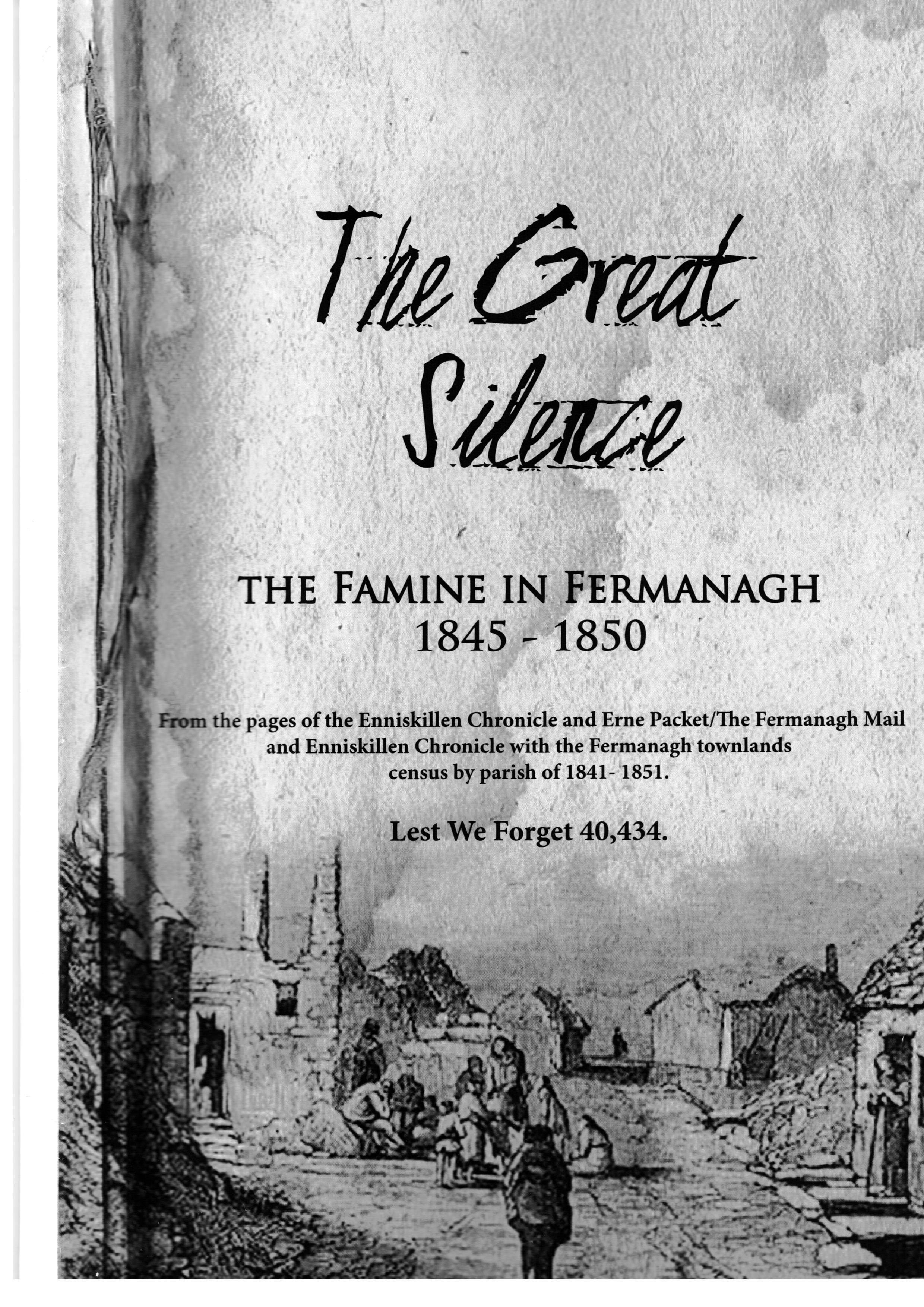
The Great Silence – The Famine in Fermanagh 1845-1850. Book Launch.


ImageThe latest book by John Cunningham will be launched in the Killyhevlin Hotel at 7.30 on Wednesday 26th of September. It is entitled The Great Silence – The Famine in Fermanagh 1845-1850. Using contemporary sources he tells of life in Fermanagh during those terrible years when over 40,000 Fermanagh people died of hunger, disease or emigrated from the county. The 216 page book is lavishly illustrated and contains the population details of every Fermanagh Townland (c2500) and the fate of Orphan Girls from the Workhouses of Enniskillen, Lisnaskea and Ballyshannon. Paupers dying on the streets of Enniskillen contrast with the glittering balls held in the great houses – life went on in the midst of terrible suffering. The book costs £15 plus £7 P&P and is available from Fermanagh County Museum and Fermanagh Tourist Office or from the author via email adam4eves@aol.com or by phone from 02868658327. The author explains the title of his ground-breaking book as follows: –

 Any individual looking out over his Fermanagh townland in 1850 would have experienced the Great Silence – the Great Physical Silence which followed the Great Hunger. It was a dismal scene to survey empty cottages and untilled fields. Many of the familiar faces – often a hundred or more, men, women and children in some townlands, lay dead, often uncoffined, in hurried graves. Their children’s playful laughter stilled forever; the adults’ music and

conversation gone forever. Those lucky to have got away to the corners of the world will never return. In little over a period of five years famine, disease and emigration swept away over 40,000 Fermanagh people; (more than two-thirds of today’s county population). In these pages we hear the voices of the people of the time tell of life and how it was in the words of the time in a local Fermanagh newspaper.


There is a second Great Silence – that of the guilty and greedy, the profiteering merchants, farmers, landlords, shippers, the uncaring, the vilifying English press and the murderous indifference of Government. Not many of these want to talk about the famine or recognise its terrible legacy. Some who profited from the misfortunes of those around them during those years have good reason for wanting it forgotten.


And there is a third Great Silence born of a condition of the mind known as non-rational guilt. Victims burdened with non-rational guilt have not earned this guilt through their own wrongdoing but feel the guilt of survivors – why not me too when others I knew perished. Paradoxically, while victims have been observed to cling to their non-rational guilt, perpetrators often disavow their guilt though the use of a variety of strategies including projection, rationalization, and denial. They may also promulgate the idea that the abuse is but a fantasy in the mind of the victim. That failing, they will attempt to justify the abuse on the basis that it is deserved by the victim.


Sir Charles Trevelyan believed that the Famine was an Act of God directed on Ireland and the Highlands of Scotland but then too many clergymen vacuously declared that the famine was a divine punishment for the sins of the people. So God had it in for us!! Can our great silence be non- rational guilt? Our individual ancestors made it through those terrible times through survival instinct, good luck or good judgement and survived while thousands perished around them – or else we would not be here.


Ayrshire or Cunninghame Cattle

Ayrshire or Cunninghame Cattle

Few things have brought more distinction to the name of Ayrshire than the county’s breed of dairy cattle. The Ayrshires have brought prosperity to the land of their origin and proved their worth in most dairy farming areas of the world. For over 150 years they have been one of the best all round dairy breeds and have shown their adaptability to a wide variety of climates and conditions.

The distinctive and pleasing appearance of the Ayrshire has made it easily identifiable, even to the layman, be it on the pastures of its native county, the prairies of Canada or the green fields of New Zealand. Unfortunately, the modem practice of dehorning has robbed it of its crowning glory.

The breed as we know it is not indigenous to the county, indeed, it bears little resemblance to the cattle kept by Ayrshire farmers of 250 years ago. The native breed was small and stocky, their rough coats were black, black and white or dark brown in colour, and their meat and milk production was poor.

Until the middle of the 18th century, the countryside of Ayrshire was very much in its natural state. The soil was wet, cold and badly cultivated; it seems incredible that manure was not commonly applied to the land in the county until the 1760’s. Agriculture as an industry did not exist and farming was conducted at little above subsistence level for the families engaged in it. The heavy horse was only starting to take over from the ox and wheeled carts to replace sledges.

 The inefficient state of farming meant that farmers were unable to produce enough fodder to allow them to keep a reasonable number of cattle through the winter months and each autumn all but a few breeding animals were slaughtered and their meat salted. In bad seasons, the few that were over-wintered were bled regularly, the blood being mixed with oatmeal to supplement the diet of the farmer and his family. Bleeding and calf production left the cattle permanently emaciated and never able to reach a reasonable standard of quality in themselves or their offspring. Large herds of cattle were unknown and milk production was not on a commercial scale.

 A few enlightened landowners encouraged new farming methods and began the transformation of Ayrshire into the excellent farming land of modern times. Crop rotation, soil improvement, new designs of plough, the planting of shelter belts of trees, the enclosing of fields with hedges and dykes, and improved animal husbandry were all promoted.

 Amongst the enlightened men to whom we are indebted were:- the 10th and 11th Earls of Eglinton; the 4th Earl of Loudoun; Alexander Fairlie of Fairlie Estate, Dundonald; John Dunlop of Dunlop; Bruce Campbell of Galston; General Stewart of Stair; John Orr of Barrowfield; Colonel Blair of Blair; the Oswalds of Auchencruive; the Boswells of Auchinleck; the Brisbanes of Largs; and Colonel Fullarton of Fullarton, Troon.

Improvements in pasture land and fodder production allowed the keeping and over-wintering of more cattle and as part of the new attitude to farming, men began to develop better cattle.

 As nothing was recorded at the time, it is impossible to be certain about the early evolution of the Ayrshire dairy breed. Even the timing is in doubt. Generally, improvement is said to have begun in the third quarter of the 18th century but there is an indication that it may have started very much earlier. In a treatise entitled, A General View of the Agriculture in the County of Ayr, written in 1793, Colonel William Fullarton of Troon observed that ‘a breed of cattle has for more than a century been established, remarkable for the quantity and quality of their milk production. They have long been denominated the Dunlop breed.’

There can be no doubt that Fullarton was referring to the early stages of the Ayrshires. It appears that in the beginning they took their name from the parish of Dunlop or from the Dunlops of Dunlop, the local gentry who are known to have been involved in their improvement. In other parts of Ayrshire, they became known as Cunninghame cattle and, eventually, when their fame spread beyond the county, they were called Ayrshire cattle. In other words, the name became less localised as the breed spread out from its source.

It is thought that over many years, the native cattle were crossed with cattle from Teeside and Holland. The introduction of mahogany and white colourings proves that cross-breeding took place but the most important factor in the evolution would be judicious selection and mating of stock by men of vision. Improvement would be a long, slow process and would take many generations of men, most of whom were from the same families, to produce the excellent animal we know as the Ayrshire. The layman is unlikely to appreciate the tribute that is due to the early breeders for having achieved the outstanding qualities of the breed, for having fixed the characteristics so uniformly, and for having set a standard of conformation that has been accepted for so long.

It is probable that Robert Bums introduced the breed to Dumfriesshire. In 1788, when he married Jean Armour, Major Andrew Dunlop of Dunlop gave them a cow as a wedding present and we can presume that it would be one of the new breed for which the family had become famed. Bums moved into Ellisland Farm, Dumfries and a few years later a Dumfriesshire minister recorded that ‘Mr. Robert Bums speaks of the merits of the new Ayrshire breed.’

By the end of the first quarter of the 19th century, the new Ayrshires were well established all over South-West Scotland, in Lanarkshire, Stirlingshire and the islands of Arran and Bute. By 1856, when a World Agricultural Congress was held in Paris, and pictures of the main cattle breeds of Europe were drawn for a commemorative booklet, one of the cows illustrated was an Ayrshire, showing that the breed was known internationally.

Between 1850 and 1870, Paton of Swinlees, Dairy was the leading breeder of Ayrshires but several farmers in Kyle had begun to challenge the Cunninghame supremacy, namely, Wallace of Auchenbrain, Mauchline; Neill of Barleith, Hurlford; Baird of Garclaugh, New Cumnock; and Murray of Carston, Ochiltree.

In 1877, the Ayrshire Cattle Herd Book Society of Great Britain and Ireland was formed and the Society ensured that all pedigrees of the breed were proved and registered. The name of the Society shows that the breed had become popular throughout the British Isles and by 1879 animals had been exported to North America arid Sweden.

Before the end of the 19th century, more names had been added to the list of farms which had become famous for the quality of their herds, including Aikenbrae, Barboigh, Bumhead, Bumhouses, Changue, Craighead, Drumsuie, Gree, Harperland, High Tarbeg, Billhouse (Galston), Hillhouse (Kilmarnock), Hobsland, Mansfield Mains, Overton, Purroch and Townhead. World renowned herds of the 20th century include many of those already listed, plus Balig, Bargower, Brieryside, Brocklehill, Carnell, Dalgig, Humeston, Killoch, Knowe, Laigh Milton, Lessnessock, Muir, Pant and Wheatrig. Animals from these and other herds are still sought by breeders in every continent.

Apart from the continuing, though admittedly diminishing, popularity of the Ayrehires in Britain and Ireland, there are still Ayrshire Breed Societies in 12 widely differing countries, namely, Australia. Brazil. Canada, Columbia, Czechoslovakia, Finland, Kenya, New Zealand, South Africa, U.S.A., U.S.S.R. and Zimbabwe. The breed is also popular in Japan and Ayrshire bulls have been exported to India.

In recent years, several other breeds have gained popularity as dairy cattle, often to the prejudice of the Ayrshires. Even in their native county they have been replaced in many herds. It may be that in a time to come they will be relegated to the status of a rare breed. If that still unlikely scenario should ever come to pass, the Ayrshires and the men who established the breed will be entitled to places of honour in agricultural history. Undoubtedly, the Ayrshire has a proud place in the county’s heritage.
Cross Border Smuggling in the 1940s and 1950s.

Rare things smuggled – 5-10-1940. Five tons of onions were seized by an R.U.C. Customs patrol at the Border near Clones. They were being unloaded from a lorry on the Monaghan side and carried across to a horse and cart on the other side.

A smuggling secret – 7-12-1940. At Derrylin Petty Sessions there were several successful prosecutions for possession of cigarettes which had come from Eire. The Customs Officer, Mr. Dickson, pointed out a secret of his trade by showing that in the words “W. D. & H. O. Wills” printed on every cigarette, the “&” had no tail above the downward stroke on the Northern Ireland cigarette, while a tail was visible on the Free State “&”. At the same court numerous cyclists were summonsed for offences. The fines imposed were:- not having a mask on the headlamp, 5s with 2s costs; no rear light 3s with 3s costs; not having more than one brake 2s with 2s costs; no bell 1s with 2s costs.

Smuggling eggs – 7-12-1940. The importation of eggs to the Six Counties was prohibited at the weekend. It had lately developed into a lucrative enterprise for 26 county poultry producers with eggs at 4d per dozen more north of the Border. About 6 to 8 dozen Ballyshannon producers regularly exported to Belleek. Pettigo poultry farmers are in a sorry plight as there is not a registered egg dealer within 18 miles on the Donegal side and they had previously sold all their eggs in Northern Ireland. Large seizures of eggs taken across the Border were made in Belleek and Pettigo since and the bringing of turkeys across the Border for sale is likely to be similarly prohibited.

Faithful friends in smuggling – 14-12-1940. Faithful dog at Belleek. A small farmer with his donkey and cart containing three pigs were apprehended at Belleek by Six Counties customs. The farmer was allowed to go home but the donkey and cart with pigs was detained in a yard in the village while the Customs investigated their suspicion that they were smuggled. The farmer’s dog which had accompanied them could not be persuaded either by coaxing or coercion to leave the donkey and cart and spent the night with them. Next day the pigs were forfeited but the donkey and cart released and the dog accompanied his inseparable companion home.

A smuggling battle – 6-4-1940. The scene of the “battle” between 90 flour smugglers and fourteen Guards and Customs men, was mountainous Moneygashel, near Blacklion, two or three miles from Cuilcagh Mountain and about a mile from the Shannon Pot, the source of Ireland’s largest river. The authorities were lying in wait near Moneygashel School awaiting a party of fourteen men who had crossed from Leitrim into Fermanagh to obtain flour which was about 8 shillings a sack cheaper in Northern Ireland. It was then stashed near the border and conveyed south by teams of donkeys across fields and bye-ways until the smugglers met the county road at Moneygashel.

On the night of the 27th the authorities lay in wait but never expected the huge convoy of over 100 donkeys and mules each carrying one or two hundredweights of flour and attended by about 90 men armed with sticks. When they were challenged the men were determined to break through and hand to hand combat began under a cloud covered moon with donkeys rushing too and fro braying, and men swearing and shouting. The apparent leader was on horseback and encouraged his men as he slashed at the fourteen engaged on behalf of the State. The narrow roadway hampered the attackers and eventually the authorities began to get the upper hand and at this juncture the attackers grabbed additional ammunition from the stone ditches and forced the authorities back. Still they held the roadway and in the morning when the smugglers had melted away seventy donkeys were gathered up and over two tons of flour apart from a huge amount spilled over the road and fields.

All of the Customs men took sick leave the following day as nobody was unscathed while Sergeant T. J. Rocks, who was in charge of the party was confined to his bed with a large gash to his head in which three stitches had been inserted. Many arrests have been made.

Big time smuggling – 11-11-1950. Big Belleek Seizure. On Sunday Sergt.  Cordher and Constables. Forde and Mc Alinden seized a Ford 8 car with 9,300 cigarettes, 15lbs of butter and other articles from John Johnston, New Lodge Road, Belfast. The goods were in the upholstery of the car. Released on bail of £300 and a surety for the same amount. Garrison police seized 3,000 cigarettes on the Kiltyclogher border.

Bare faced smuggling – 20-12-1958. Belleek man fined £100 on Customs charge at Ballyshannon – Detained pending payment of penalty. Patrick Greenan, Commons, Belleek, was fined £100 for importing 3cwt of wheaten flour to Eire. He and Andrew Duffy were seen wheeling two wheelbarrows containing goods down Belleek Street. They were observed by Constable Mc Kee of Belleek RUC who informed Seamus Hogan APO, Cloghore Customs Post. Charges against John James Greenan, Clyhore and J. J. Greenan and Sons, Ltd, Cloghore were dropped.

Smuggling fines were generally in the region of £100 and this was invariably out of the reach of the person caught and from around this area they would be sent to serve a prison sentence, generally of six months, to Belfast’s Crumlin Road. From Belleek the two local taxi men, Gilpin Irwin and Jimmy Greenan got the job alternately of running the guilty party to the Crumlin Road Jail in Belfast. On this occasion Jimmy had the run and the prisoner with two policemen as escorts set off for Belfast after the court in Belleek. Jimmy was a man fond of a drink and obviously the two police were also and they stopped first in Lack, then Omagh and Ballygawley and did not get to the prison until 9 where they found it closed for the night. The prisoner would have to be lodged in a barrack cell in Belfast and lodged in prison the next morning. This was done and Jimmy and the two policemen had a convivial night in Belfast. In the morning when they went to the barrack to collect their prisoner and take him to the prison they found he was gone. Someone had paid the £100 fine, he had been traced to his barrack cell, freed, given a train ticket to return to the loving bosom of his family and while they stood there looking at each other he was on his way home. As Jimmy and the two policemen rounded the corner of Belleek’s street there was their former prisoner waving at them – home before them. The two policemen received a severe caution and could have lost their jobs and Jimmy was not awarded another prisoner transfer from Belleek for over a year.

Along the Border in a short stretch between Pettigo and Scraghy there were seven country shops on the Southern side who all flourished during the time of smuggling. On shop called Haughey’s did a roaring trade in cigarettes and tobacco. It was believed that at the weekends it did a trade as good as a shop on O’Connell Street in Dublin. It was a one room shop that served only one customer at a time. Nobody wanted anyone else to know their business – how much of any item they were buying.

And finally another odd smuggling offence – 1-4-1939. Corsets. A fine of £100 with a strong recommendation to the Revenue Commissioners that it be greatly reduced was imposed on Miss Annie Jane Mills at Pettigo Court. She was charged with having being knowingly concerned in the evasion of payment of customs duty on corsets imported by her. She had been in the drapery business in the South and had come back to Pettigo to look after her aged mother and had an agency for a brand of corsets but got little sale for them as they were too expensive.


Enniskillen Urban Councillors V Troops in Fermanagh in WW2

The Holy Urban Councillors.

(Of Enniskillen – This poem in the Fermanagh Herald of 27-9-1941 describes the position of the Enniskillen Urban Councillors who were strict guardians of the Sabbath Day but were forced to yield to pressure to allow soldiers and airmen from the UK, USA, Canada, South Africa etc., access to the cinema on Sunday. Sunday golf in Enniskillen was also breached at this time. )

Oh we’re the holy Councillors of Enniskillen Town,

We fear the Lord, we keep the law, we stand for Church and Crown,

We love the Ten Commandments; to keep them is our boast,

But the one concerning Sabbath days is that we love the most.

On Sundays to all kinds of sport we offer stern denials,

All joy we shed, and go instead with long and solemn dials,

To keep the townsfolk holy too, we do our little best;

By banning entertainments on the Seventh Day of Rest.

But recently a horde of pagan soldiers who prefer

Sitting at moving pictures to kneeling down to prayer

Descended on our holy town with bayonets, guns and rifles

And swept aside out righteous laws, which they described as trifles.

And ruefully ‘neath force majeure, our statutes we forsook

Discarding the Commandment, and the teaching of the Book;

It doesn’t seem quite logical I fear we must agree,

But what in thunder could we do? No other choice had we.

To save our face in the fall from grace we made a solemn stricture

That only those in uniform on Sundays see a picture.

So gnash your teeth or thump your craws, it’s all the same to us,

We’ll make you all respect our laws no matter how you cuss,

And hearken, Sabbath breakers, when you come to your reward,

You’ll all be sniffing brimstone while we are walking with the Lord.

With halos round our holy heads, in stained-glass windows glorious

We’ll be remembered in our Church, the holy men victorious;

And thus like saints and martyrs will our memory go down

The holy, holy, holy men, of Enniskillen Town!


TIM – Transcribed J.B.C. 25-12-2006.